There is no single matcha dosage that works for every latte.
The right amount depends on cup size, milk type, sweetness, matcha profile, preparation method and the flavor intensity your café or beverage brand wants to achieve.
For commercial buyers, the objective is not simply to use more matcha.
It is to find a dosage that delivers the desired color and matcha character while keeping the recipe consistent, repeatable and commercially practical.
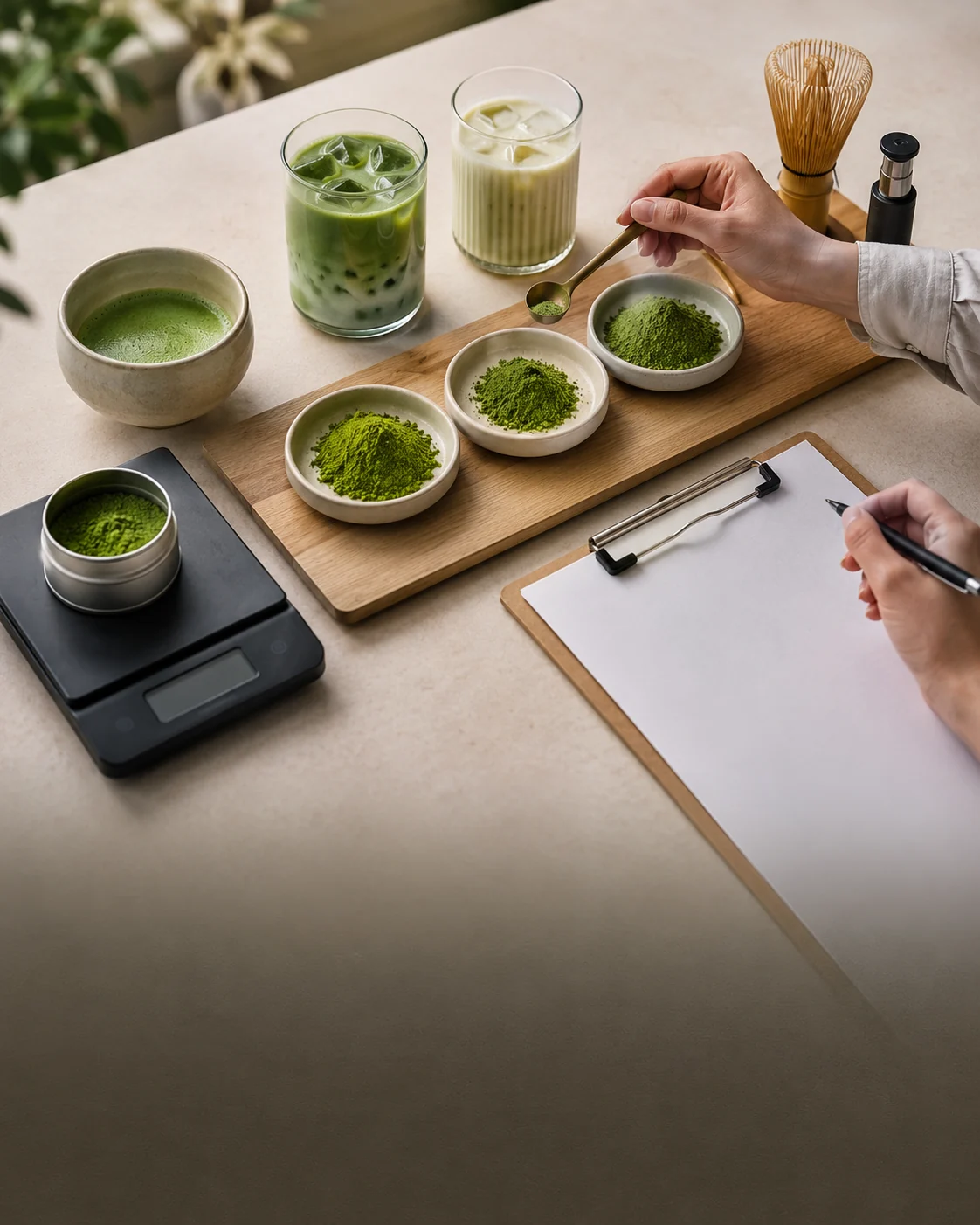
A useful starting point is to test the same matcha at several dosage levels—for example 2 g, 3 g and 4 g per serving—while keeping every other recipe variable unchanged.
The final dosage should then be selected based on the finished drink rather than the dry powder alone.
In This Guide
1. Start With a Practical Matcha Dosage Test
Instead of choosing one dose immediately, begin with a controlled comparison.
For example:
| Test | Matcha Dosage | What You Are Evaluating |
|---|---|---|
| A | 2 g | Lighter, more milk-forward profile |
| B | 3 g | Balanced café-style matcha presence |
| C | 4 g | Stronger matcha-forward profile |
These are testing points, not universal recipe standards.
The same 3 g dose may perform very differently depending on the matcha product, milk volume and sweetener level.
Keep the rest of the recipe identical during the test. That means the same:
- cup size
- milk
- sweetener
- water
- ice
- preparation method
- serving temperature
Only change one variable: the amount of matcha.
This gives you a much clearer comparison.
2. Matcha Dosage by Cup Size
A dosage that performs well in a smaller cup may taste weak when the same amount is used in a larger serving.
Increasing milk volume without adjusting the matcha changes the ratio between tea and the rest of the drink.
When testing recipes, record:
- cup volume
- matcha dosage
- milk volume
- water volume
- sweetener quantity
- ice quantity
- preparation method
Do not rely only on labels such as small, medium and large because actual serving volumes differ between cafés.
The more useful metric is grams of matcha per finished serving.
Build a Matcha Latte Recipe Matrix
Commercial cafés benefit from recording recipes in a repeatable format. A simple testing matrix might look like this:
| Variable | Test A | Test B | Test C |
|---|---|---|---|
| Matcha | 2 g | 3 g | 4 g |
| Cup Size | Same | Same | Same |
| Milk | Same | Same | Same |
| Sweetener | Same | Same | Same |
| Ice | Same | Same | Same |
| Preparation | Same | Same | Same |
Then score each version for:
- color
- aroma
- matcha intensity
- sweetness balance
- bitterness and astringency
- mouthfeel
- overall preference
- cost per serving
This creates a repeatable recipe-development process rather than relying on one person’s first impression.
3. Why Milk Type Matters
Different milks can significantly change both the flavor and visual appearance of matcha.
Dairy milk, oat milk, soy milk and other plant-based alternatives can affect:
- perceived matcha intensity
- sweetness
- mouthfeel
- finished color
- bitterness perception
- aroma
A matcha that tastes strong when whisked with water may become much softer after being combined with milk.
For that reason, cafés should test matcha in the same milk that will actually be used on the menu.
If your café offers several milk options, the same dosage may not produce exactly the same sensory result across all of them. You do not necessarily need a different recipe for every milk, but the differences should at least be evaluated before launch.
4. How Sweetness Changes Matcha Intensity
Sugar and flavored syrups can reduce the perceived intensity of matcha.
This becomes especially important in drinks containing ingredients such as:
- vanilla
- brown sugar
- strawberry
- coconut
- fruit purée
- flavored cold foam
- sweetened milk
A matcha that works well in a lightly sweetened drink may become difficult to perceive in a heavily flavored beverage.
Rather than automatically increasing the matcha dosage, test the complete recipe first.
The correct balance is between matcha intensity + sweetness + milk + finished flavor, not matcha dosage alone.
5. Hot vs Iced Matcha Lattes
Hot and iced drinks should not automatically be treated as the same formulation.
Ice changes both dilution and serving temperature. Cold temperature can also change how customers perceive:
- sweetness
- aroma
- bitterness
- matcha intensity
For an iced drink, additional dilution may occur as the ice melts.
A café offering both formats should therefore run separate tests for hot matcha latte and iced matcha latte before locking the final recipes.
6. Matcha Profile and Dosage
Using more matcha is not always the solution to a weak latte.
Different matcha profiles vary in:
- flavor intensity
- color
- aroma
- bitterness
- astringency
- texture
- dispersion
- performance in milk
A stronger matcha profile may achieve the desired latte character at a different dosage than a softer profile.
This is why commercial recipe development should evaluate matcha profile + dosage + finished application together.
For café sourcing, see our matcha powder for lattes and café drinks.
Do Not Judge Matcha Only by Powder Color
Dry powder appearance is useful, but it does not tell you how the matcha will perform in your actual beverage.
Dry Powder → Whisked Matcha → Finished Latte → Customer-Ready Recipe
A very bright powder may still perform differently once combined with milk, sweetener and ice. The finished beverage is ultimately what your customer will experience.
For a broader evaluation framework, see how to evaluate matcha powder quality for commercial use.
7. Consider Matcha Cost per Serving
For cafés, price per kilogram is only one part of the commercial calculation.
Matcha cost per serving = Matcha price per kg ÷ 1,000 × grams used per serving
If one recipe uses 2 g and another uses 4 g, the ingredient cost contribution from matcha doubles even though the matcha price per kilogram has not changed. This becomes significant across hundreds or thousands of drinks.
However, the lowest dosage is not automatically the best commercial choice.
If reducing the amount produces weak color, poor matcha flavor, excessive milk dominance or lower customer satisfaction, the lower-cost recipe may not be the better commercial recipe.
The objective is to balance:
- finished flavor
- color
- menu positioning
- customer expectation
- consistency
- cost per serving
Compare Matcha Cost by Finished Performance
Two matcha products with different prices per kilogram should not necessarily be compared only by purchase price.
Product A may cost less per kilogram but require a higher dosage, while Product B may cost more per kilogram but achieve the desired finished profile at a different dosage. That does not automatically mean either product is cheaper.
Commercial buyers should compare price per kg + dosage + finished performance.
This is one reason sample testing should happen before a larger purchasing decision.
8. How to Run a Café Sample Test
When evaluating several matcha products, use controlled conditions.
Keep these variables identical:
- milk
- sweetener
- matcha dosage
- water temperature
- water volume
- preparation method
- cup size
- ice quantity
Then compare:
- finished color
- matcha intensity
- aroma
- bitterness
- astringency
- dispersion
- mouthfeel
- aftertaste
- cost per serving
This method gives a much more useful comparison than evaluating powders only from photographs or dry appearance.
Start with controlled product comparisons by requesting matcha samples for your café recipe.
Use a Simple Café Evaluation Scorecard
For a commercial sample test, your café team can score each matcha using the same criteria.
| Evaluation Area | What to Check |
|---|---|
| Color | Does the finished latte match your menu positioning? |
| Aroma | Is the matcha still noticeable after adding milk? |
| Flavor | Is the tea character strong enough? |
| Bitterness | Is it balanced at the intended dosage? |
| Mouthfeel | Does the finished drink feel smooth? |
| Dispersion | Does the matcha integrate consistently? |
| Sweetness Balance | Does the matcha remain noticeable with your sweetener? |
| Cost per Serving | Is the final recipe commercially practical? |
The scoring system does not need to be complicated. Its main purpose is to make every sample comparison more consistent.
9. Standardize the Recipe Before Scaling
Before purchasing larger commercial quantities, confirm both the matcha product and the recipe.
Once your café has selected a matcha and locked the recipe, record:
- matcha product
- dosage
- cup size
- water volume
- milk
- sweetener
- ice
- whisking or mixing method
- serving instructions
This helps staff reproduce the same drink and gives purchasing teams a clearer estimate of expected matcha consumption.
For commercial supply planning, calculate approximate monthly demand using:
Drinks per day × matcha grams per drink × operating days
This makes bulk purchasing and reorder planning much more accurate.
Frequently Asked Questions About Matcha Dosage for Lattes
How much matcha powder should I use in a latte?
There is no universal dosage for every latte. For commercial recipe development, test several controlled dosage points—such as 2 g, 3 g and 4 g per serving—using the same milk, cup size, sweetness and preparation method. Choose the final amount based on the finished drink rather than the powder alone.
Is 2 grams of matcha enough for a latte?
It can be, depending on the cup size, matcha profile, milk volume and desired flavor intensity. A 2 g test is useful as a lower-dose reference point. If the finished drink tastes too milk-forward or the matcha character is difficult to perceive, compare it with a higher-dose version under the same conditions.
Should an iced matcha latte use more matcha?
Not necessarily. Iced drinks should be tested separately because ice, dilution and cold serving temperature can change the finished result. Rather than automatically increasing the dosage, test the actual iced recipe and compare matcha intensity, sweetness and dilution.
Does stronger matcha mean I can use less powder?
Potentially, but this should be confirmed through recipe testing. Different matcha products vary in sensory intensity and performance in milk. A stronger profile may achieve the desired result at a different dosage, but commercial decisions should be based on the finished drink.
Does milk type change how much matcha I need?
It can. Different dairy and plant-based milks affect sweetness, mouthfeel, color and perceived matcha intensity. Test the matcha with the milk actually used on your menu before deciding on the final dosage.
Should cafés evaluate matcha in water before making a latte?
Water evaluation can help buyers understand the matcha’s aroma, taste and whisking characteristics. However, if the final product is a latte, the commercial decision should ultimately be based on performance in the actual latte formulation.
How do I calculate matcha cost per latte?
Use: matcha price per kg ÷ 1,000 × grams of matcha used per drink. This gives the direct matcha ingredient cost per serving. For commercial evaluation, calculate milk, sweetener, packaging, labor and other ingredient costs separately.
Can I request matcha samples for café testing?
Yes. Sample evaluation allows café buyers to compare different matcha profiles using their actual milk, cup size, sweetness and preparation method before moving to larger commercial quantities. Request Matcha Samples.
Ready to Test Matcha in Your Café Recipe?
The most reliable way to select matcha for a commercial latte program is to test it in the drink you actually plan to sell.
Tell us your cup size, milk type, target flavor, hot or iced format, estimated volume and destination market. Matcha Origin Co. can help you compare suitable matcha profiles through sample evaluation before moving to commercial supply.