
For commercial buyers, product quality is only one part of supplier evaluation.
Technical and compliance documentation helps purchasing, product development and quality teams understand what product is being supplied, how it is specified, and what supporting evidence is available for a particular product or batch.
However, not every document applies to every matcha product.
A supplier may carry multiple origins, product profiles, production partners or certified supply streams. A laboratory report may also apply only to the sample that was actually tested.
The most important principle is:
Check every document against the correct product, batch, operator and test scope.
For buyers sourcing matcha for cafés, food manufacturing, private label or retail brands, documentation should support the purchasing decision rather than simply create the appearance of compliance.
In This Guide
Quick Matcha Documentation Checklist
Before approving a matcha for commercial use, it helps to understand what each document is intended to confirm.
| Document | What It Helps Confirm |
|---|---|
| Technical Data Sheet (TDS) | Standard product specification |
| Batch COA | Analytical or specification results for a particular batch |
| Third-Party Test Report | Independent results for the tested sample and stated scope |
| Organic Documentation | Certification coverage for the applicable product or operator |
| Product Specification | Product identity, application and commercial requirements |
| Traceability Information | Product and batch identification |
| Origin Information | Country, region and supply-chain roles |
| Export Documents | Shipment and destination-market paperwork |
A complete documentation package does not necessarily mean every buyer needs every document.
The correct set depends on the product, application, destination market and purchasing requirements.
1. Technical Data Sheet (TDS)
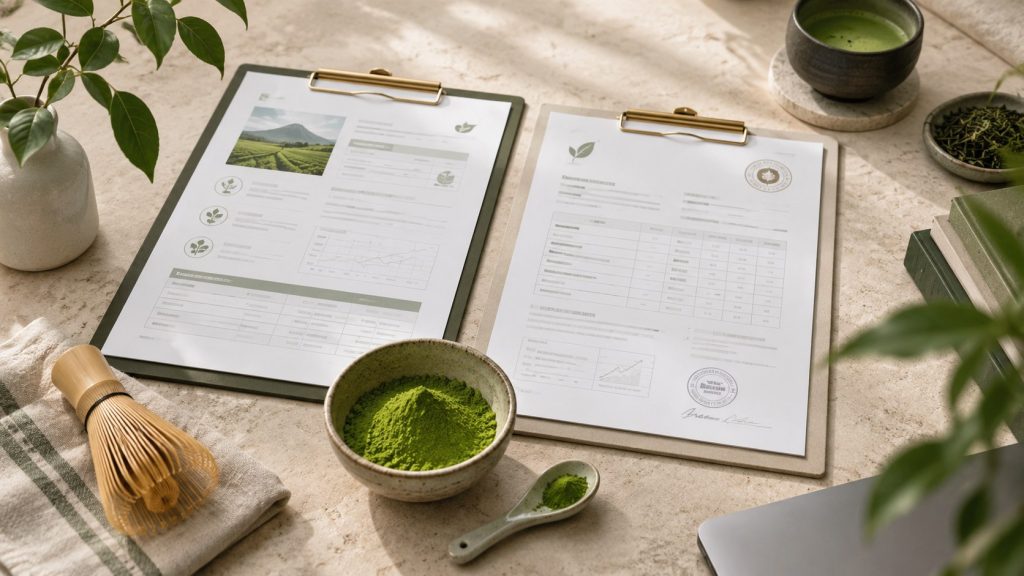
A Technical Data Sheet describes the standard specification of a product for commercial evaluation.
Depending on the matcha, a TDS may include:
- product name
- botanical source
- country of origin
- intended application
- processing information
- appearance
- aroma and sensory profile
- particle size
- moisture
- physical and chemical parameters
- microbiological specifications
- packaging
- storage conditions
- shelf life
The purpose of a TDS is to help buyers understand what product they are evaluating.
It may also provide specification limits or standard product ranges that can be used when comparing different products.
A TDS should not be confused with a batch-specific analytical report.
A TDS describes the product standard. A COA describes a specific batch or tested sample.
Selected Matcha Origin Co. products include downloadable public Technical Data Sheets for commercial evaluation.
Review our available documentation for currently available product and compliance information.
2. Certificate of Analysis (COA)
A Certificate of Analysis normally reports analytical or specification results associated with a particular batch or sample.
Depending on the product and testing scope, a COA may include:
- product name
- lot or batch number
- manufacture date
- appearance
- moisture
- particle size
- chemical composition
- heavy metals
- microbiological results
- other relevant analytical parameters
For commercial buyers, the most important question is not simply:
“Do you have a COA?”
The more useful question is:
Which product and batch does this COA apply to?
A historical COA may help a buyer understand previous product performance or supplier documentation practices.
However, it should not automatically be treated as the analytical result of a future production batch.
When batch-specific documentation is required, the COA should be matched to the relevant commercial batch.
3. Third-Party Testing Reports
Independent laboratory testing may be used to provide additional verification for specific food-safety, composition or market requirements.
Testing may cover areas such as:
- pesticide residues
- heavy metals
- microbiology
- particle size
- chemical composition
- contaminants
- other market-specific parameters
The presence of a laboratory logo alone is not enough to determine whether a report applies to the product being purchased.
Commercial buyers should check:
- which sample was tested
- when the sample was tested
- who submitted the sample
- which laboratory performed the test
- which test methods were used
- what parameters were included
- whether the report applies to the selected product
The key question is not:
“Do you have a third-party test report?”
It is:
Which sample was tested, when was it tested, and what test scope does the report cover?
Testing results should be interpreted within the scope stated on the laboratory report.
Learn more about our quality and testing support.

4. Organic Documentation
If organic status is important to the buyer, the certification scope should be checked carefully.
Organic documentation may relate to:
- a certified operator
- processor
- exporter
- production facility
- product group
- certified harvest
- specific supply chain
An organic certificate should not automatically be treated as evidence that every product sold by a supplier is organic.
Commercial buyers should confirm:
- which operator is certified
- which products are covered
- which certification program applies
- whether the certificate is currently valid
- whether the product being purchased is within the certified scope
For mixed product portfolios, organic and conventional matcha may exist within the same sourcing network.
The certification should therefore be matched to the applicable product and supply arrangement.
5. Product Specification
A product specification may be supplied as a standalone document or incorporated into the Technical Data Sheet.
Its purpose is to define what the buyer and supplier understand the product to be.
Useful information may include:
- product identity
- intended commercial application
- origin
- production or processing information
- sensory profile
- physical specification
- packaging
- shelf life
- storage requirements
Product specifications become particularly important when a buyer is comparing several matcha profiles.
Supplier grade names should not be used as the only basis for comparison because grade terminology is not standardized across the global matcha market.
Two suppliers may use different grade names for products intended for similar applications.
Commercial buyers should therefore compare:
actual product specification + sample performance + documentation
rather than relying only on a grade label.
6. Batch and Traceability Information
Batch identification becomes increasingly important once a matcha moves from initial sampling into repeat commercial purchasing.
Useful traceability information may include:
- lot or batch number
- production date
- best-before or expiry date
- product code
- producer information
- packaging code
- shipment reference
The exact traceability system varies between suppliers and production partners.
For repeat purchasing, buyers should understand how the supplier connects:
product specification → production batch → documentation → commercial shipment
This makes it easier to investigate differences between shipments and maintain better repeat-order control.
Review how we organize batch and traceability information for commercial supply.

7. Origin and Supply-Chain Information
Origin can affect labeling, brand positioning, regulatory review and purchasing decisions.
However, several different entities may participate in the supply chain.
Commercial buyers should distinguish between:
- country of origin
- growing or production region
- producer
- processor
- exporter
- sourcing company
- brand or commercial supplier
These are not necessarily the same organization.
For example, a sourcing company may coordinate product selection and export while production is carried out by a separate processing partner.
Clear documentation should help buyers understand which entity performs which role without assuming that every company named in the supply chain is the manufacturer.

8. Commercial and Export Documents
Once the purchasing process moves from sampling to commercial shipment, additional documents may be required.
Depending on the destination market and transaction, these may include:
- commercial invoice
- packing list
- certificate of origin
- shipping documentation
- phytosanitary documentation where applicable
- destination-specific import documents
- other commercial records
Requirements vary by country, shipment type and importer.
Commercial buyers should confirm the actual requirements for the intended market rather than assuming that the same export document set applies everywhere.

Documents Should Be Product-Specific
One of the most common documentation mistakes in B2B ingredient sourcing is assuming:
one report = entire product catalog
That is rarely a safe assumption.
A useful documentation system should make it clear:
- what document is available
- which product it covers
- which batch it covers
- which operator or supplier it relates to
- what certification scope applies
- what test scope applies
- whether the document is current
This is particularly important when a supplier offers products from multiple production partners or multiple certification streams.
Matcha Origin Co. organizes currently available product and compliance information through our testing and compliance documentation resources.
How to Review Matcha Documents Before Scaling
Documentation review should be part of the purchasing process rather than something requested only after a problem occurs.
A practical B2B workflow is:
Product Selection → Sample Evaluation → Technical Specification Review → Documentation Review → Commercial Confirmation → Bulk Supply
First identify a product that fits the intended application.
Then evaluate the sample in the product you actually plan to sell.
After that, review the relevant TDS, batch information, testing or certification documentation before committing to larger commercial quantities.
This approach helps the buyer evaluate both:
- product performance
- documentation readiness
For buyers still comparing products, see our guide on how to evaluate matcha powder quality for commercial use.
For the broader purchasing process, see how to buy matcha powder in bulk.
Frequently Asked Questions About Matcha Supplier Documentation
Is a TDS the same as a COA?
No.
A Technical Data Sheet describes the standard product specification used for commercial evaluation.
A Certificate of Analysis reports analytical or specification results associated with a particular batch or tested sample.
In simple terms:
TDS = product standard
COA = batch or sample results
Commercial buyers may use both documents, but they serve different purposes.
Should every batch have its own COA?
If a buyer requires batch-level analytical verification, the COA should correspond to the relevant commercial batch.
A historical COA can be useful during preliminary supplier evaluation, but it should not automatically be treated as the analytical result for a future shipment.
Availability of batch-specific COAs should be confirmed for the selected product and order.
Does one third-party test report cover every matcha product?
Not necessarily.
Third-party laboratory results apply to the sample tested and the scope stated in the report.
Buyers should check the product or sample identity, test date, testing laboratory, test methods and parameters before relying on the report.
A report for one matcha product should not automatically be assumed to cover a supplier’s entire catalog.
Does one organic certificate cover every matcha product?
Not necessarily.
Organic certification may apply to a particular operator, processor, exporter, product group or certified supply scope.
Commercial buyers should confirm that the product being purchased is actually included within the applicable certification scope.
What documents should I request before placing a bulk matcha order?
The appropriate documentation depends on the product and destination market.
Depending on the project, a buyer may review:
- product TDS
- applicable batch COA
- third-party analytical testing
- organic or other certification documentation
- batch and traceability information
- origin information
- commercial and export documents
The goal is not to collect the largest number of files.
The goal is to obtain the documents that actually apply to the product and order being evaluated.
When should documentation be reviewed?
Ideally, documentation should be reviewed after initial product and sample evaluation but before a buyer commits to larger commercial quantities.
For regulated markets or projects with specific quality requirements, documentation requirements should be discussed even earlier.
This helps avoid selecting a product that performs well in samples but cannot provide the documentation required by the buyer’s market or quality team.
Need Documentation for a Matcha Project?
Tell us which matcha product you are evaluating, your destination market and the documents required by your purchasing or quality team.
Matcha Origin Co. can help identify which technical, batch-specific and compliance documents are currently available for the selected product and project.
Leave a Reply