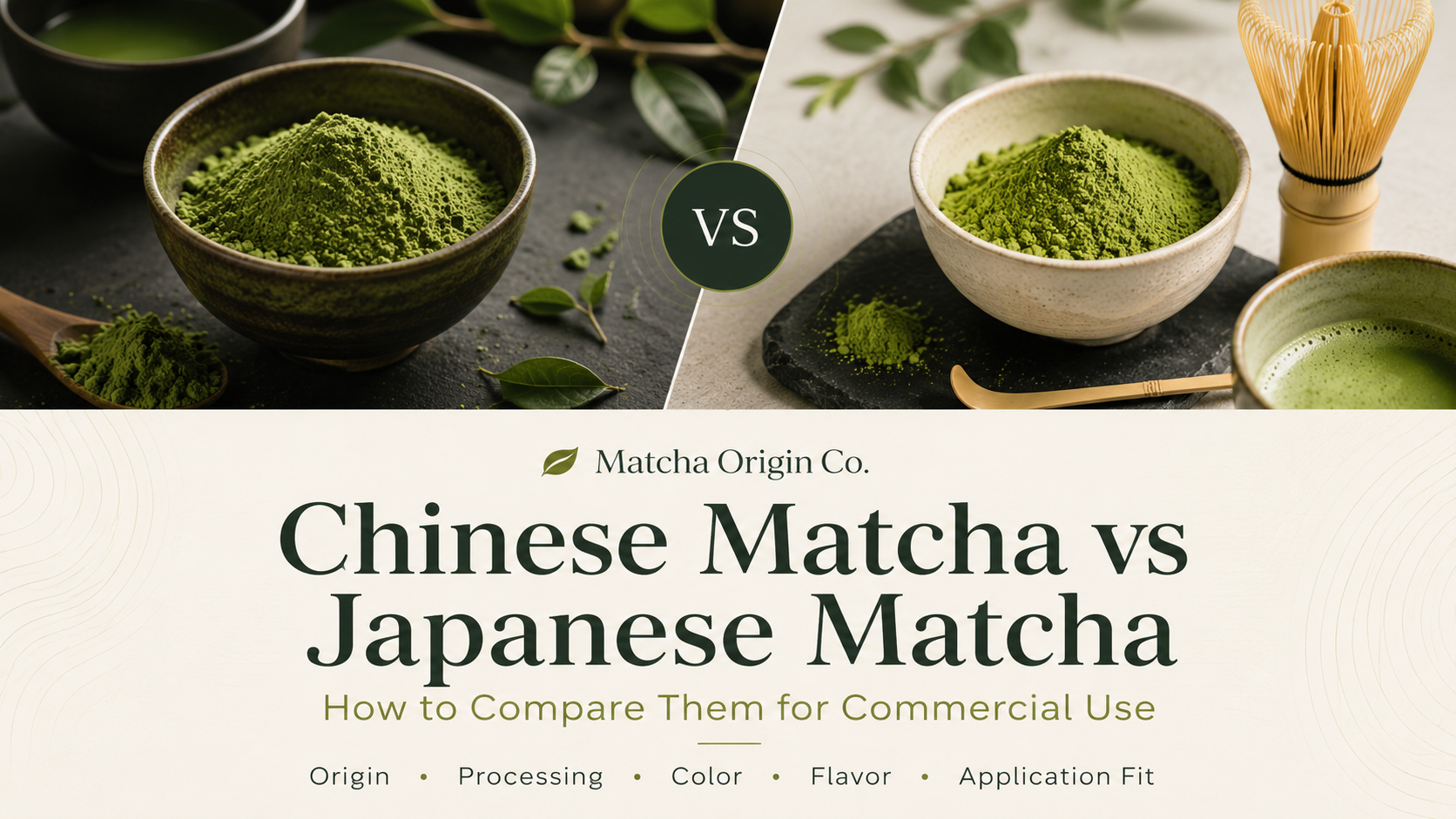
For a commercial buyer, choosing between Chinese matcha and Japanese matcha is not simply a question of which country produces “better” matcha.
Origin matters, but it is only one part of the sourcing decision.
The producer, tea cultivar, growing conditions, shading practices, raw material selection, processing method, milling, batch consistency and intended application can all influence how a matcha performs in the finished product. Research on matcha production also shows that shading conditions, tea variety and milling method can materially affect color, aroma, taste and chemical composition.
For cafés, beverage brands, bakeries and food manufacturers, the more useful question is therefore:
Which matcha performs best in the product you are actually making?
Chinese Matcha vs Japanese Matcha: What Actually Changes?
Japanese matcha has a long-established production tradition connected with tencha and Japanese tea culture. Japan’s Ministry of Agriculture, Forestry and Fisheries describes traditional matcha production as grinding tencha into fine powder, with regions such as Kyoto historically associated with this production system.
China also has established commercial matcha production and ongoing research into cultivation, shading, processing and milling. Published work from Chinese tea research and production organizations has examined how tencha quality and different grinding methods affect matcha color, aroma, taste and composition. Other research has compared matcha produced in multiple Chinese regions, including Hangzhou, using standardized processing and sensory evaluation.
This means that neither “Chinese matcha” nor “Japanese matcha” describes one single product profile.
Two matcha powders from the same country may perform very differently if they come from different cultivars, harvests, processing systems or producers.
Origin Is Only One Part of Matcha Quality
Origin can help a buyer understand provenance and production context, but it does not replace product evaluation.
Shading is one example. Research has shown that shading conditions can affect chlorophyll, amino acids, tea polyphenols and other components associated with matcha appearance and sensory characteristics. The effect also depends on factors such as cultivar and duration of shading.
Milling matters as well. Research comparing different tencha grades and grinding systems found measurable differences in aroma, taste, color and physicochemical composition.
For a commercial buyer, this is important because a country-of-origin label alone cannot tell you:
- whether the green color will remain attractive in milk,
- whether the matcha flavor will remain noticeable after sugar or dairy is added,
- how it will behave during baking,
- whether its texture is suitable for your process,
- or whether the batch documentation matches your purchasing requirements.
Those questions have to be answered at the product and batch level.
Chinese Matcha for Commercial Applications
Chinese matcha is now produced across multiple tea-growing and processing regions rather than representing one single geographic profile.
A recent study comparing matcha from different Chinese regions—including Hangzhou, Tongren, Enshi and Wuyi—found differences in flavor-related compounds and sensory characteristics between origins even when the samples were processed using the same stated production technology.
That is an important point for B2B buyers:
“Chinese matcha” is a sourcing category, not a quality grade.
A commercial buyer should therefore evaluate the individual product rather than purchasing solely on the basis of country.
At Matcha Origin Co., our approach is to connect origin information with the actual intended application, sample evaluation and available supply documentation.
Buyers who want to understand our current sourcing framework can learn more about Chinese matcha on the dedicated origin page.
Japanese Matcha for Commercial Applications
Japan has a particularly strong historical association with matcha, especially through tencha production and tea ceremony culture.
Traditional Japanese production systems can involve shaded tea cultivation, steaming, drying without rolling, removal of stems and veins, and grinding the resulting tencha into fine powder. Japanese regions and producers may also differ considerably in cultivar, harvest timing, production scale and intended market.
For commercial procurement, that means “Japanese matcha” should not automatically be treated as one uniform specification either.
A matcha designed for traditional whisking may not necessarily be the most commercially appropriate option for a sweetened latte, baked product or large-scale food formulation.
The relevant question remains the same:
How does this specific matcha perform in the intended finished product?
A Commercial Comparison
| Factor | Chinese Matcha | Japanese Matcha | What the Buyer Should Check |
|---|---|---|---|
| Origin | Multiple producing regions and partners | Multiple established tea regions and producers | Exact producer and product origin |
| Production | Varies by producer and specification | Varies by region, producer and specification | Actual processing specification |
| Color | Product-specific | Product-specific | Dry powder and finished-product color |
| Flavor | Product-specific | Product-specific | Performance in the actual recipe |
| Milling | Different milling systems may be used | Different traditional and commercial systems may be used | Particle size, texture and dispersion |
| Application | Whisking, latte, culinary and manufacturing profiles may exist | Whisking, latte, culinary and manufacturing profiles may exist | Intended commercial use |
| Documentation | Depends on product, supplier, batch and test scope | Depends on product, supplier, batch and test scope | COA, origin, organic or testing scope where applicable |
| Commercial decision | Sample evaluation required | Sample evaluation required | Compare under identical conditions |
The purpose of this comparison is not to declare one origin superior.
It is to show why country alone is not enough information for commercial sourcing.
Compare Matcha by Finished-Product Performance
For a wholesale or commercial buyer, evaluation should move beyond tasting the powder in plain water.
A café should test matcha in the same milk, serving ratio, sweetener and preparation method that will be used on the menu.
A bakery should evaluate the powder after mixing and after heat processing.
A food manufacturer may need to consider dispersion, flavor intensity, finished-product color, processing stability and cost-in-use.
The same matcha can appear very different depending on the formulation.
This is why Matcha Origin Co. recommends evaluating samples before moving into larger commercial quantities.
What Cafés and Beverage Brands Should Evaluate
For lattes and café drinks, the most useful comparison is usually not:
Which powder looks greener in the bag?
It is:
Which powder performs better in our actual drink?
Milk changes both color perception and flavor intensity. Sweeteners, serving size, ice and matcha dosage can change the result again.
For this reason, two candidate matcha powders should be tested using the same formulation and preparation method.
Commercial evaluation should focus on finished color, recognizable matcha character, bitterness and astringency balance, aroma, dispersion, mouthfeel and cost per serving.
The origin can remain part of the brand story, but finished-product performance should drive the purchasing decision.
What Bakeries and Food Manufacturers Should Evaluate
Baking creates a different set of requirements.
Heat, sugar, fat, flour, dairy and other ingredients can change both the appearance and sensory impact of matcha.
A powder that performs well when whisked may not necessarily provide the desired result in cookies, cakes, fillings, ice cream or manufactured food products.
Commercial buyers should therefore compare candidate samples inside the actual formula and processing conditions.
The most relevant factors may include color before and after processing, matcha flavor after dilution into the recipe, bitterness, aroma, particle distribution and total cost-in-use.
Again, this is a product-level decision rather than a country-level decision.
Documentation, Origin & Supply Transparency
For B2B sourcing, sensory quality is only one part of the purchasing decision.
Buyers may also need product specifications, manufacturer COAs, organic documentation, batch information or selected third-party analytical testing.
The availability and relevance of those documents should always be checked against the specific product, batch, supplier, certification scope and test scope.
A report for one tested sample should not automatically be assumed to cover unrelated products or future batches.
Matcha Origin Co. therefore presents documentation as product- and project-specific support rather than as a universal certification claim.
Sample Both Before Making a Commercial Decision
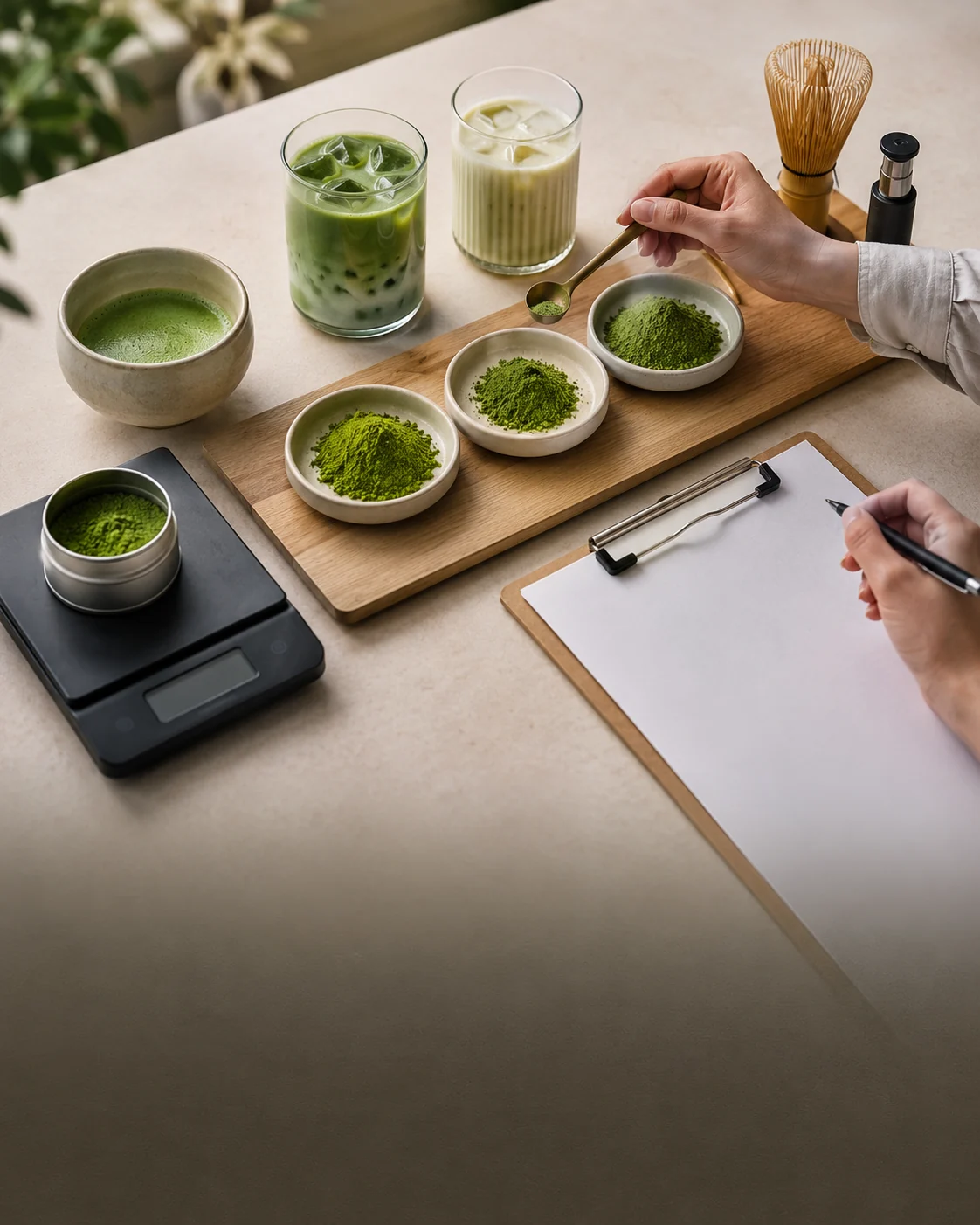
When buyers compare Chinese matcha and Japanese matcha, the fairest evaluation is a controlled side-by-side sample test.
Use the same formulation, dosage, water or milk, preparation method and serving conditions.
Then compare the actual finished products.
This removes much of the bias created by assumptions about origin and gives the purchasing team information that is directly relevant to commercial performance.
For a growing brand, that can be more useful than choosing a product because one country has a stronger reputation in the category.
Compare Matcha in Your Own Application
Tell us what you are making, your target market and expected commercial volume.
We can help you shortlist suitable matcha profiles for sample evaluation before you make a larger sourcing decision.
Chinese vs Japanese Matcha: Frequently Asked Questions
Is Japanese matcha always better than Chinese matcha?
No. Country of origin alone does not determine the quality or suitability of a specific matcha. Producer, cultivar, growing conditions, processing, milling, batch characteristics and intended application all matter. Research also shows meaningful variation among matcha from different cultivars, production conditions and geographic regions.
Is Chinese matcha real matcha?
China has established commercial matcha production, matcha-specific processing research and regional sensory evaluation standards. Published Chinese research describes matcha made from shaded tea material and examines processing and milling methods specifically for matcha production.
Is Chinese matcha cheaper than Japanese matcha?
It is better not to assume this universally. Commercial price depends on the specific producer, quality specification, harvest, packaging, order size, supply conditions and market. Buyers should compare actual quotations alongside sample performance rather than treating country as a fixed price tier.
Which origin is better for matcha lattes?
There is no universal answer. The better option is the matcha that achieves the desired color, flavor intensity, mouthfeel and cost-in-use in your actual latte formulation.
Which origin is better for baking?
Again, the finished recipe matters more than country alone. Compare candidate powders using the same recipe, dosage, temperature and processing time.
Can I compare Chinese and Japanese matcha samples before ordering?
Yes. A controlled sample comparison is the most practical way to evaluate suitability for a commercial application before scaling.
Leave a Reply