For a commercial buyer, matcha quality cannot be judged from color or origin alone.
The right evaluation depends on what the matcha will be used for.
A matcha designed for straight whisking may be evaluated differently from one intended for lattes, baking or food manufacturing.
The most useful question is:
How does this product perform in the application you plan to sell?
Start With the Intended Application
Before comparing samples, define the use case.
Commercial matcha may be evaluated for:
- straight whisking
- café lattes
- milk tea
- desserts
- baking
- ice cream
- packaged beverages
- food manufacturing
Application affects which characteristics matter most.
Evaluate Dry Powder Appearance
Dry powder can provide an initial indication of product characteristics.
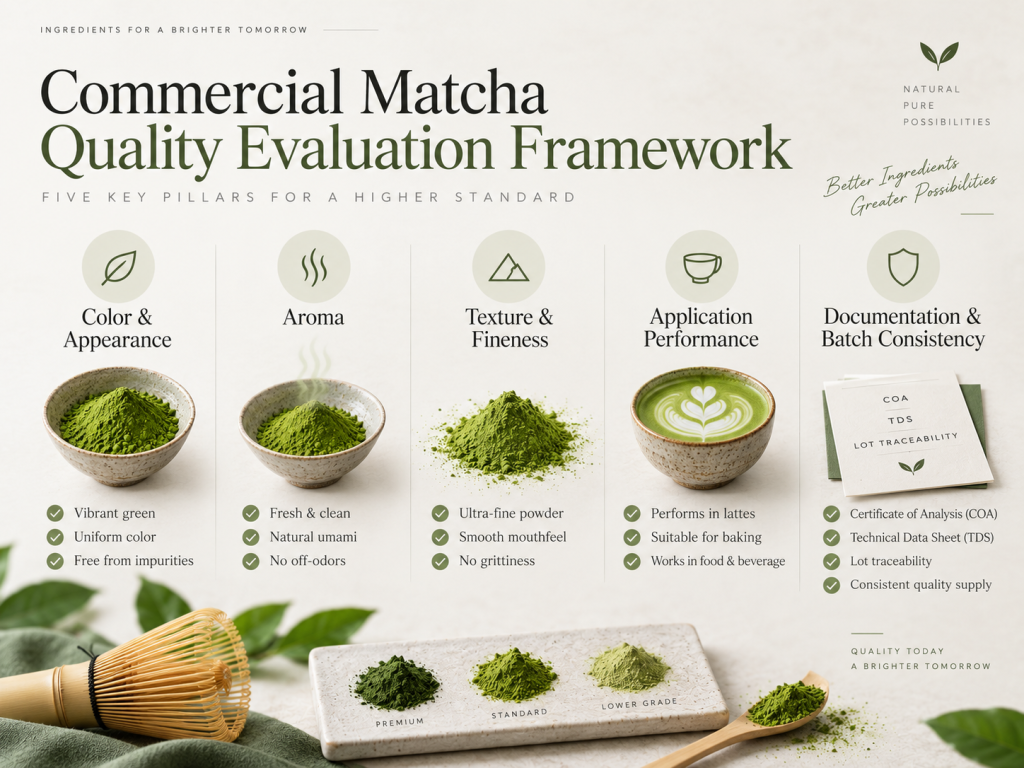
Buyers commonly examine:
- color
- uniformity
- texture
- visible agglomeration
- aroma
However, dry powder appearance should not be the final purchasing decision.
A visually attractive powder may behave differently once mixed into a commercial formulation.
Evaluate Particle Size and Texture
Particle size can affect:
- mouthfeel
- dispersion
- suspension
- whisking performance
- processing behavior
For technical purchasing, ask the supplier how fineness is specified or tested.
Depending on the product, documentation may use sieve measurements, micron measurements or another defined method.
The important point is to compare results using a consistent testing basis.
Evaluate Aroma and Flavor
Sensory evaluation should consider:
- fresh tea character
- vegetal notes
- umami
- bitterness
- astringency
- sweetness perception
- aftertaste
Avoid assuming that one description automatically represents every batch or product.
Sensory performance should be evaluated using actual samples.
Test the Finished Application
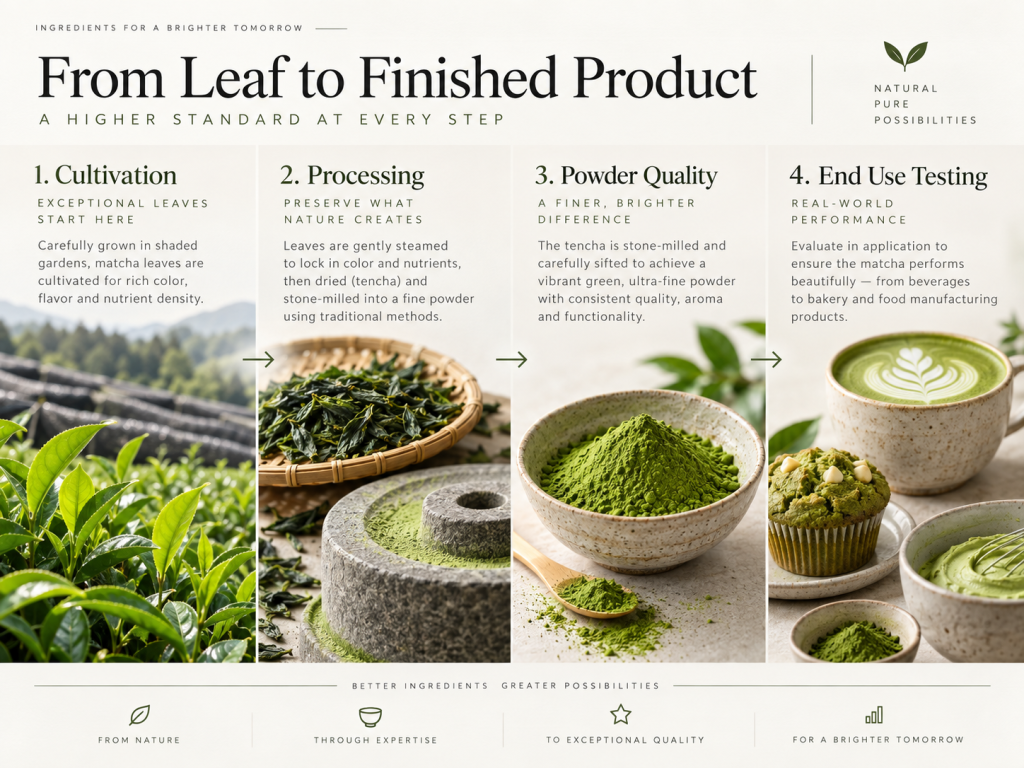
This is one of the most important steps.
For latte programs, evaluate matcha in milk.
For baking, evaluate the finished baked product.
For food manufacturing, test the matcha inside the actual formula and process.
Compare:
- finished color
- flavor intensity
- aroma
- mouthfeel
- dispersion
- processing behavior
- cost-in-use
Review Physical and Chemical Specifications
For commercial procurement, technical information may include parameters such as:
- moisture
- ash
- particle size
- caffeine
- tea polyphenols
- L-theanine
The exact values and test methods depend on the product, supplier, sample and batch.
A buyer should not assume that one analytical result represents every future shipment.
Review Contaminant and Microbiological Information

Depending on market and application, buyers may also need information relating to:
- heavy metals
- pesticide residues
- total plate count
- yeast and mould
- E. coli
- Salmonella
- other relevant microbiological parameters
Which tests are required depends on destination market, product category and buyer requirements.
Look at Batch Consistency
A strong commercial sourcing decision considers more than the first sample.
Ask how the supplier manages:
- product specification
- batch identification
- COA availability
- repeat-order consistency
- origin information
- documentation changes
This becomes increasingly important as purchasing volume grows.
Documentation Should Match the Product
Do not treat one certificate or test report as universal evidence.
Commercial documentation should be checked against:
product
sample
batch
operator
certification scope
test scope
You can review our quality and testing support for more information.
Sample Evaluation Before Scaling
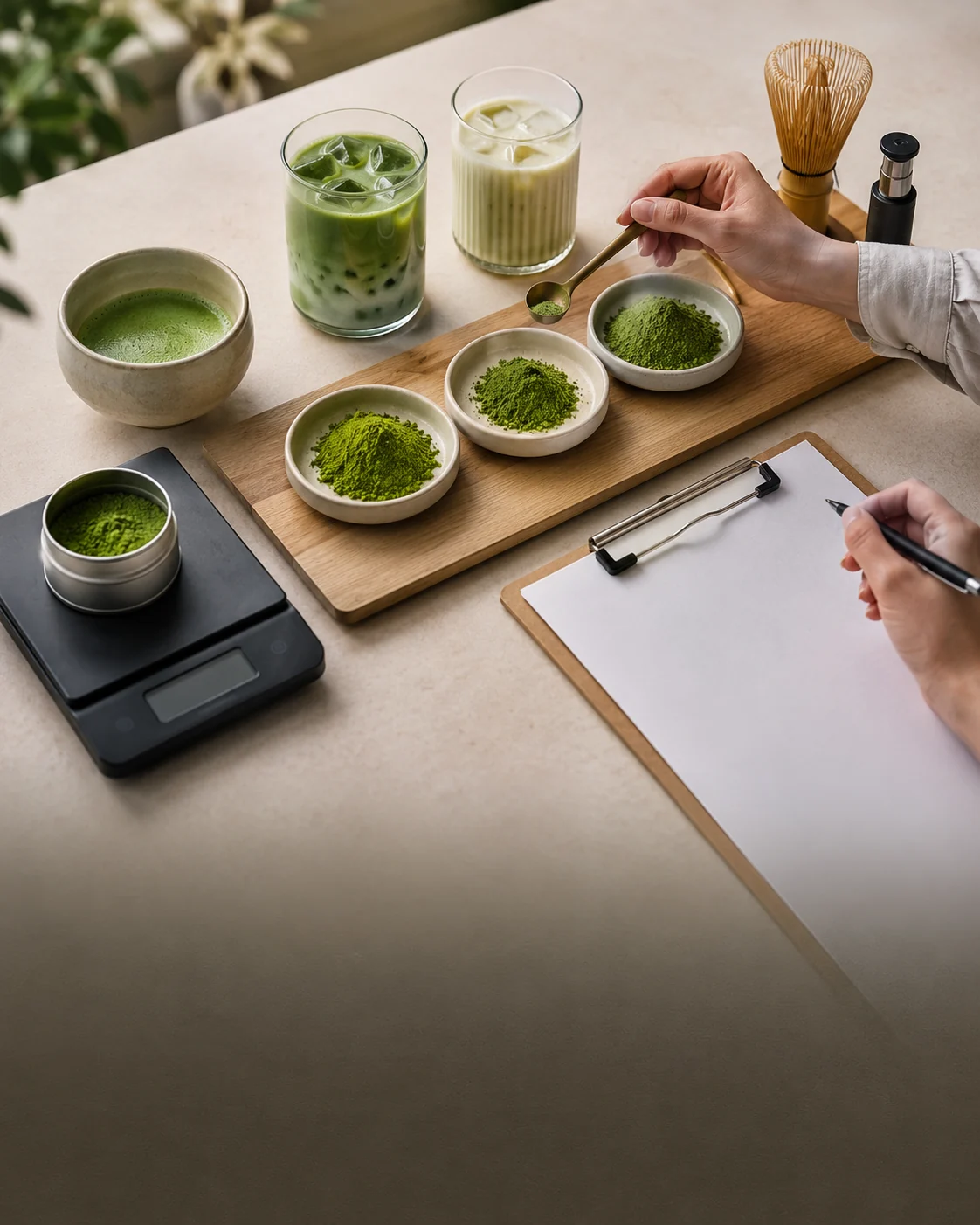
The best way to compare matcha quality is controlled sample testing.
Use identical preparation or processing conditions and document the results.
Then compare both technical data and finished-product performance.
For products intended for commercial supply, explore our bulk matcha supply options.