Matcha Quality Testing for Commercial Buyers
Commercial matcha quality should be evaluated against the product you are making, the market you plan to sell into and the sample or batch you intend to buy. A grade name, product photo or single certificate cannot answer every quality question.
What Does Matcha Quality Testing Include?
For B2B sourcing, matcha quality testing combines application evaluation, analytical testing and documentation review. Buyers should confirm that the matcha works in the finished product, the selected sample or batch meets the agreed parameters, and each report covers the material and market in question.
Application testing
Does the matcha perform in the finished drink, food or product?
Analytical testing
Does the identified sample or batch meet the agreed test parameters?
Market fit
Does the test scope match destination-market and customer requirements?
Document review
Does the report apply to the product, sample or batch being purchased?
A grade name, product photo or single certificate cannot answer all four questions. Application testing is not analytical testing; neither replaces documentation review.
Application → Market → Batch → Testing Scope
Start with what you are making. Then identify the destination, the actual material being evaluated and the tests or documents needed before commercial approval.
What are you making?
Define the drink, dessert, straight-whisking, RTD, manufacturing or retail use. Milk, heat and process conditions expose different qualities.
Where will it be sold?
Confirm the destination and customer specifications. EU-oriented and U.S.-oriented reviews may differ; neither is a matcha quality grade.
Which material is tested?
Record product, sample, lot, test date and report owner. A result for one submitted sample does not cover unrelated products or future batches.
Which parameters matter?
Agree the pesticide, heavy-metal, microbiological or other parameters and the applicable acceptance criteria for this project.
What to Evaluate Before You Scale
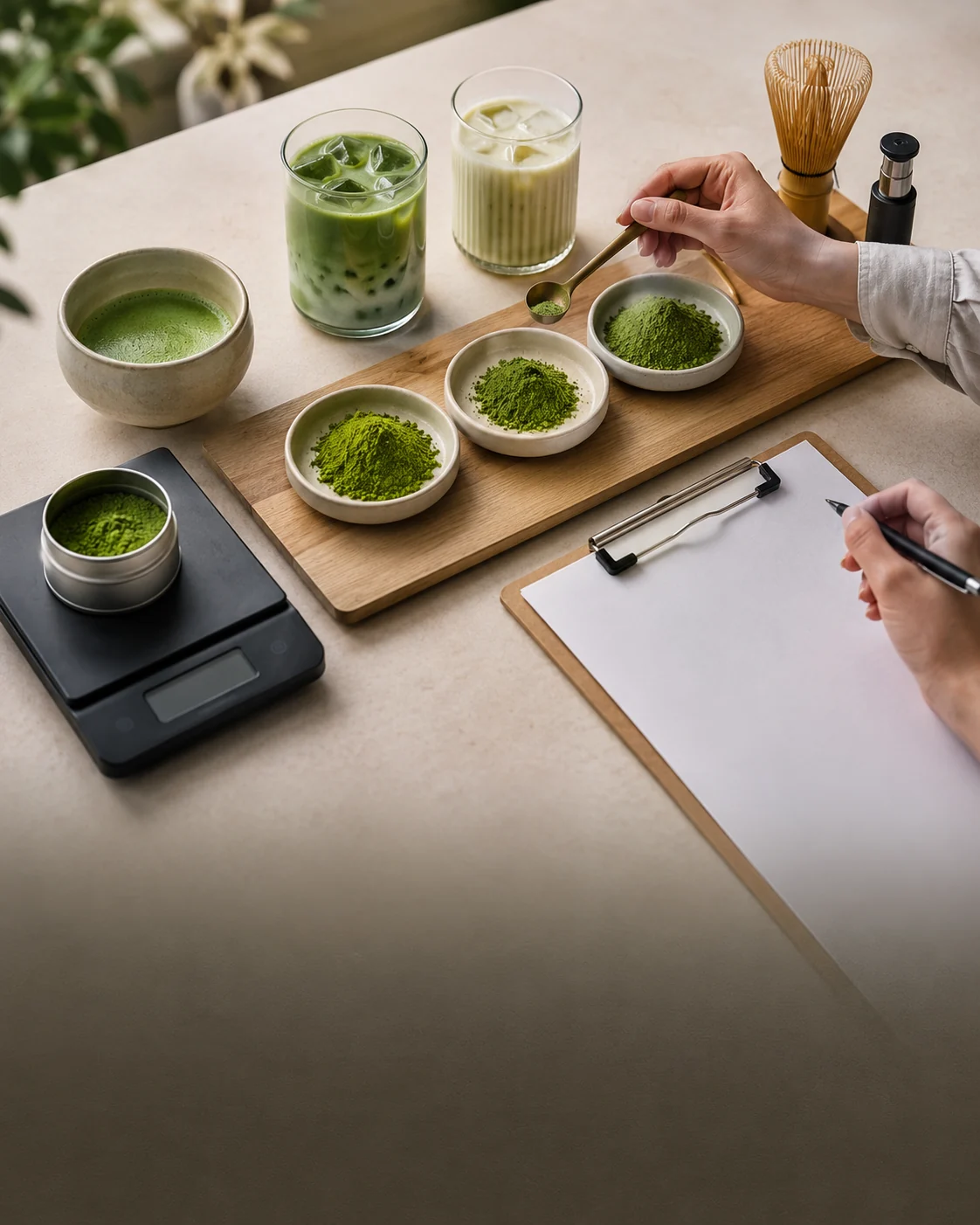
Test the matcha in the actual product or menu application. Keep the recipe and preparation conditions consistent when comparing shortlisted samples.
Color
Evaluate finished-product appearance and stability, not dry powder color alone.
Aroma
Check freshness and whether the aroma remains appropriate after mixing or processing.
Flavor
Compare matcha presence, umami, sweetness, bitterness and astringency in the full recipe.
Texture & Dispersion
Assess smoothness, suspension, settling and mouthfeel in the intended base.
Process Performance
Observe whisking, blending, heating, baking, pH or storage behavior as relevant.
Cost-in-Use
Confirm the approved dose, then calculate cost per serving or finished unit.
What Laboratory Testing May Be Relevant?
Testing may be available or arranged for selected products or batches where a buyer, destination market or commercial specification requires it. Confirm the exact parameters, methods and acceptance criteria for the identified material.
Pesticide residues
Confirm the tested sample or batch, pesticide panel, date, laboratory and comparison criteria.
Heavy metals
Parameters may include lead, arsenic, cadmium or mercury; verify the actual report and required limits.
Microbiology
Panels may include total plate count, yeasts, moulds, E. coli or Salmonella, depending on scope.
Other specifications
Moisture, physical or compositional parameters can be discussed when relevant to the project.
What Does a Third-Party Report Prove?
A third-party report is useful only within its stated scope. Testing for applicable projects has included Eurofins; SGS reports have also been used for applicable products or historical samples and batches. Neither name is a blanket certification of all Matcha Origin Co. products.
EU-Oriented and U.S.-Oriented Projects
Destination-market requirements and internal product profiles are separate. An A–7A profile describes application positioning; it does not by itself establish regulatory compliance. Confirm market-specific testing and documentation for the selected product or batch.
How Should Buyers Read a Matcha Test Report?
Ask these seven questions before using a result in a buying decision.
- Who owns it?Identify the applicant, manufacturer or other named report owner.
- What was tested?Check the exact sample description and product identity.
- Which sample or batch?Look for a reference that connects the result to the intended supply.
- When was it tested?Check whether the date is relevant to the current project.
- Which parameters?A pesticide result does not answer microbiological or heavy-metal questions.
- Which criteria?Compare results with the applicable buyer or destination-market requirements.
- Can it be shared?Review laboratory restrictions on public use, excerpts, logos and claims.
When Should Testing Happen?
Define requirements
Discuss known destination-market and customer requirements early.
Test in the application
Compare color, flavor, texture, dose, process behavior and cost-in-use under consistent conditions.
Confirm the material
Align the approved profile, sample-batch relationship, specifications, analytical scope and packaging.
Reconfirm as needed
Do not assume one approved sample or report represents every future lot.
Quality Testing vs Documentation
Specifications Narrow the Options. The Application Makes the Decision.
Matcha is a sensory ingredient. Products that look similar on paper can perform differently in milk, baking, straight whisking or manufacturing.
Frequently Asked Questions
Can Matcha Origin Co. provide pesticide-residue testing?
Pesticide-residue testing may be available or arranged for selected products or batches depending on destination market, buyer specification and project. Confirm the exact panel, sample or batch and acceptance criteria before relying on a result.
Can you provide microbiological and heavy-metal testing?
Depending on the selected product, batch and document scope, microbiological and heavy-metal parameters may be available through a manufacturer COA or third-party testing. Confirm the exact parameters for the project.
Do you use Eurofins or SGS?
Third-party testing for applicable projects has included Eurofins, and SGS reports have also been used for applicable products or historical samples or batches. Confirm the specific laboratory and report scope for the selected project.
Does one test report cover every Matcha Origin product?
No. A report applies to the tested sample or batch and stated analytical scope. It is not universal proof for unrelated products, suppliers or future batches.
Are EU-oriented and U.S.-oriented batches different matcha grades?
No. Destination-market requirements and Matcha Origin Co.'s internal product profiles are separate. A profile helps identify application fit; market-specific testing and documentation must be confirmed independently.
Can I see a laboratory report before ordering?
Where a relevant report is available for buyer review, access depends on report owner, product or batch relevance and laboratory usage terms. Some reports cannot be published for general marketing use.
How should I evaluate a matcha sample?
Test it in the intended application under consistent conditions. Compare finished color, aroma, flavor, bitterness, texture, dispersion, processing performance, dose and cost-in-use before commercial approval.
Should I choose the matcha with the best-looking laboratory report?
No. Analytical testing answers defined safety or compositional questions within its scope; it does not replace sensory and application evaluation. Commercial approval should consider both required testing and finished-product performance.
Tell Us What You Need to Verify
Share your application, destination market, selected profile or sample, expected volume, analytical parameters and documentation needs. We can review the next step for sample evaluation and testing support.
Physical sample testing and technical documentation answer different sourcing questions. See our matcha sample comparison guide.