
Regulatory source check: 8 November 2026. This guide uses the dated EU sources linked below. Rules and product classifications can change; check the applicable legal text and shipment requirements before dispatch.
Buying matcha for the European Union involves more than asking a supplier for a certificate.
For an EU importer, beverage brand, food manufacturer or private-label business, different documents answer different questions.
A pesticide-residue report does not prove every aspect of food compliance.
A COA does not automatically prove EU pesticide compliance.
An organic certificate does not replace batch testing.
And a supplier’s statement that a product is “EU compliant” should not be treated as a substitute for checking the exact product, batch, destination and regulatory scope.
A more useful purchasing process is:
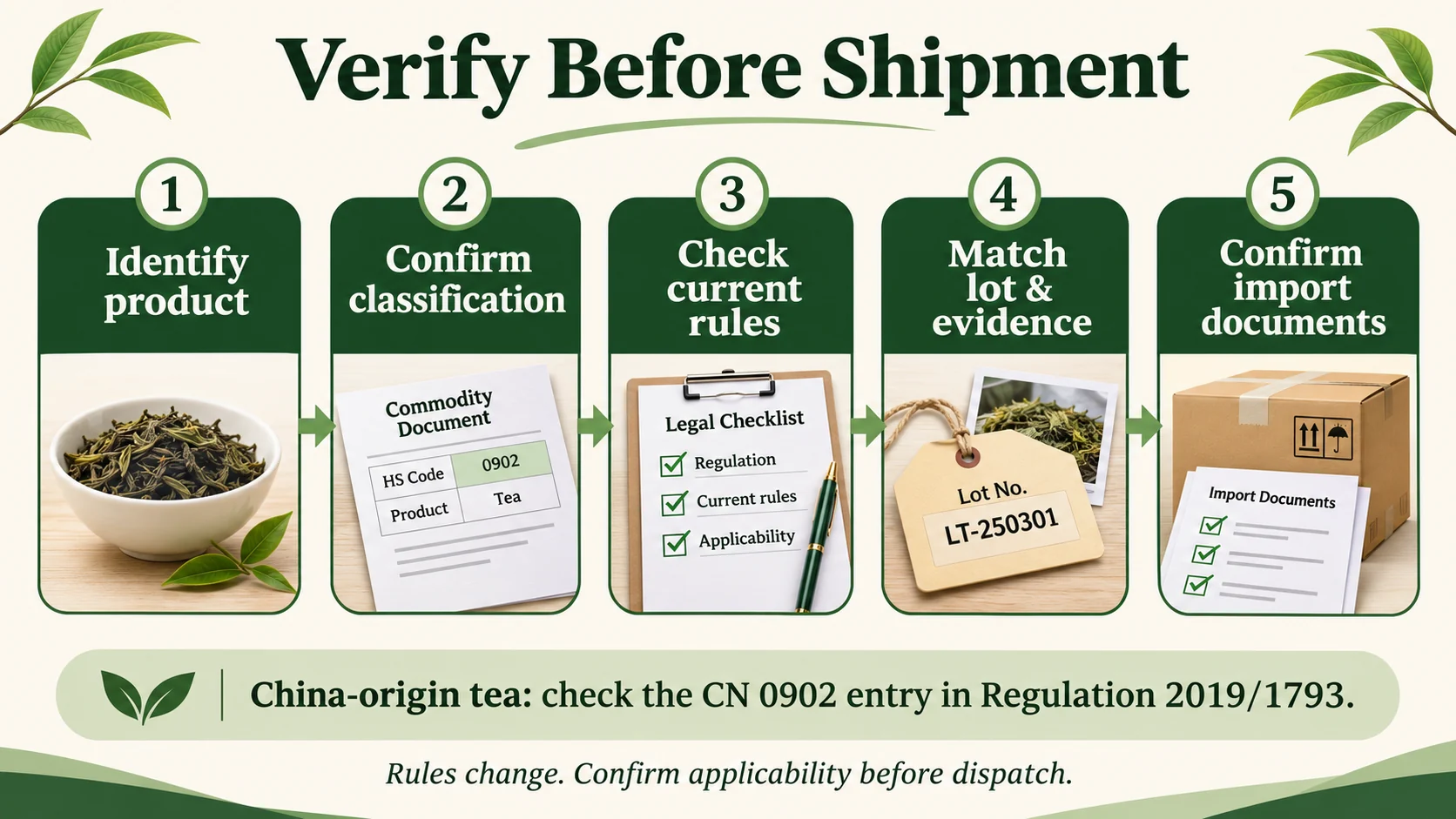
identify the product → check applicable EU limits → review supplier documents → test where appropriate → confirm batch and origin → verify import documents → then scale.
This guide explains the main issues commercial matcha buyers should discuss before ordering.
Important: This article is a B2B sourcing guide, not legal advice. EU requirements can change, and importers should verify the current rules for the exact product, origin, use and destination Member State before shipment.
1. Start With Pesticide Maximum Residue Levels
Pesticide residues are one of the most important compliance topics for tea and matcha entering the EU.
The main EU framework is Regulation (EC) No 396/2005.
EU Maximum Residue Levels, or MRLs, apply to food placed on the EU market whether it was produced inside the EU or imported from a non-EU country. Official EU source
That means a supplier should not assume:
“This pesticide is permitted in the producing country, so it is acceptable in Europe.”
The relevant question is:
Does the residue level comply with the applicable EU MRL for the product?
2. The EU Default MRL Is 0.01 mg/kg — But Not for Every Pesticide
One of the most commonly misunderstood EU rules is the 0.01 mg/kg default MRL.
The European Commission explains that when no specific MRL has been established for a particular active substance/product combination, a default level of 0.01 mg/kg generally applies. Official EU source
But this does not mean:
every pesticide must always be below 0.01 mg/kg.
Some active substances have their own specific MRLs.
So an EU pesticide test should not simply use one universal number for every compound.
The buyer or laboratory should compare the detected residues with the current applicable EU limits for the relevant commodity and active substance.
3. Processed Products Need Extra Care
Matcha is not simply brewed tea.
The powdered leaf is consumed as part of the finished product.
EU Regulation 396/2005 also contains provisions for processed and composite foods.
Article 20 requires relevant MRLs to be considered while accounting for changes caused by processing, including concentration or dilution. Official EU source
For B2B buyers, this means the compliance question may be more complicated than:
“Did the raw leaf pass?”
You need to understand:
- what product was tested
- whether it was finished matcha powder
- how the commodity was classified
- whether a processing factor is relevant
- which EU MRL was used for comparison
If the supplier’s report simply says “pesticide: PASS” without showing the tested compounds, results, methods and applicable limits, it provides much less useful evidence.
4. What Should a Pesticide Test Report Show?
A useful analytical report should make it possible to answer several questions.
Sample identity
Does the report identify the actual matcha product?
Batch or lot
Is the tested material connected to a specific lot?
Test date
When was the test performed?
Test scope
Which pesticide residues were analyzed?
Analytical result
What level was detected?
Method / LOQ
What analytical method and limit of quantification were used?
Regulatory comparison
Which specification or regulatory limit was used to determine compliance?
This is much more useful than a generic supplier statement saying:
EU standard passed.
5. A COA Is Not the Same Thing as a Pesticide Report
Commercial matcha buyers often ask for a “COA,” but that term can describe different documents.
A manufacturer COA may include:
- moisture
- appearance
- sensory information
- microbiological results
- internal specifications
- batch identification
Another COA may include different parameters.
A separate third-party pesticide report may contain hundreds of pesticide compounds.
Neither should automatically be treated as a substitute for the other.
A better question is:
What does this specific document verify?
For every document, identify:
product → batch → parameter → method → result → date.
6. Contaminants Are a Separate Regulatory Area
Pesticides are not the only potential chemical concern.
EU food-contaminant rules are primarily set under Commission Regulation (EU) 2023/915.
The regulation contains maximum levels for specific contaminants and specific food categories. Official EU source
For example, the current regulation includes a maximum level of 0.75 mg/kg for perchlorate in dried tea (Camellia sinensis). Official EU source
That illustrates an important principle:
contamination requirements must be checked contaminant by contaminant and food category by food category.
Do not assume that one generic “heavy metals test” or “EU test” covers every regulated contaminant.
7. Do EU Rules Set One Universal Heavy-Metal Panel for Matcha?
No single statement such as:
“EU matcha must pass Pb, Cd, As and Hg at these four universal limits”
should be accepted without checking the exact regulatory basis.
Regulation (EU) 2023/915 sets maximum levels for particular contaminants in particular food categories.
Not every contaminant has a matcha-specific maximum level written in exactly the same way.
Commercial buyers may still request lead, cadmium, arsenic or mercury testing as:
- supplier specification
- customer requirement
- risk-management measure
- destination-market requirement
But these should be distinguished from a claim that a particular four-metal panel itself equals “EU certification.”
8. Microbiological Testing Is Also Not One Universal Matcha Standard
EU Regulation (EC) No 2073/2005 establishes microbiological criteria for certain microorganisms and certain food categories.
The European Commission emphasizes that microbiological testing is only one part of food-safety management and does not, by itself, guarantee food safety. Good Hygiene Practice, Good Manufacturing Practice and HACCP-based controls remain important. Official EU source
There is not one universal microbiological panel that every dry matcha powder must automatically use under this regulation.
Commercial matcha specifications may nevertheless include parameters such as:
- total plate count
- yeast and mould
- coliforms
- E. coli
- Salmonella
depending on the buyer, producer, application and risk assessment.
The important point is to separate:
legal food-safety criteria
from:
buyer or supplier specifications.
9. “Microbiology Passed” Needs Context
If a supplier provides microbiological results, check:
- test method
- sample
- batch
- unit
- specification
- result
- date
For example:
Salmonella: Not Detected
is more useful when the report also identifies:
- sample size
- test method
- product
- lot
rather than appearing as an isolated statement on a marketing page.
10. Organic Matcha Has an Additional Import Requirement
If matcha is going to be sold as organic in the EU, pesticide testing alone is not enough.
EU organic production and labelling are governed primarily by Regulation (EU) 2018/848. Official EU source
For organic products imported into the EU, the European Commission states that an appropriate electronic Certificate of Inspection (e-COI) is required and administered through TRACES.
The required e-COI and its official verification must be addressed before release as organic; the importer should confirm the applicable control and release procedure for the consignment. Official EU source
This means buyers should distinguish between:
organic certificate
and
shipment-specific import documentation.
A supplier showing a valid organic certificate does not automatically prove that every shipment already has the required import COI.
11. What Should EU Organic Buyers Confirm?
Before ordering organic matcha, discuss:
Certified operator
Which operator is covered by the organic certification?
Product scope
Does the certificate cover the actual matcha product?
Certification status
Is it currently valid?
Control body
Which recognized control body issued or supervises the certification?
Shipment e-COI
Who will create and manage the electronic Certificate of Inspection in TRACES?
Importer responsibility
Which EU importer or operator will handle the relevant organic import steps?
These details should be clarified before commercial shipment, not after the goods arrive.
12. Check the China-Origin Tea Entry for Increased Border Controls
In Annex I of the consolidated Regulation (EU) 2019/1793 dated 30 June 2026, the China entry includes tea, whether or not flavoured, CN code 0902, for pesticide residues, with a 20% frequency of identity and physical checks. Official EU source
This is a control frequency, not a tariff, a failure rate or a requirement that only 20% of goods comply. All consignments must comply with applicable food law.
For matcha, confirm the actual commodity description and CN/TARIC classification with the importer and competent authority. Do not assume that every formulated matcha blend has the same classification as pure tea powder.
Where the entry applies, plan the applicable official-control, pre-notification and entry-document workflow with the importer before dispatch. Recheck the current annex and relevant provisions before shipment.
13. Border Control Lists Can Change
This is an important procurement point.
A matcha shipment that was not subject to additional controls when one order was placed may face a different regulatory environment later.
Do not save a regulatory screenshot from 2024 or 2025 and assume it is permanently valid.
Before shipment, verify:
- current product-country listings
- applicable hazards
- required certificates
- sampling/check frequency where relevant
This is especially important for repeat importers.
14. “EU Compliant” Is Too Broad as a Supplier Claim
A supplier may say:
Our matcha is EU compliant.
But EU food compliance can involve different questions:
- pesticides
- contaminants
- microbiology
- hygiene
- organic rules
- labelling
- import documentation
- product-specific requirements
A single lab report rarely proves all of them.
The more professional sourcing approach is:
Which requirements does this product currently have evidence for?
That question produces a much clearer buyer-supplier discussion.
15. Third-Party Testing Should Be Product-Specific
Third-party testing is valuable when the report actually applies to the product you plan to buy.
Avoid assuming:
Supplier A tested one matcha → every matcha from Supplier A is verified.
The report may only cover:
- one product
- one sample
- one lot
- one production date
A buyer should therefore ask how the sample tested relates to the commercial material being offered.
This is especially important when the supplier sells multiple grades or profiles.
16. Do You Need Eurofins or SGS Specifically?
The EU does not require buyers to use one particular global laboratory brand simply because the product is matcha.
Companies such as Eurofins, SGS and other qualified laboratories are commonly used for food testing, but the important questions are:
- competence
- accreditation
- method
- scope
- detection limits
- report acceptance for the intended purpose
Do not choose a report purely because a well-known laboratory logo appears at the top.
Read the actual report.
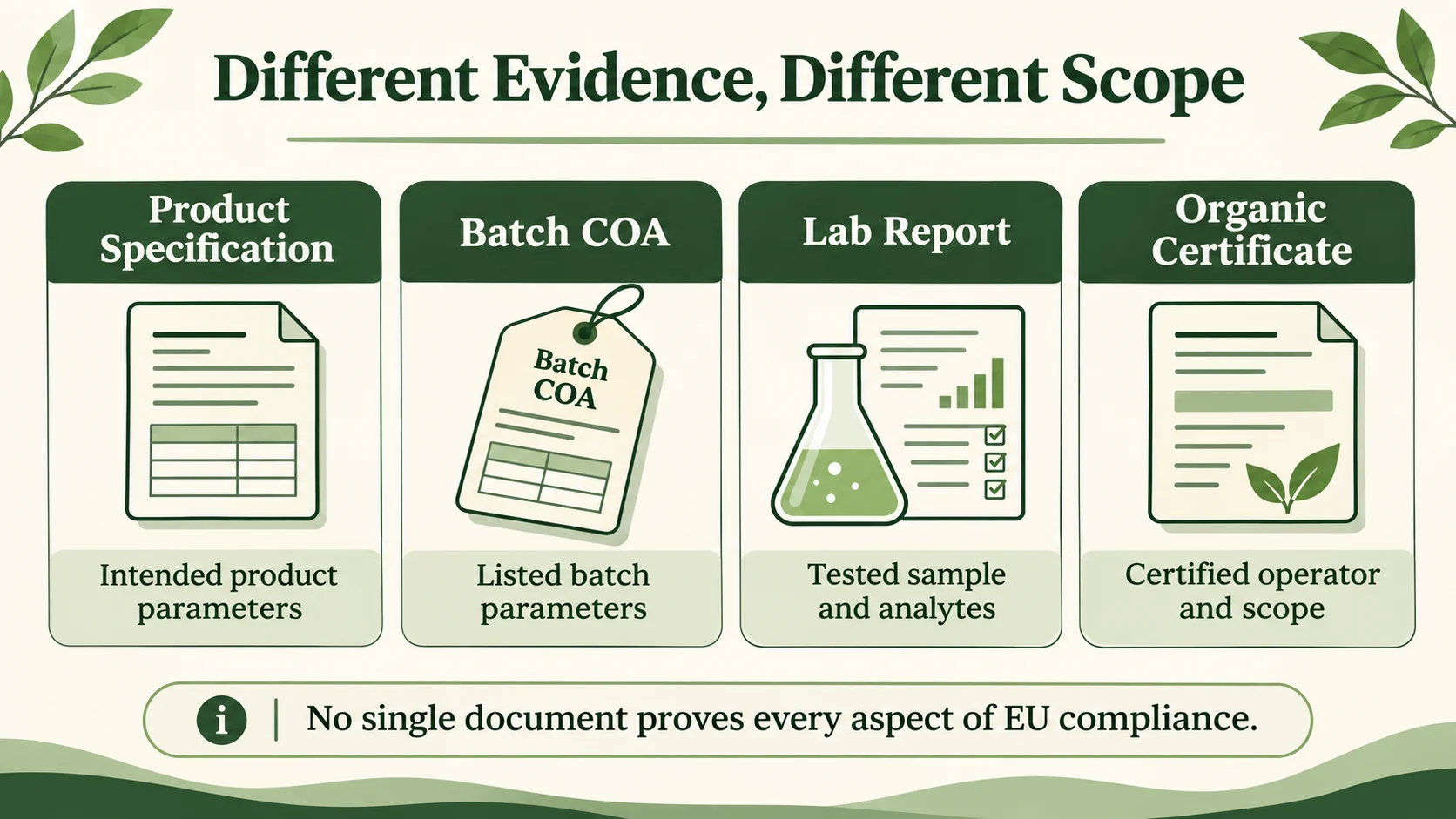
17. Supplier Specification vs Batch Report
A commercial buyer should understand the difference.
Product Specification / TDS
Usually describes the intended product parameters.
It may include:
- appearance
- ingredient
- origin
- moisture target
- sensory characteristics
- packing
- general specification
Batch COA
Shows results or confirmed parameters for a specific production batch.
Third-Party Analytical Report
Shows testing performed by an external laboratory on a particular submitted sample.
These documents are complementary. See our Matcha Supplier Documents guide for document-scope questions.
They should not be collapsed into one category called:
“certificates.”
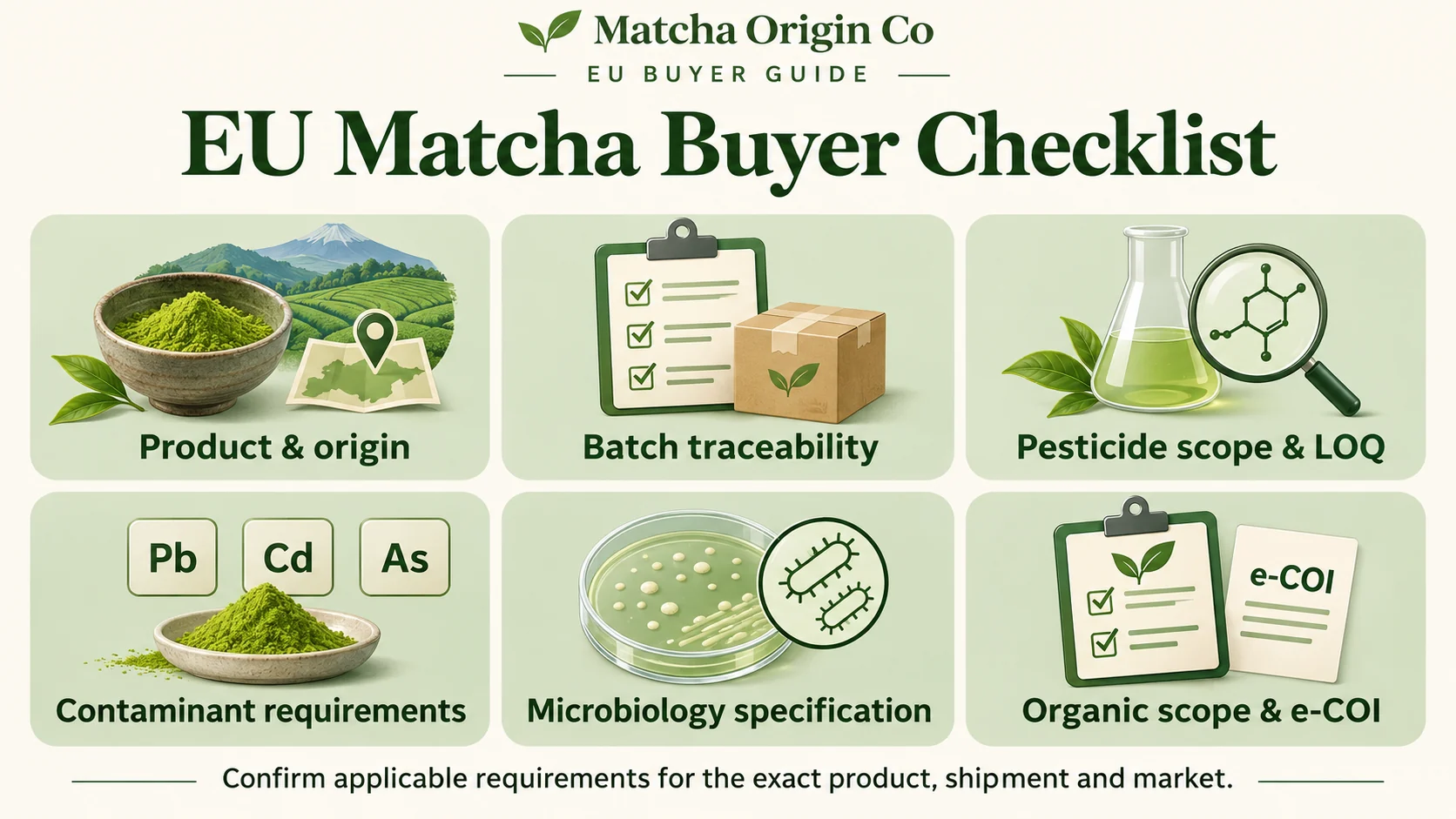
18. Recommended Documentation Checklist for EU Matcha Buyers
Before a larger order, review the following where relevant.
| Document / Information | What It Helps Confirm |
|---|---|
| Product specification | Intended product parameters |
| Ingredient statement | What the product contains |
| Country of origin | Where the product was produced |
| Batch / lot ID | Traceability |
| Manufacturer COA | Batch-specific supplier results where available |
| Pesticide report | Residue test scope and results |
| Microbiology report | Microbiological test results where required |
| Contaminant testing | Selected chemical contaminants where required |
| Organic certificate | Certified organic scope |
| e-COI / TRACES | Organic import consignment documentation |
| Commercial invoice | Transaction details |
| Packing list | Shipment contents |
The table is a sourcing checklist, not an exhaustive list of mandatory import documents. Legal documentation obligations still apply even when a buyer does not request a document.
The required set depends on:
product → application → destination → customer → certification status.
19. Testing Before Sampling vs Testing Before Mass Order
The timing of testing matters.
Stage 1 — Supplier Qualification
Before requesting samples, review:
- supplier identity
- origin
- product specification
- available certificates
- available historical testing
This helps eliminate unsuitable suppliers.
Stage 2 — Sample Evaluation
Test the product in the actual application.
For a café:
milk + sweetness + dosage.
For a bakery:
actual recipe + processing conditions.
For manufacturing:
actual formulation and process.
Stage 3 — Commercial / Batch Confirmation
Before larger purchasing, confirm:
- commercial product
- lot
- required testing
- documentation
- packaging
- volume
- import requirements
This prevents a common mistake:
approving Sample A, then buying a different product without realizing it.
20. Do Not Order 200 kg Because One Sample Looked Good
Sensory approval is only one part of commercial qualification.
Before scaling, confirm:
- sample-to-bulk relationship
- repeat supply
- product identity
- documentation
- required testing
- cost
- lead time
- packing
- destination requirements
This is especially important in a tight supply market where substitutions may occur.
21. A Practical EU Matcha Buyer Workflow
A structured sourcing process can look like this:
Step 1 — Define Application
Latte, straight whisking, baking, RTD, food manufacturing or retail.
Step 2 — Define Market
Which EU country or countries will receive the product?
Step 3 — Define Required Status
Conventional or organic?
Step 4 — Request Product Documents
Specification, origin, available COA and testing.
Step 5 — Evaluate Samples
Test sensory and technical performance.
Step 6 — Identify Regulatory Testing Needs
Check current pesticide MRLs, contaminants, microbiological and other applicable requirements.
Step 7 — Confirm Commercial Lot
Make sure the order relates to the approved product.
Step 8 — Confirm Import Documentation
Especially for organic products and any currently controlled product-country combinations.
Step 9 — Scale
Move into repeat commercial supply only after the product and supply route are understood. Review Bulk Matcha supply against the approved product, documentation and volume requirements.
22. What Matcha Origin Co. Can Support
Matcha Origin Co. supports B2B buyers with product and project-specific documentation rather than claiming that every matcha carries the same evidence.
Depending on the selected product, supplier, batch and project scope, available support may include:
- product specifications
- manufacturer COA
- batch information
- organic documentation
- selected pesticide testing
- microbiological testing
- heavy-metal or other analytical testing
- origin and supply information
Availability should always be confirmed for the specific product and project.
View Available Documentation →
Frequently Asked Questions
What pesticide limit applies to matcha in the EU?
EU pesticide MRLs are set by active substance and product under Regulation (EC) No 396/2005. Where no specific MRL exists, a default 0.01 mg/kg generally applies. This does not mean every pesticide universally has a 0.01 mg/kg limit. Official EU source
Is a pesticide test required for every shipment?
The appropriate testing strategy depends on the product, supplier history, buyer requirements, regulatory risk and current import controls. Buyers should confirm the relevant requirements for the exact shipment rather than assume one universal rule.
Does a COA prove EU pesticide compliance?
Not automatically. A COA only provides evidence for the parameters and sample or batch actually identified in its scope. If pesticide residues are not tested, the COA does not itself verify pesticide MRL compliance.
Is EU organic certification enough to import organic matcha?
No. Organic imports into the EU also require the appropriate electronic Certificate of Inspection through TRACES for the consignment. Official EU source
Does China-origin matcha automatically face extra EU border checks?
The 30 June 2026 consolidated Annex I lists China-origin tea, whether or not flavoured, under CN 0902 for pesticide residues, with a 20% identity and physical check frequency. Confirm whether the actual matcha product falls within that entry and recheck the current list and import procedures before shipment. Official EU source
Is there one EU microbiological standard specifically for matcha?
There is no single universal panel that every dry matcha product must automatically use under Regulation 2073/2005. Microbiological requirements depend on food category, risk, buyer specification and applicable food-safety controls. Official EU source
Do I need a heavy-metal report?
A buyer may request heavy-metal testing as part of its specification or risk-management program, but the applicable legal limits must be checked by contaminant and food category. Do not assume a generic four-metal test equals full EU compliance.
Can a supplier use one lab report for all its matcha products?
That should not be assumed. A laboratory report normally applies to the sample identified in the report. Buyers should verify how that sample relates to the product or batch they plan to purchase.
The Key Rule for EU Matcha Sourcing: Evidence Must Stay Within Scope
For B2B matcha sourcing, one of the most useful principles is simple:
Do not make a compliance claim broader than the evidence supporting it.
A pesticide report verifies the residues it tested.
A microbiology report verifies the microorganisms in its scope.
An organic certificate verifies the certified operator and products within its scope.
A COA verifies the parameters listed for the relevant product or batch.
None of those documents should automatically be stretched into:
“Everything is EU certified.”
For commercial buyers, the safer approach is:
Product → Batch → Requirement → Document → Test → Result → Import
When those pieces line up, supplier qualification becomes much clearer.
And when they do not, the missing information becomes visible before the order is scaled.