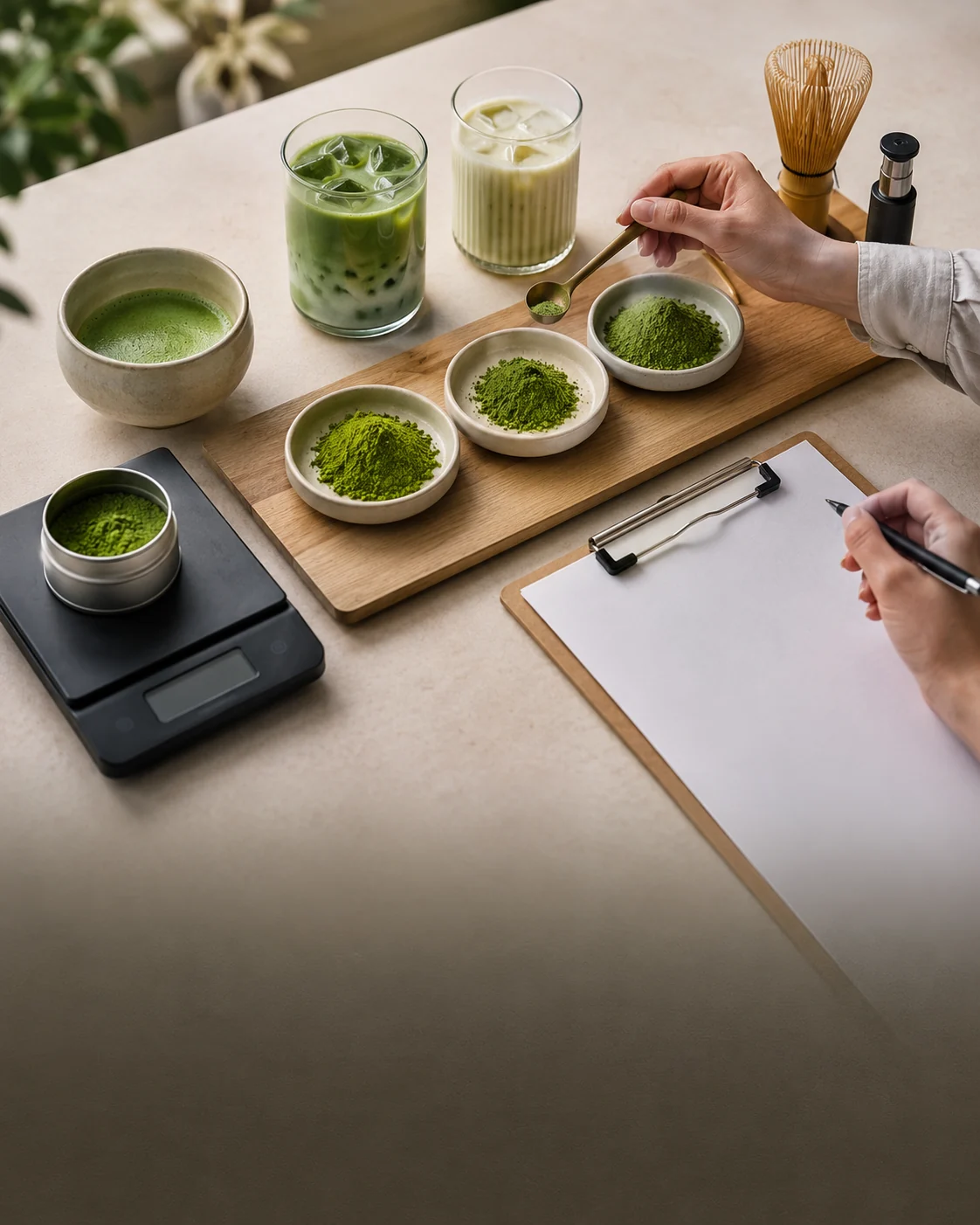
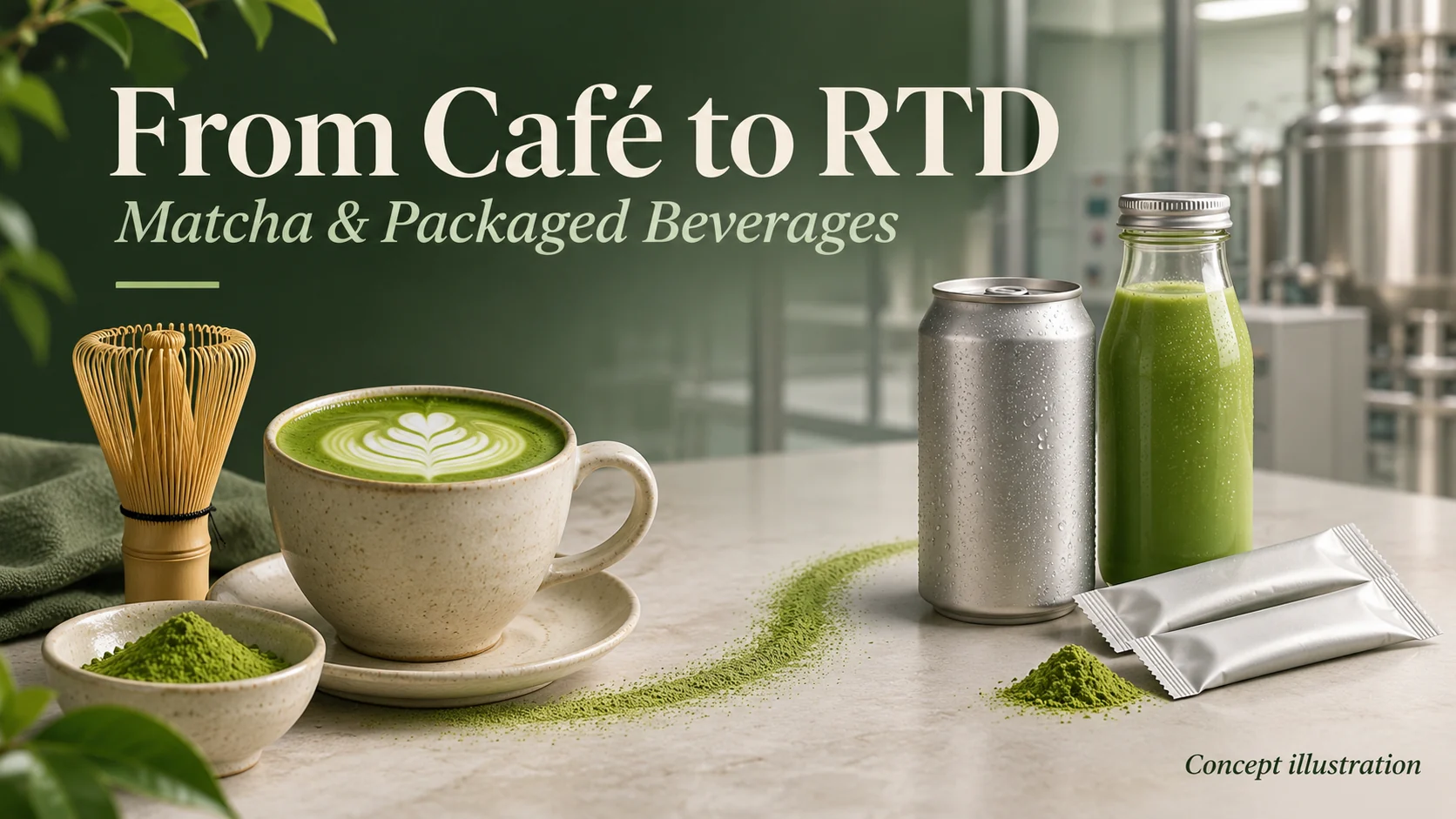
Concept illustration; not a photograph of Matcha Origin Co. facilities, products or validated test results.
Scope note: Brand launches are examples of product activity, not a market-size forecast or proof of commercial success. Company-reported figures are attributed to the company. Powder stick packs require preparation and are a convenience format, not an RTD beverage. The technical checkpoints below guide development; they do not replace product-specific process or shelf-life validation.
Matcha is no longer developing only as a café drink.
In 2026, the category is increasingly appearing in ready-to-drink cans, bottled lattes, sparkling beverages, single-serve powders and other convenience formats.
That shift matters to beverage brands because moving matcha from a café counter into a packaged product changes the development problem completely.
A café can prepare a matcha latte and serve it within minutes.
A packaged beverage may need to remain visually, technically and commercially acceptable through production, distribution, storage and consumer use.
The opportunity is therefore bigger than simply putting an existing café recipe into a can.
The more useful question is:
How should a beverage company select, test and qualify matcha for a repeatable packaged product?
Matcha Is Moving From Ritual to Convenience
BeverageDaily described the current shift as matcha moving beyond the café into cans, powdered stick packs and other convenient formats.
The report highlighted companies including CHUH and Shinzo that are using ready-to-drink products, flavored matcha and convenient single-serve formats to make matcha easier to consume outside traditional café preparation. BeverageDaily, August 19, 2026
This is an important category change.
Traditionally, matcha asks the consumer to do some work:
measure powder, add water, whisk, add milk or other ingredients, and clean the preparation tools.
Convenience products reduce those steps.
For consumers, that means easier access.
For brands, it creates new formats such as:
- canned matcha lattes
- bottled milk-based matcha
- shelf-stable drinks
- refrigerated matcha beverages
- sparkling matcha
- powdered stick packs
- flavored instant matcha systems
The format may change, but the raw material still has to perform inside the finished product.
2026 Product Launches Show the Direction of Travel
Recent launches help illustrate where the category is moving.
La Colombe announced a ready-to-drink Matcha Latte range on September 17, 2026, including Everyday Matcha Latte, Strawberry and Vanilla. The company also reported that matcha sales in its cafés had increased 188% since 2023 before it moved the concept into packaged retail. La Colombe / Chobani announcement, September 17, 2026
CHUH has taken a more flavor-forward approach.
Its canned lineup has included Blueberry, Spiced Vanilla, Lavender and Crème Brûlée, with the company reporting that it had crossed 200 retail doors in its June 22, 2026 announcement. CHUH company announcement, June 22, 2026
Shinzo has taken another route, offering single-serve flavored matcha powder packs alongside sparkling matcha products. Shinzo product range
These examples should not be treated as proof that every matcha RTD concept will succeed.
They do show something more useful:
Matcha is becoming a beverage platform rather than one fixed latte recipe.
That creates opportunities for cafés, beverage brands and food manufacturers—but it also raises the technical bar.
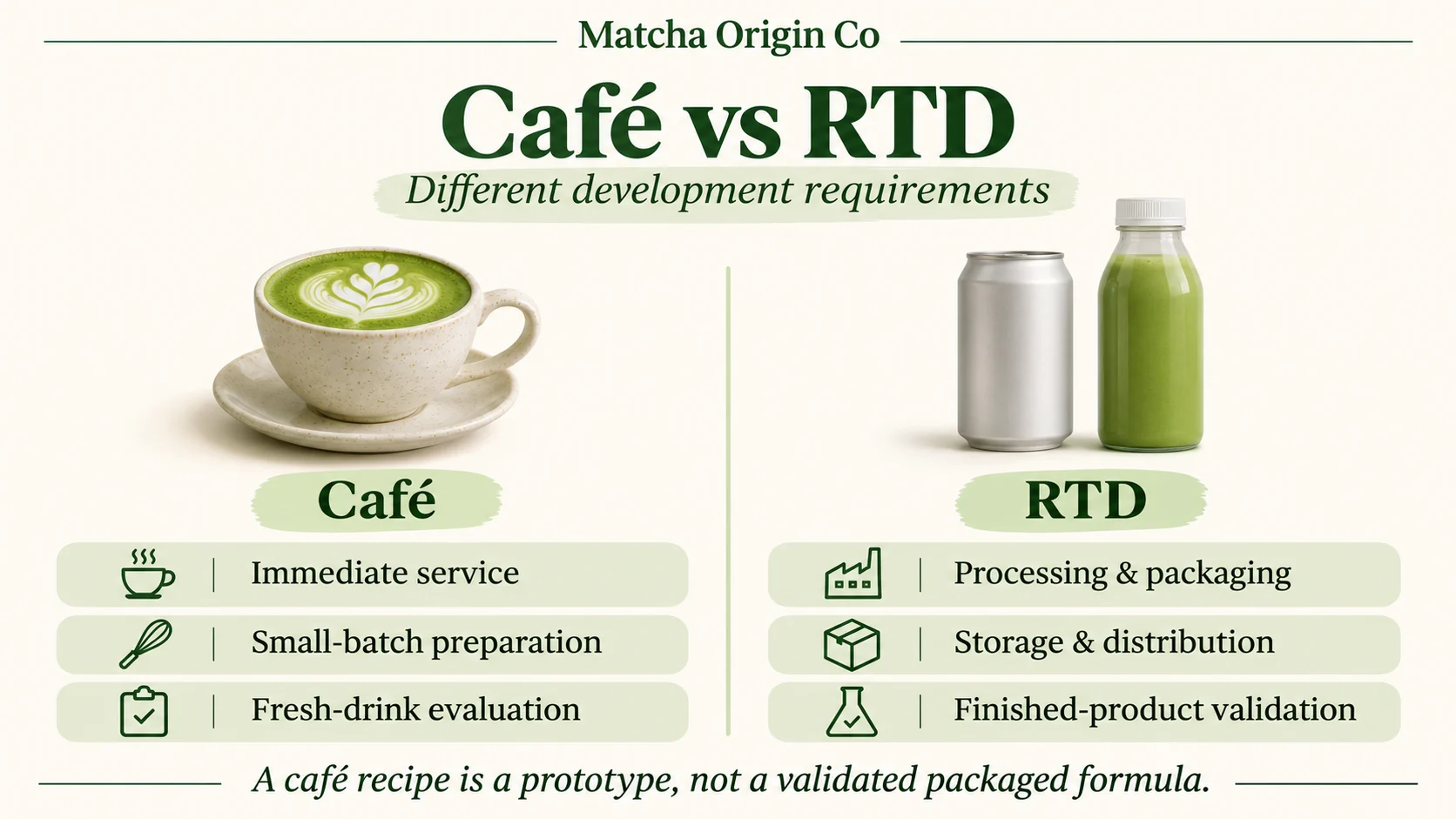
Café Matcha Is Not the Same Development Problem as RTD Matcha
A café recipe is usually optimized for immediate consumption.
A barista can:
prepare the matcha, visually inspect it, adjust the drink, add ice or milk, and serve it within minutes.
Packaged beverages operate differently.
The product may pass through:
mixing, filling, thermal processing or another preservation system, transportation, storage and potentially weeks or months before consumption.
That means a matcha that looks excellent when freshly whisked may not automatically be the best matcha for a packaged beverage.
For RTD development, brands need to evaluate the matcha inside the complete process, not only in a freshly prepared lab sample.
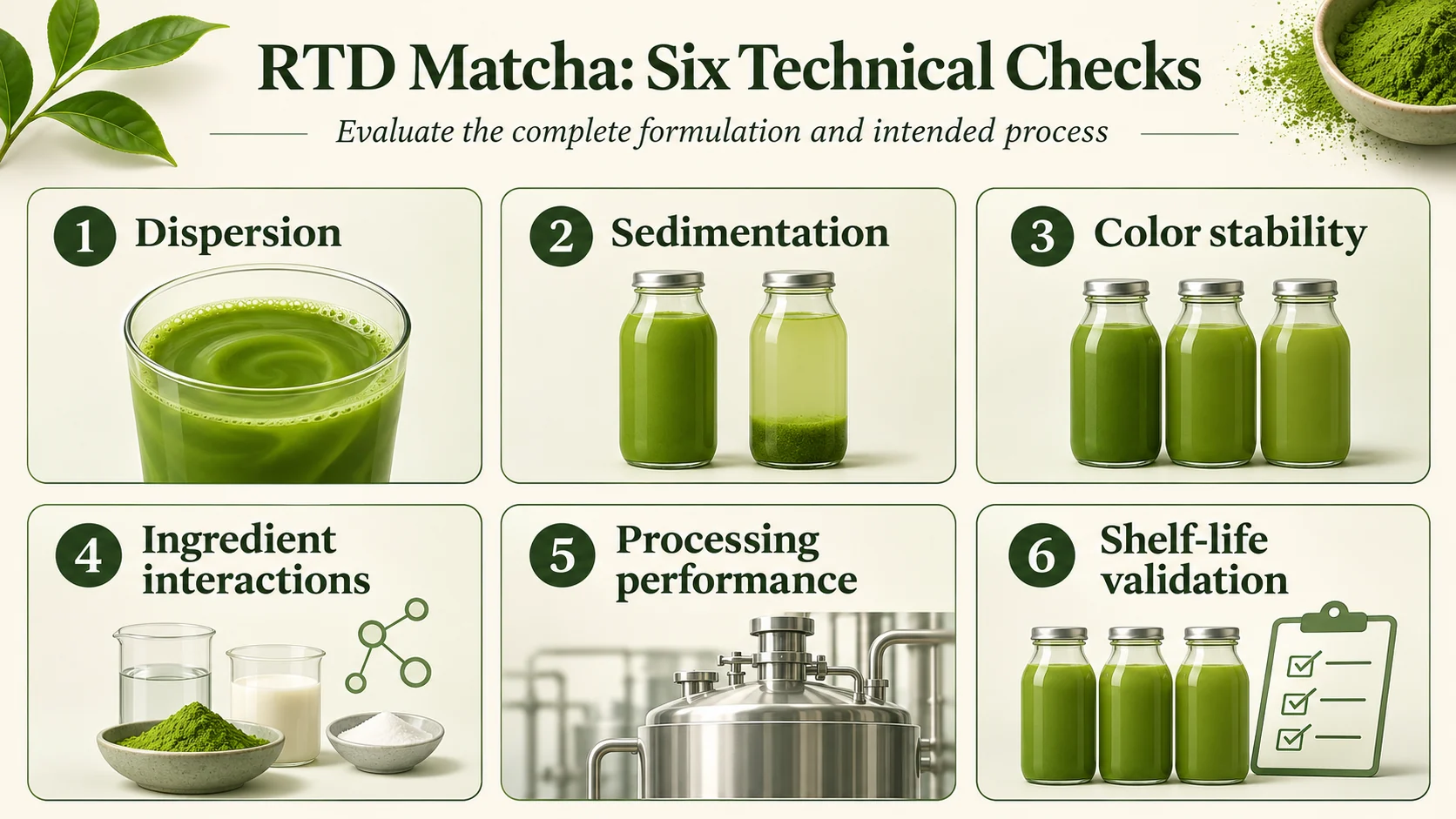
1. Dispersion: Can the Matcha Be Distributed Consistently?
Matcha does not dissolve like sugar.
It is a finely milled tea powder dispersed through a liquid.
That distinction becomes important when moving from a café cup to commercial production.
A beverage developer should evaluate:
- initial dispersion
- visible clumping
- mixing requirements
- powder incorporation
- behavior in the complete formulation
- consistency across pilot batches
The objective is not necessarily to make the powder “disappear.”
The objective is to create a finished beverage that behaves consistently enough for the intended format.
A matcha that works at 3 g in a hand-whisked latte may behave differently when mixed into a larger production tank.
2. Sedimentation: What Happens After the Drink Sits?
A freshly prepared latte may be consumed before meaningful settling becomes visible.
An RTD beverage has much more time for physical changes to appear.
Developers should therefore observe:
- sediment formation
- settling rate
- visible separation
- ease of redistribution
- texture after storage
- consumer experience after shaking, where applicable
Sedimentation is not simply a question of matcha “quality.”
The complete formulation matters.
Particle characteristics, liquid composition, proteins, fats, stabilizing systems and process conditions can all influence the finished product.
This is why RTD buyers should test the actual formula rather than judge matcha only by powder appearance.
3. Color Stability: Fresh Green Is Only the Starting Point
Visual appearance is one of matcha’s strongest commercial assets.
Consumers expect a recognizable green drink.
But the color observed immediately after mixing is only one checkpoint.
For packaged beverages, brands should examine appearance:
- after mixing
- after processing
- after filling
- during storage
- near the end of the intended shelf-life study
Temperature, oxygen exposure, light, ingredients and processing conditions may all affect finished appearance.
A product developer should therefore avoid approving a matcha only because the dry powder or freshly whisked sample looks vivid.
The finished packaged beverage is the real test. Research on matcha technological properties and beverage design also highlights why powder properties should be evaluated for the intended application; it does not validate a particular commercial RTD formulation.
4. Milk, Protein and Other Ingredients Change the Matcha
A café latte already shows how dramatically milk can change matcha.
Packaged beverages add another layer because the recipe may include:
- dairy milk
- oat or other plant bases
- protein ingredients
- sugar
- flavor systems
- emulsifiers
- stabilizers
- minerals
- acids or other formulation components
These ingredients can change:
- color
- flavor intensity
- bitterness perception
- mouthfeel
- dispersion
- physical stability
This is one reason a matcha chosen for straight whisking should not automatically become the matcha used for an RTD latte.
The target application determines the evaluation criteria.
5. Processing Can Change the Sensory Result
Commercial production may involve conditions very different from café preparation.
Depending on the product and manufacturing route, the beverage may undergo a validated heat treatment or other preservation process.
The brand should evaluate the matcha after the intended process—not only before it.
Questions include:
- Does the tea character remain recognizable?
- Does bitterness change?
- Does the color remain acceptable?
- Does the aroma change?
- Does the product interact differently with the rest of the formulation?
A bench-top recipe that tastes excellent before processing is not necessarily a finished commercial formula.
Pilot testing matters.
6. Shelf-Life Is a Product Question, Not a Matcha Claim
Matcha suppliers should not promise a finished beverage shelf life simply because the matcha powder itself has a particular storage period.
Shelf-life belongs to the complete packaged product.
It depends on factors including:
- formulation
- manufacturing process
- microbiological controls
- packaging
- storage conditions
- physical stability
- sensory stability
For beverage brands, shelf-life validation should therefore occur on the final product under the appropriate development and food-safety process.
A matcha sample can help select the tea.
It cannot replace finished-product validation.
Flavor Is Helping Matcha Move Into Packaged Beverages
One of the clearest 2026 signals is the expansion of flavored matcha.
CHUH has used flavors including Blueberry, Spiced Vanilla, Lavender and Crème Brûlée, while La Colombe’s RTD launch includes Strawberry and Vanilla alongside its Everyday Matcha Latte. CHUH company announcement; La Colombe company announcement
This reflects something cafés have already demonstrated:
matcha works as a flavor platform.
Consumers do not only buy plain matcha.
They increasingly encounter matcha combined with:
- strawberry
- vanilla
- lavender
- blueberry
- brown sugar
- dessert-inspired flavors
- sparkling formats
- plant-based milk
That means café menu experimentation can become an early signal for CPG development. Our Matcha Recipe Hub offers café concepts for early exploration, rather than validated RTD formulas.
However, a successful café flavor does not automatically become a successful packaged beverage.
The formulation still has to survive commercial production.
Café Trends Can Become Product-Development Signals
Coffee shops are often early testing grounds for beverage flavors.
A café can introduce a seasonal drink quickly, observe consumer response and change the recipe without rebuilding an entire manufacturing process.
Packaged beverage development is slower and more expensive.
That makes café trends useful—but not sufficient.
A beverage company should ask:
- Is the flavor gaining repeat demand or only social-media attention?
- Can the flavor work in a scalable formulation?
- Does it remain recognizable after processing?
- Does the matcha remain visible and flavorful?
- Can the product meet its cost target?
- Can the supply chain support repeat production?
This converts trend monitoring into product-development discipline.
RTD Buyers Should Choose Matcha by Application
A beverage manufacturer should not begin by asking:
What is your highest grade?
A better starting point is:
What matcha performs best in our specific formula and process?
For an RTD latte, the buyer may care about:
- color through milk
- flavor intensity
- bitterness
- dispersion
- process performance
- batch consistency
- cost
- documentation
- supply continuity
For a sparkling matcha product, the priorities may be different.
For a stick-pack product, they may differ again.
The word “premium” does not answer these questions.
Neither does “ceremonial.”
Cost per Kilogram Is Not Enough
Commercial beverage brands ultimately sell a finished unit.
That means ingredient economics should be evaluated at the approved dosage.
A simplified matcha cost calculation is:
matcha price per kg ÷ 1,000 × matcha grams per unit
For example, two matcha products may have different kilogram prices but require different dosages to achieve the desired finished flavor and color.
The lower-priced matcha may not always produce the lower-cost finished beverage.
Then add the rest of the formulation:
- milk or plant base
- flavors
- sweeteners
- packaging
- processing
- manufacturing loss
- freight
- other production costs
For a packaged beverage, the relevant question is:
What is the ingredient and production cost of an approved sellable unit?
not simply:
What does one kilogram of matcha cost?
What Documentation Should Beverage Brands Discuss?
Documentation requirements depend on the product, destination market, selected matcha and project scope.
Before moving into commercial production, brands should clarify which documents are relevant to the actual product or lot.
These may include, where applicable:
- product specification
- ingredient information
- manufacturer COA
- batch information
- pesticide-residue testing
- microbiological testing
- heavy-metal testing
- organic documentation
- origin information
- other project-specific documentation
A supplier should not present one document as evidence for something it did not test.
For example:
a pesticide-residue report does not establish microbiological quality or certify every other product attribute.
Likewise:
a general supplier certificate is not automatically a batch-specific COA.
The scope of each document matters. Review Available Documentation and confirm the applicable product, lot and destination-market requirements.
Sample Selection Should Happen Before Pilot Production
A practical beverage-development process can begin with several matcha candidates.
Step 1 — Define the Product
Clarify:
- RTD latte, sparkling matcha, concentrate or another format
- dairy or plant-based system
- flavor
- sweetness target
- target market
- expected volume
- target cost
Step 2 — Shortlist Matcha Profiles
Choose candidates based on the intended product rather than broad grade names alone.
Step 3 — Bench Test
Compare candidates in the same base formulation.
Keep the recipe and processing conditions as consistent as possible.
Step 4 — Select the Strongest Candidates
Evaluate:
- flavor
- color
- bitterness
- dispersion
- dosage
- cost
- documentation availability
Step 5 — Move Into Pilot Production
Test the matcha through the actual manufacturing process.
Step 6 — Validate the Finished Product
Review the final formulation, processing, packaging, quality and shelf-life requirements before scaling.
This process is more useful than choosing a matcha from a price sheet and discovering technical problems later.
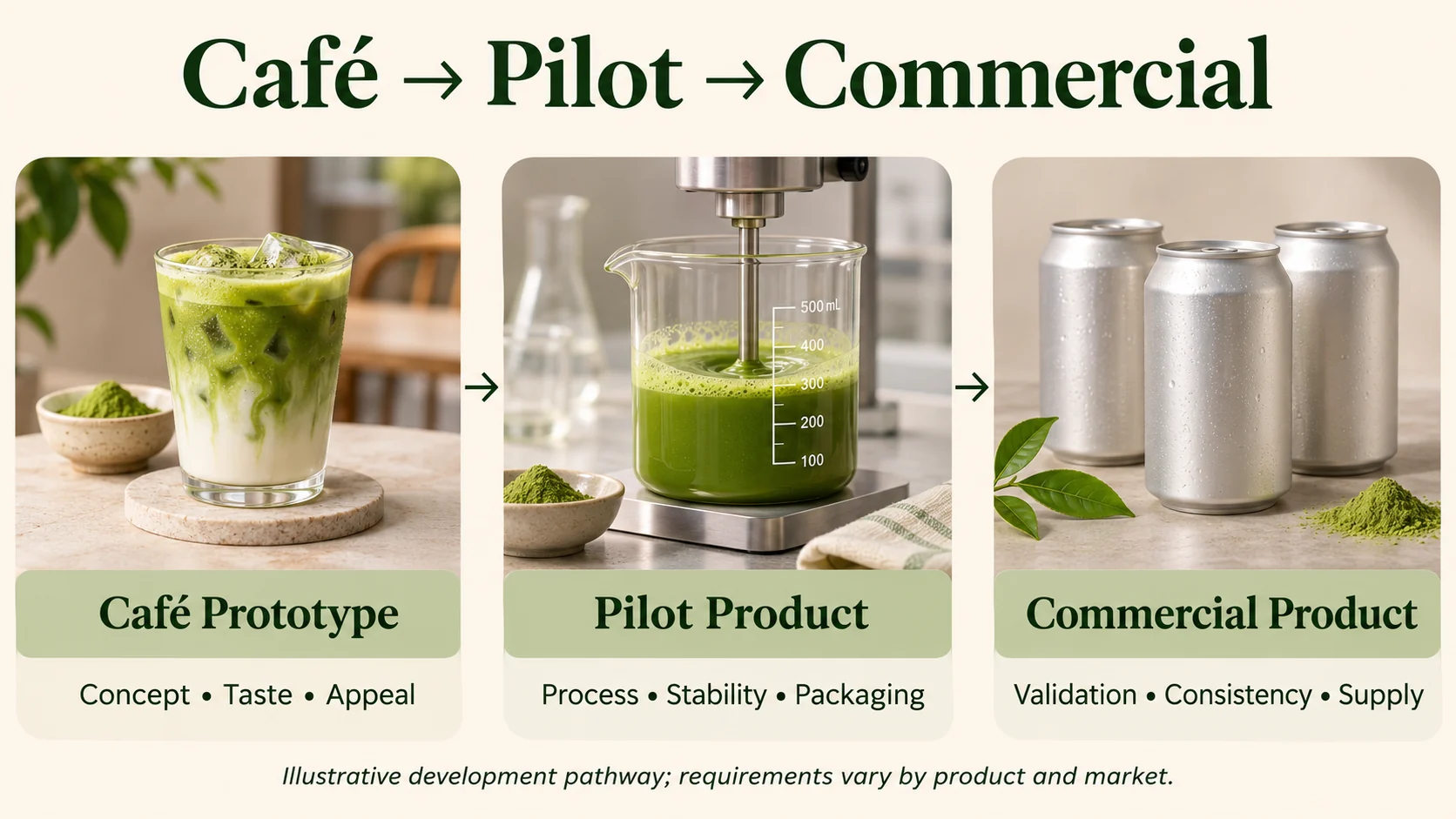
Café → Pilot → Commercial Production
The pathway from café concept to packaged product can be viewed as three different stages.
Café Prototype
Purpose:
Does the concept taste good?
Evaluate:
- flavor idea
- visual appeal
- consumer proposition
Pilot Product
Purpose:
Can the recipe survive a manufacturing process?
Evaluate:
- mixing
- processing
- physical behavior
- sensory changes
- packaging compatibility
Commercial Product
Purpose:
Can the brand manufacture and sell it consistently?
Evaluate:
- repeatability
- quality controls
- documentation
- supply continuity
- finished cost
- shelf-life validation
A successful café prototype only completes the first stage.
Why Supply Planning Matters for RTD More Than Café Service
A café might use a few kilograms of matcha each month.
A packaged beverage launch can increase consumption dramatically once distribution expands.
That means beverage companies should discuss future volume earlier.
Questions include:
- What is the expected pilot volume?
- What is the expected commercial order?
- How frequently will production repeat?
- Can the selected profile support the forecast?
- Is a backup profile required?
- What lead time should be planned?
One excellent sample is not enough if the same product cannot be supplied consistently later.
Matcha Supply Is Already Becoming More Commercial
The growth of packaged formats is happening while the wider matcha supply chain is already under pressure.
At the same time, consumer interest continues to expand.
BeverageDaily documented new matcha convenience formats in August 2026. These launch examples indicate product-development activity; they do not establish total RTD market growth or future sales. BeverageDaily, August 19, 2026
This combination creates both opportunity and risk.
Brands entering RTD matcha may benefit from growing consumer awareness.
They also need to qualify supply more carefully because scaling a successful packaged beverage can create much larger raw-material requirements than a single café menu item.
What Matcha Origin Co. Recommends for Beverage Development
Matcha Origin Co. uses an application-led approach.
For food and beverage projects, we recommend starting with the finished product rather than selecting only by grade name.
Share:
- intended beverage format
- dairy or plant-based base
- flavor concept
- target market
- expected volume
- target product positioning
- required documentation
Suitable profiles can then be shortlisted for evaluation.
The matcha should be tested in the actual formulation before moving into commercial scale.
Explore Food & Beverage Manufacturing →
Buyer Checklist: Before Scaling an RTD Matcha Product
Before approving a commercial matcha, confirm:
Product Fit
Does the matcha perform in the finished formula?
Approved Dose
How much matcha is actually required per unit?
Processing Performance
What happens after the intended production process?
Physical Stability
Does the formulation meet the product’s expectations for dispersion, sedimentation and appearance?
Sensory Stability
Does the flavor, aroma and color remain acceptable through the intended product life?
Documentation
Are the required documents applicable to the selected product or lot?
Cost
What is the matcha cost per finished unit?
Supply
Can the selected profile support projected commercial volumes?
Frequently Asked Questions
What is RTD matcha?
RTD means “ready to drink.” An RTD matcha beverage is packaged for consumption without requiring the consumer to whisk or prepare matcha powder separately. Formats can include canned or bottled matcha lattes, sparkling beverages and other packaged drinks.
Is RTD matcha growing in 2026?
There are clear signs of increasing product activity. BeverageDaily has highlighted matcha moving into canned drinks, stick packs and other convenience formats, while brands including La Colombe and CHUH have introduced or expanded packaged matcha beverage ranges in 2026. BeverageDaily; La Colombe announcement; CHUH announcement
Can a café matcha latte recipe be used directly for RTD production?
Not necessarily. A café drink is usually consumed immediately, while an RTD product may undergo commercial processing, packaging and storage. The complete formulation should be tested through the intended manufacturing process.
What matcha is best for RTD beverages?
There is no single matcha that is best for every RTD product. Select according to the formulation, processing method, target flavor, color, dosage, cost, documentation and supply requirements.
Does ceremonial matcha work better in packaged drinks?
Not automatically. “Ceremonial” is not a universal technical standard for RTD performance. A beverage developer should evaluate the actual matcha in the finished product.
Why does matcha settle in packaged beverages?
Matcha is a fine tea powder dispersed through a liquid rather than a fully soluble ingredient. Physical behavior depends on the matcha and the complete formulation. Finished-product development should evaluate sedimentation and redistribution under the intended product conditions.
What documents should an RTD matcha buyer request?
Requirements vary by product and market. Depending on the project, relevant information may include product specifications, manufacturer COA, batch details, origin information, applicable analytical testing and organic documentation.
Should a beverage brand start with samples?
Yes. Samples allow a brand to compare multiple profiles in the same formulation before committing to pilot or commercial quantities.
The Bigger Opportunity: Matcha Is Becoming a Product Platform
The significance of the current RTD expansion is not simply that consumers can now buy matcha in a can.
It shows that matcha is evolving into a broader product platform.
The same ingredient is now appearing across:
cafés → flavored drinks → RTD lattes → sparkling beverages → powdered convenience formats → food and beverage applications
That gives beverage companies more ways to build products around matcha.
But convenience does not remove the need for technical evaluation.
It increases it.
The brands that scale successfully will need to connect:
consumer trend → application → formulation → matcha selection → pilot testing → documentation → commercial supply.
For B2B buyers, that is the real transition from café matcha to packaged matcha.