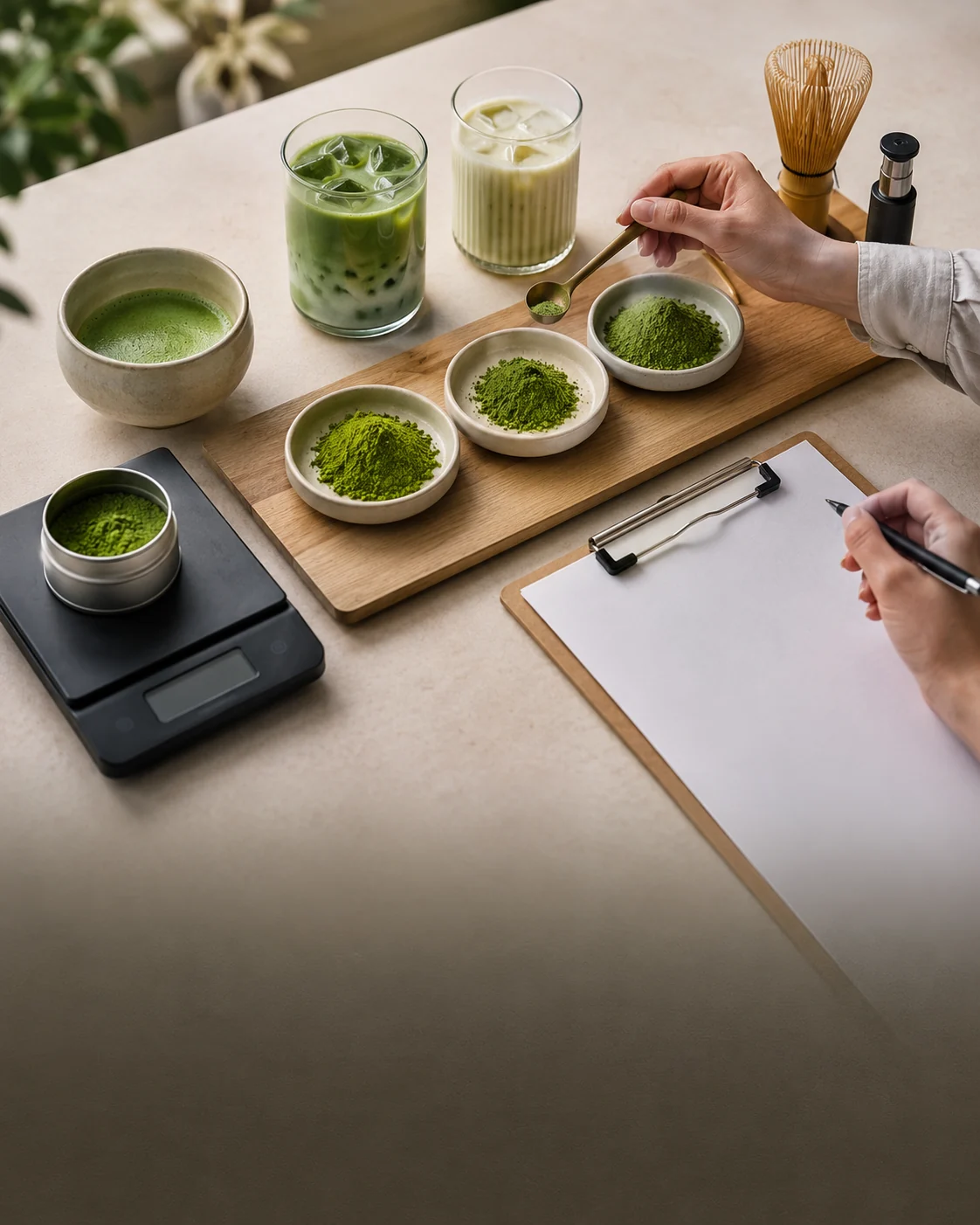
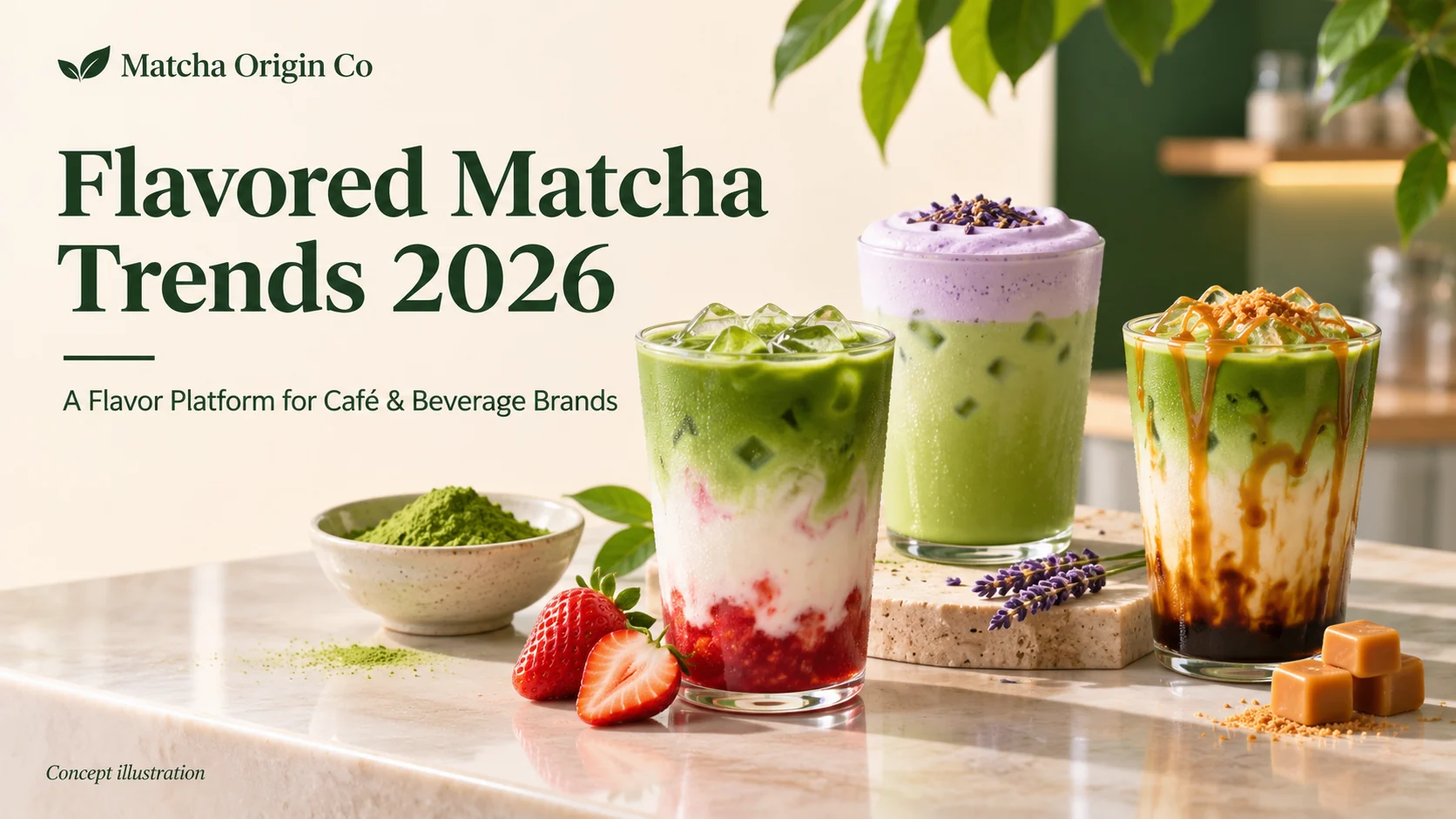
Evidence note: Brand examples describe dated product announcements and may vary by market or season. Menu presence, online popularity and sales measure different things. The development matrix is an illustrative starting point, not a universal dose recommendation or a recipe tested by Matcha Origin Co. Images are concept illustrations, not brand product photographs or test results.
Matcha is no longer developing as one fixed drink.
In 2026, the category is increasingly behaving like a flavor platform.
Cafés and beverage brands are combining matcha with berries, vanilla, lavender, mango, brown sugar, bakery-inspired flavors, cold foam and even coffee. The important shift is not simply that more flavored matcha drinks exist.
It is that major operators are using matcha as a base for repeat menu innovation rather than treating it as one specialty green tea latte.
For B2B buyers, that changes how matcha should be selected.
A matcha that works well in a lightly sweetened classic latte may not automatically perform in strawberry purée, raspberry cold foam, brown sugar syrup or dessert-style beverages.
The better development process is:
choose the flavor concept → define the finished recipe → test matcha in that recipe → standardize dose and cost → then scale supply.
Matcha Is Becoming a Menu Platform
One of the clearest signals comes from Starbucks.
The company says it had four matcha drinks on its menu in 2023. By February 2026, its year-round matcha lineup had roughly tripled, with products ranging from Protein Matcha to fruit-forward and dessert-inspired drinks such as Iced Double Berry Matcha and Iced Banana Bread Matcha. Starbucks described matcha as a platform for continued beverage innovation. Starbucks, February 25, 2026
Its 2026 U.S. announcements have included the following examples; availability is not necessarily simultaneous or permanent. Spring menu; fall menu.
- Double Berry Matcha
- Banana Bread Matcha
- Lavender Cream Matcha
- Mango Cream Matcha
- Pumpkin Cream Matcha
In its February 3, 2026 launch description, Starbucks paired strawberry purée and matcha with raspberry cream cold foam for Double Berry, and paired matcha with brown sugar and banana cream cold foam for Banana Bread. These are dated launch descriptions, not assurances of current recipes in every market. Starbucks launch, February 3, 2026
That matters because these are not simply different syrups added to one static drink.
They show a modular menu system:
matcha base + milk + flavor layer + foam/topping + seasonal concept
For independent cafés and beverage developers, that model is highly relevant.
The Trend Is Moving Beyond Specialty Matcha Cafés
Flavored matcha is also entering mainstream retail.
In the UK, Kenco launched Vanilla Matcha Latte and Strawberry Matcha Latte sachets for retailers including Tesco, Asda and Sainsbury’s. JDE Peet’s said the launch responded to coffee-shop-led trends and cited Tastewise data showing strong growth in matcha menu items and social discussion. The Grocer, May 5, 2026, reporting JDE Peet’s announcement
This is a useful signal because Kenco is not positioning the products as specialist tea-ceremony products.
It is taking familiar café flavor combinations and translating them into an accessible supermarket format.
That suggests flavored matcha is moving across several stages:
specialty café → mainstream café → retail convenience → packaged beverage
The exact consumer and product requirements change at each stage, but flavor is helping matcha travel between them.
Menu Growth Matters More Than Social Hype Alone
Matcha has clearly benefited from social media, but viral content is not enough to prove a durable category.
A more useful indicator is whether the ingredient continues appearing on real menus.
Tastewise reported in October 2026 that matcha’s U.S. menu presence was still growing, up 13.6% over the previous year, even as social interest cooled from its 2025 peak. Tastewise, October 13, 2026
That distinction is important.
A trend driven only by social posts can disappear quickly.
A category that continues to expand on menus is more interesting for operators because it suggests businesses are finding ways to sell the product repeatedly.
For cafés, the question should therefore shift from:
Is matcha trending?
to:
Which matcha formats and flavors are becoming repeatable menu products?
Strawberry Matcha Is One of the Clearest Flavor Signals
Strawberry is one of the clearest examples of a recognizable flavored-matcha format in the sources reviewed here.
FoodNavigator, citing Spate in its September 22, 2026 report, described a 26.6% year-over-year increase in strawberry-matcha online popularity. This is an interest metric, not a retail sales growth figure. FoodNavigator / Spate, September 22, 2026
Trend percentages should not be combined across platforms: geography, measurement windows and the distinction between menu listings and online interest all affect what a growth figure means. Tastewise: menu and social signals
Operationally, strawberry works well because it creates several things at once:
- familiar fruit flavor
- strong visual color contrast
- layered drink presentation
- natural connection with milk
- room for purée, syrup or cold-foam variations
But cafés should not assume every strawberry formulation needs the same matcha.
A heavily sweetened strawberry sauce may require a different matcha profile or dose from a lightly sweetened fresh-fruit purée.
Fruit Matcha Is Expanding Beyond Strawberry
Berry and tropical fruit combinations are broadening the category.
Starbucks’ Double Berry Matcha uses strawberry and raspberry, while Mango Cream Matcha pushes the same platform toward tropical fruit. Starbucks February launch; Starbucks spring announcement
Additional examples include CHUH’s blueberry product range and 2026 reporting on banana and yuzu matcha combinations. CHUH product range; FoodNavigator flavor reporting
For cafés, fruit creates a useful development framework.
Softer Fruit Profiles
Examples:
- strawberry
- banana
- peach
These may produce sweeter, rounder drinks.
Tart Fruit Profiles
Examples:
- raspberry
- yuzu
- citrus
These require closer attention to acidity, sweetness and milk interaction.
Tropical Profiles
Examples:
- mango
- coconut combinations
These can create strong menu identity but may also overpower delicate matcha.
The correct matcha dose should therefore be approved inside the finished fruit recipe.
Dessert and Nostalgic Flavors Are Becoming More Important
One of the strongest 2026 beverage trends is not completely unfamiliar flavors.
It is familiar dessert or bakery flavors rebuilt inside modern beverages.
FoodNavigator noted that coffee and tea innovation is increasingly moving toward nostalgic and dessert-adjacent flavors. FoodNavigator / Spate
Matcha fits this particularly well.
Examples already appearing in the market include:
- Banana Bread Matcha
- Crème Brûlée Matcha
- brown sugar matcha
- pumpkin cream matcha
- chocolate-style matcha combinations
Starbucks’ February 2026 Banana Bread Matcha launch is a useful example: its brown sugar, banana cream cold foam and caramel crunch topping translated a bakery concept into beverage form. Starbucks launch description, February 3, 2026
For café operators, this creates a useful menu-development question:
Which familiar food flavor can be translated into a matcha drink without losing the matcha itself?
Floral Matcha Has Moved Beyond a Niche Concept
Lavender is another strong example.
Starbucks brought back Iced Lavender Cream Matcha in 2026, pairing matcha with lavender cold foam, while emerging packaged beverage brands have also explored lavender matcha. Starbucks spring menu, March 2, 2026
Floral drinks require careful balance.
A small change in lavender syrup or floral extract can have a large effect on the finished drink.
For cafés, that means floral matcha should be standardized more carefully than instructions such as:
add lavender to taste.
During development, record:
- exact flavoring product
- portion per drink
- matcha dose
- milk volume
- sweetness
- finished aroma
- aftertaste
A drink that tastes mostly like perfume is not a stronger flavored matcha.
Unsweetened Matcha Gives Cafés More Flavor Flexibility
Starbucks introduced unsweetened matcha powder in the U.S. in 2025 and has explicitly linked that change with greater customization of sweetness and flavors. Starbucks, February 25, 2026
That illustrates an important commercial principle.
When the matcha base is already heavily sweetened, cafés have less control when adding:
- strawberry purée
- brown sugar
- vanilla
- honey
- flavored foam
- dessert syrups
Pure matcha powder gives the operator more control over the rest of the formulation.
That does not mean a formulated matcha latte mix is always wrong.
It means cafés should understand what is already inside the base before adding further sweetness.
For a detailed comparison, see Matcha Latte Mix vs Matcha Powder: Café Buyer Guide.
Flavor Can Make Matcha More Accessible—but Can Also Hide It
Flavor innovation can help customers who find straight matcha too vegetal, bitter or unfamiliar.
Fruit, vanilla, milk and sweeteners can make the drink more approachable.
But there is a limit.
If the consumer can no longer identify the matcha, the café may effectively be selling a flavored milk drink with a small amount of green tea.
This matters commercially because matcha is usually one of the higher-cost ingredients in the drink.
The café should ask:
Are we paying for matcha that the customer cannot taste?
That is why flavor development should include dose testing.
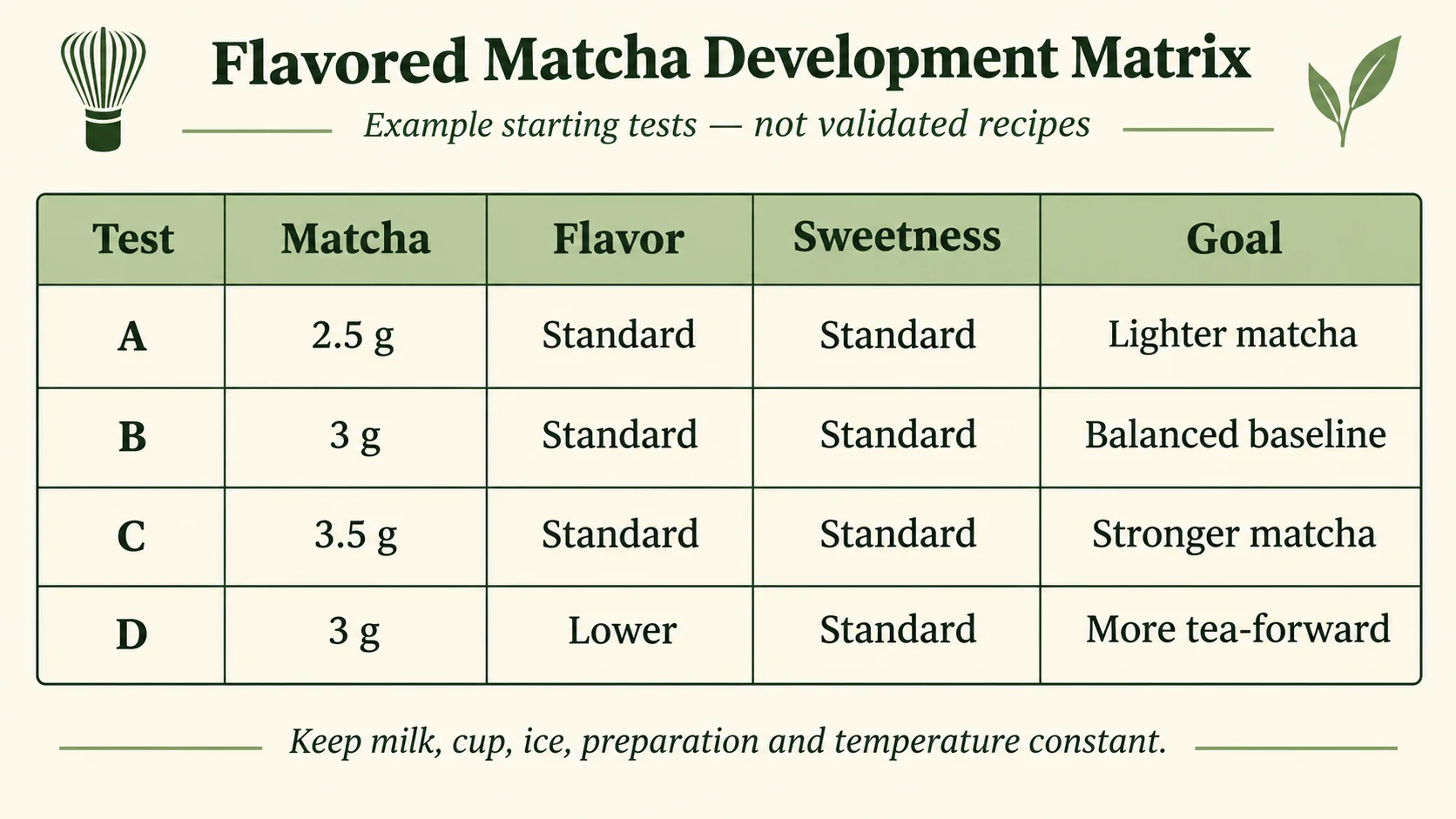
A Simple Flavored Matcha Development Matrix
Instead of approving one recipe immediately, compare several controlled versions.
The example doses below are development starting points only. Approve the final dose in the actual drink; these are not validated recipes.
| Test | Matcha | Flavor | Sweetness | Goal |
|---|---|---|---|---|
| A | 2.5 g | Standard | Standard | Lighter matcha |
| B | 3 g | Standard | Standard | Balanced baseline |
| C | 3.5 g | Standard | Standard | Stronger matcha |
| D | 3 g | Lower flavor | Standard | More tea-forward |
Keep unchanged:
- milk
- cup size
- ice
- preparation method
- flavor product
- serving temperature
Then evaluate:
- matcha visibility
- flavor intensity
- sweetness
- bitterness
- finished color
- aroma
- cost per serving
Changing one variable at a time produces much more useful information than repeatedly adjusting the entire drink.
Flavor Architecture Is More Useful Than Chasing Every Trend
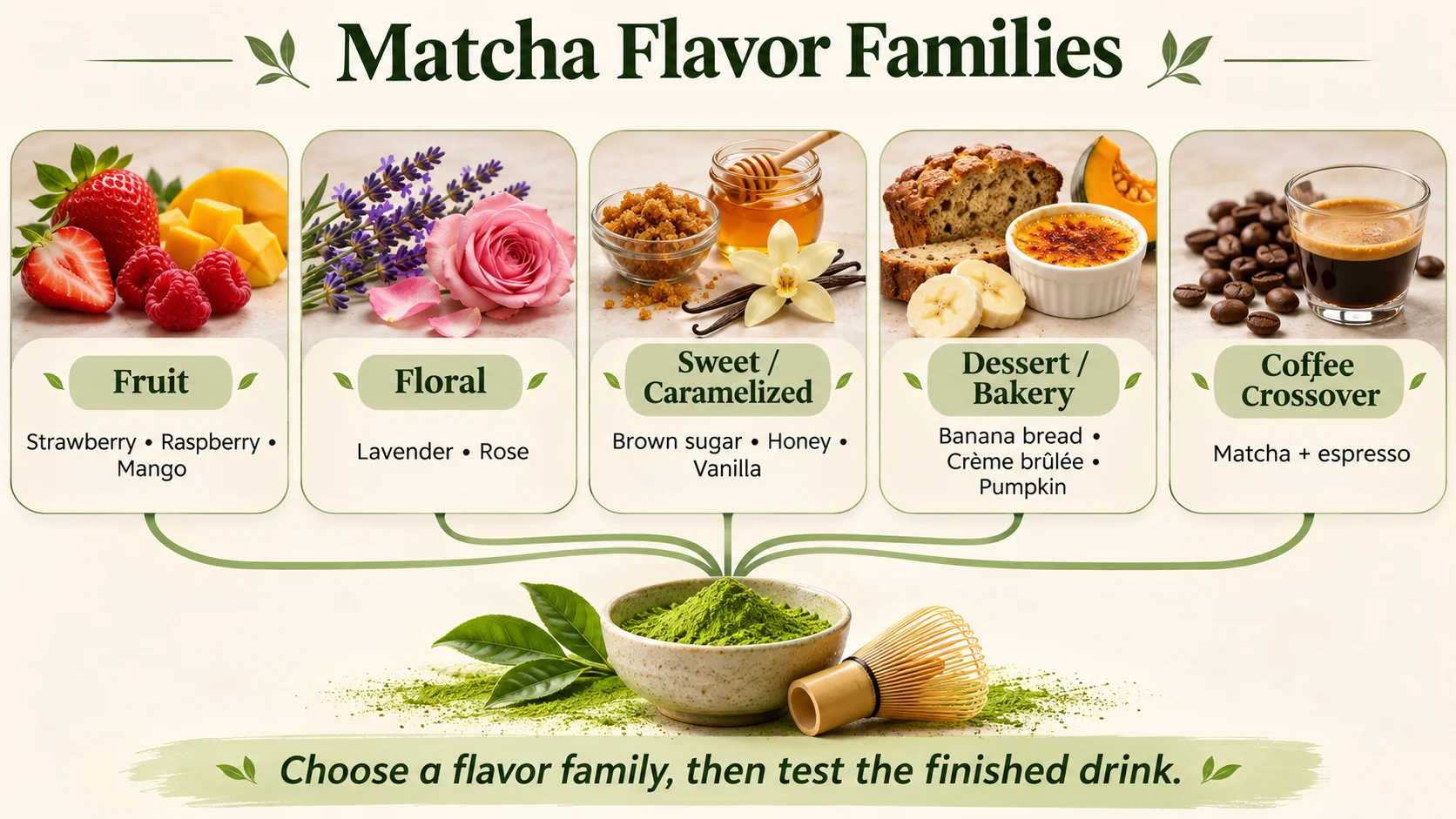
A café does not need 15 unrelated flavored matcha drinks.
A better approach is to build a small number of reusable flavor families.
Fruit
Examples:
Strawberry
Raspberry
Mango
Floral
Examples:
Lavender
Rose-style concepts where appropriate
Sweet / Caramelized
Examples:
Brown sugar
Honey
Vanilla
Dessert / Bakery
Examples:
Banana bread
Crème brûlée
Pumpkin cream
Coffee Crossover
Examples:
Dirty Matcha
Matcha + espresso
Once the café understands these families, it can reuse preparation components more intelligently.
For example:
one raspberry component could support:
raspberry matcha latte
raspberry cold foam
berry matcha seasonal drinks
Likewise:
one approved matcha cold foam can be paired with several base drinks.
This reduces operational complexity.
Café Components Are Becoming as Important as Complete Recipes
The rise of flavored matcha is not only creating more finished drinks.
It is creating reusable components.
Examples include:
- matcha cold foam
- fruit purée
- flavored cream foam
- brown sugar syrup
- matcha syrup or concentrate
- vanilla base
This matters because cafés can build multiple menu items from a smaller number of standardized components.
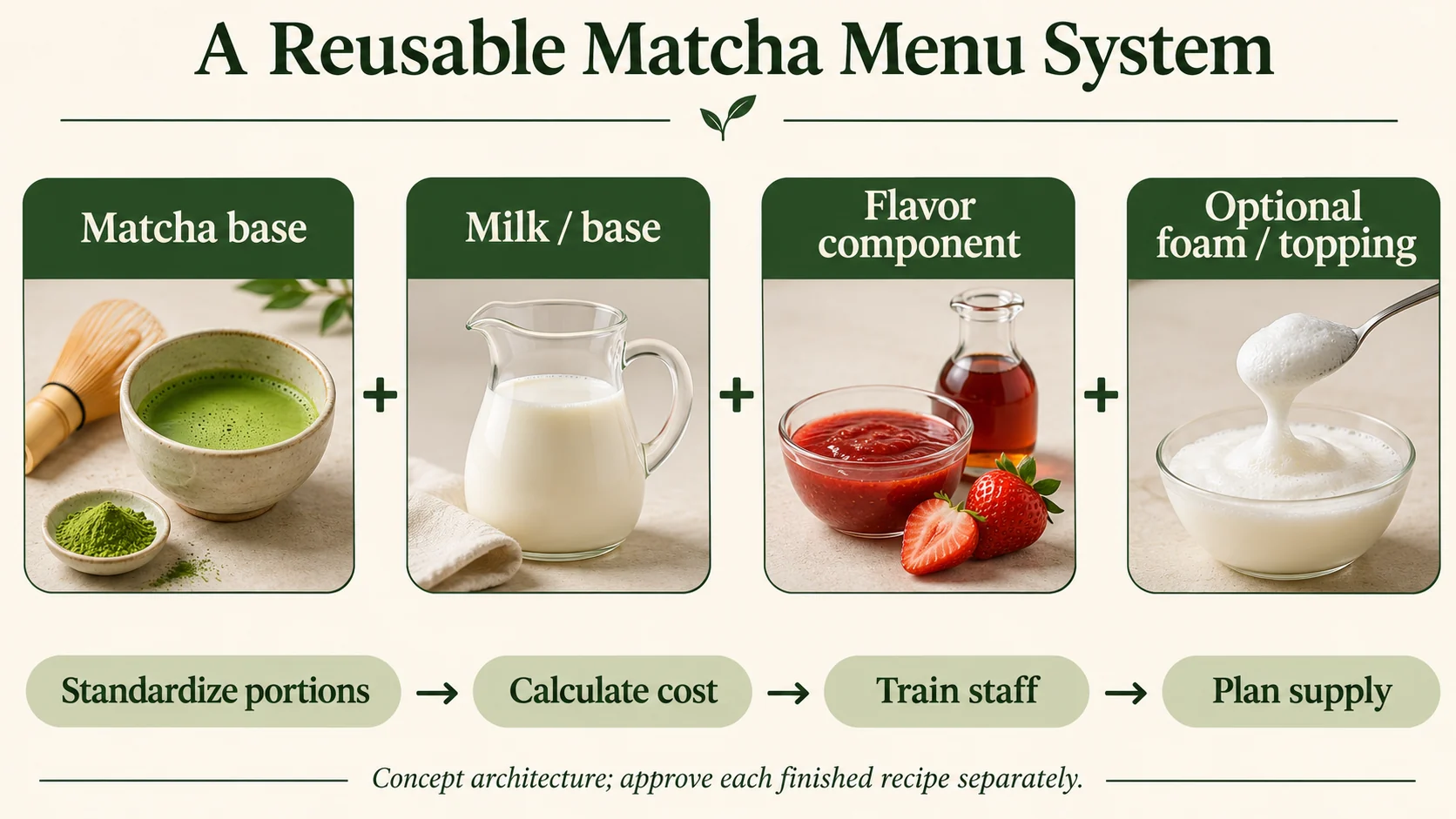
A well-designed café system might look like:
Matcha base
+
Milk
+
Flavor component
+
Optional foam/topping
That structure can improve:
- training
- service speed
- ingredient control
- seasonal menu development
It also makes recipe costing easier.
More Flavor Does Not Mean You Need More Matcha SKUs
A café with six flavored matcha drinks does not necessarily need six different matcha powders.
Often, one well-selected café profile can support several drinks.
A second premium profile may be useful for:
- matcha-forward signatures
- lighter-sweetened drinks
- premium menu positioning
The useful question is:
How many different approved applications can this profile support?
not:
How many different matcha products can we put behind the counter?
Reducing unnecessary SKU complexity can simplify purchasing and training.
Matcha Selection Changes With Flavor Intensity
The more ingredients added to a matcha drink, the more important finished-drink testing becomes.
A lightly sweetened latte may emphasize:
- aroma
- umami
- smoothness
A strawberry drink may emphasize:
- color through milk and fruit
- flavor persistence
- bitterness balance
A brown sugar drink may emphasize:
- matcha visibility through sweetness
- cost at the approved dose
A dirty matcha may emphasize:
- balance against roasted coffee flavors
There is no universal “best café matcha” independent of recipe.
That is why Matcha Origin Co. uses application-led sample evaluation.
Cost per Serving Becomes More Important as Recipes Get Complex
Flavored drinks contain more cost components than plain lattes.
Possible ingredients include:
- matcha
- milk
- fruit purée
- syrup
- cold foam
- cream
- toppings
- packaging
A café should therefore calculate the approved drink rather than only looking at matcha price per kilogram.
For matcha:
price per kg ÷ 1,000 × approved grams per drink
Then add the rest of the recipe.
This also helps determine whether an extra 0.5 g of matcha actually improves the drink enough to justify the additional cost.
Use the Matcha Cost Per Serving Calculator for menu planning.
What Café Buyers Should Ask Before Scaling a Flavored Matcha Menu
1. What Is the Core Matcha Profile?
Identify the product used across the menu.
2. What Is the Approved Dose?
Record grams per drink.
3. Which Flavor Components Are Shared?
Look for reusable syrup, fruit or foam systems.
4. Does Matcha Remain Noticeable?
Taste after the drink is fully mixed.
5. What Is the Cost Per Finished Drink?
Calculate all ingredients, not only matcha.
6. Can Staff Reproduce It?
Translate the recipe into measurable portions.
7. Can the Matcha Supply Scale?
Confirm commercial supply before the drink becomes a permanent menu item.
What Beverage Brands Can Learn From Café Flavor Trends
Cafés can test flavors faster than packaged beverage companies.
That makes café menus useful early indicators.
But beverage manufacturers should not directly copy a café formula into an RTD product.
A flavor that works at the counter still needs to be tested for:
- formulation
- processing
- stability
- packaging
- shelf-life
- commercial production
For the packaged-product side, see From Café to RTD: How Matcha Is Moving Into Packaged Beverages.
The relationship is:
Café trend → consumer signal → product-development concept → technical validation → commercial product
not:
popular café drink → immediately manufacture it.
How Matcha Origin Co. Approaches Flavored Beverage Development
For cafés and beverage brands, we recommend starting with the finished application.
Share:
- drink concept
- milk/base
- flavor ingredients
- sweetness target
- approximate matcha dose
- expected volume
- market
- target cost
Suitable matcha profiles can then be shortlisted.
The most useful comparison is the finished recipe rather than dry powder alone.
Explore Matcha for Lattes & Café Drinks →
Calculate Matcha Cost Per Serving →
Frequently Asked Questions
Is flavored matcha still growing in 2026?
There is evidence of continued product launches and menu expansion in 2026. These signals should not be treated as a single global flavored-matcha sales growth rate. Major café operators, retail brands and beverage companies continue adding flavored matcha products. Starbucks has expanded its matcha lineup across berry, banana bread, lavender, mango and pumpkin concepts, while retail brands including Kenco have launched flavored matcha products for mainstream grocery channels. Starbucks menu update; Kenco launch reporting; Starbucks spring; Starbucks fall menu
What are the most popular flavored matcha combinations?
Strawberry is one of the clearest mainstream combinations, while berry, vanilla, lavender, mango, brown sugar and dessert-inspired flavors are also appearing across café and packaged beverage launches. Specific popularity varies by market and measurement period. FoodNavigator / Spate; CHUH product range
Does a flavored matcha latte need ceremonial matcha?
Not necessarily. Commercial cafés should evaluate matcha according to finished color, flavor through milk and syrup, bitterness, required dose, consistency and cost per serving rather than grade wording alone.
Should cafés use pure matcha or matcha latte mix for flavored drinks?
Both can be used, but pure matcha gives greater control over sweetness and added flavors. A formulated latte mix may already contain sweetener or other ingredients, so review the ingredient list and final recipe before deciding.
How much matcha should be used in a flavored latte?
There is no universal dose. Test the same drink at several controlled matcha levels while keeping milk, flavor and sweetness constant. The correct dose is the one that produces the approved finished drink.
Should cafés follow every viral matcha flavor?
No. Social trends can provide ideas, but operators should prioritize flavors that fit their customer base, ingredient system, workflow, margin and brand positioning.
Can café trends be used for RTD beverage development?
Yes, as an innovation signal. However, packaged beverages require additional formulation, process, stability, packaging and shelf-life validation before scaling.
The Bigger Shift: Matcha Is Becoming a Flavor System
The most important 2026 trend is not strawberry matcha, lavender matcha or banana bread matcha by itself.
It is the fact that matcha can now support multiple flavor families and consumption occasions.
Starbucks’ year-round matcha lineup has expanded substantially since 2023, Kenco has taken flavored matcha into major UK supermarkets, and market data continues to show matcha growing on menus even as social attention becomes less explosive than its 2025 peak. Starbucks; Kenco reporting; Tastewise
That is what category maturity begins to look like.
For cafés and beverage brands, the opportunity is not to chase every green drink trend.
It is to build a controlled system:
Matcha profile → flavor family → standardized recipe → cost → service workflow → supply
When those pieces are documented, flavored matcha becomes more than a seasonal novelty.
It becomes a scalable beverage platform.