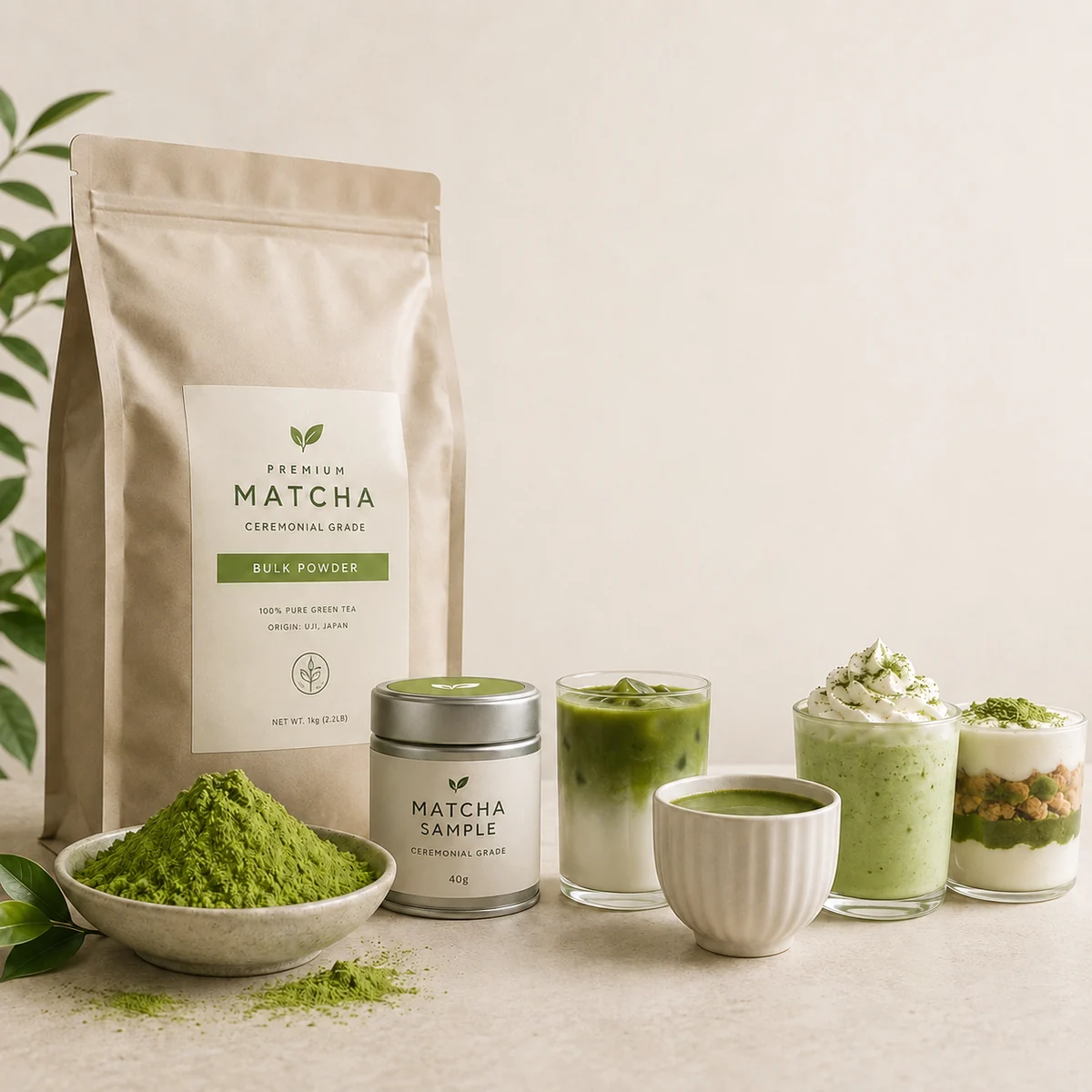
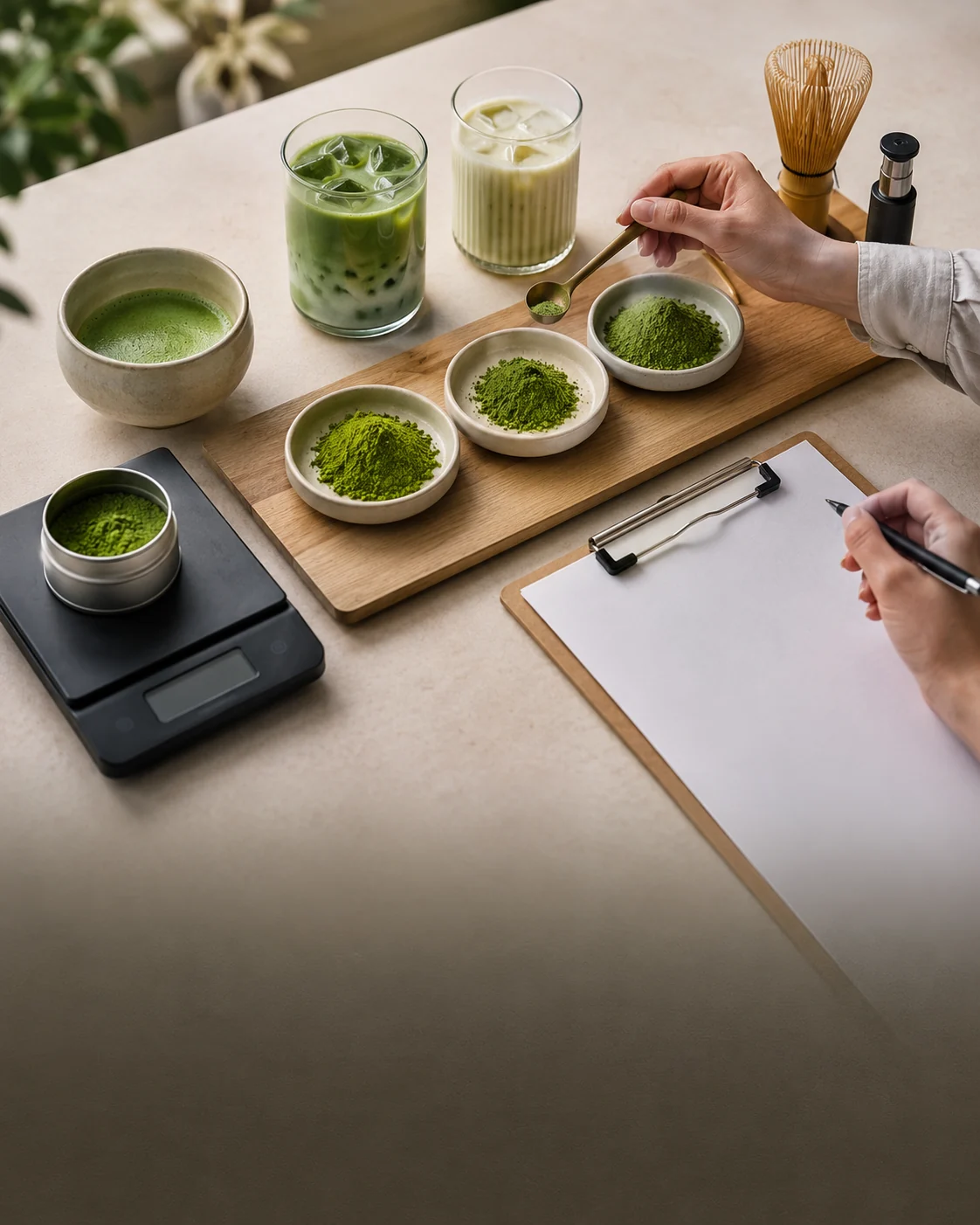
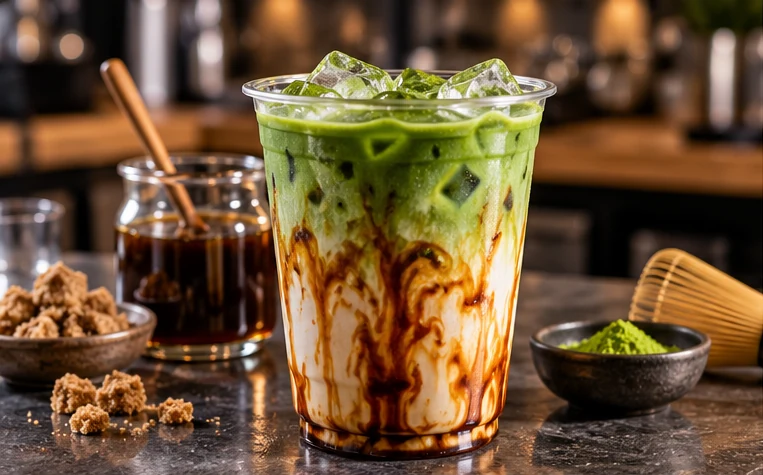
A brown sugar matcha latte combines matcha, milk and a caramel-like brown sugar syrup in a format that works well for both iced and hot café menus.
For commercial service, the important part is not simply adding brown sugar to a matcha latte. The recipe needs a consistent syrup concentration, repeatable matcha dose and approved milk-to-matcha ratio so every barista can reproduce the same drink.
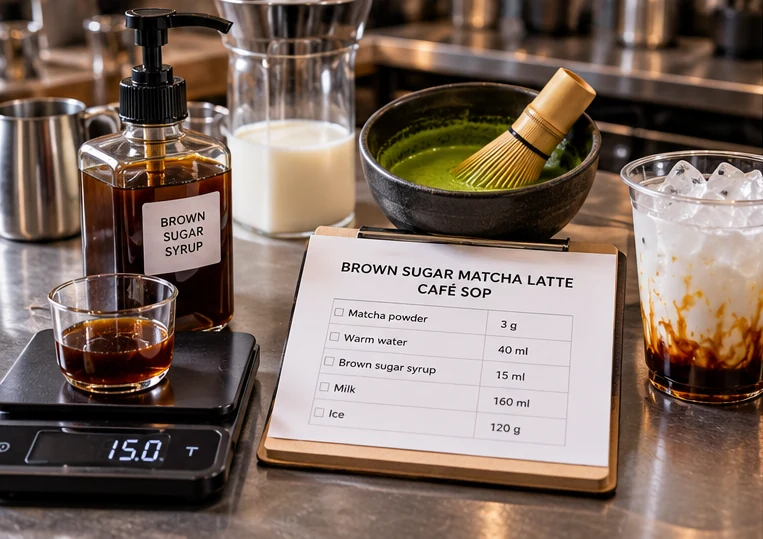
A practical starting point for one iced serving is 3 g matcha, 40 ml warm water, 15 ml brown sugar syrup and approximately 160 ml milk. Treat these numbers as a café development formula rather than a universal standard. Test the drink with your actual matcha, syrup, milk, cup and ice before approving it for service.
Iced Brown Sugar Matcha Latte: Starting Café Recipe
Yield: 1 drink
Suggested cup: approximately 450–500 ml
Starting matcha dose: 3 g
| Ingredient | Starting Amount |
|---|---|
| Unsweetened matcha powder | 3 g |
| Warm water | 40 ml |
| Brown sugar syrup | 15 ml |
| Cold milk | 160 ml |
| Ice | approximately 120 g |
Use water at approximately 70–80°C for preparing the matcha.
Use the 1:1 by-weight house syrup below as the initial test specification. Measure the finished syrup portion in milliliters; 15 ml is not interchangeable with 15 g. If your café uses a commercial brown sugar syrup or a more concentrated recipe, adjust the amount based on finished-drink sweetness rather than copying the same volume automatically.
How to Make an Iced Brown Sugar Matcha Latte
1. Add the brown sugar syrup
Measure the approved amount of brown sugar syrup into the serving glass.
For a visual brown-sugar effect, some cafés coat part of the inside of the glass with syrup before adding the other ingredients.
This is primarily a presentation choice. The final recipe should still be evaluated after stirring.
2. Add ice and milk
Add the ice, followed by approximately 160 ml of cold milk.
Keep the milk volume consistent during recipe development because changing the milk-to-matcha ratio can noticeably change tea intensity.
3. Prepare the matcha
Sift 3 g of matcha into a bowl or preparation vessel.
Add 40 ml of warm water and whisk until the matcha is fully dispersed and lightly frothy.
Avoid boiling water and make sure no dry powder remains.
4. Finish the drink
Pour the matcha slowly over the milk and ice.
For a more defined layered appearance, pour over the ice or over the back of a spoon.
Serve promptly and stir before evaluating the final flavor.
If you also use a sweetened matcha component, review our Matcha Syrup Recipe for Cafés before combining it with brown sugar syrup, so the finished drink does not receive duplicate sweetener portions.
House Brown Sugar Syrup for Café Testing
A café can use commercial brown sugar syrup or develop a simple house version.
For initial recipe development, a 1:1 ratio by weight provides an easy starting point:
| Ingredient | Starting Batch |
|---|---|
| Brown sugar | 200 g |
| Water | 200 g |
Combine the sugar and water in a saucepan.
Heat gently while stirring until the sugar is completely dissolved. Avoid prolonged high heat: evaporation changes concentration. This dissolution method does not create caramel. Record finished batch yield for consistency.
Cool the syrup using your normal food-safety procedures and transfer it to a clean, labeled container.
Do not assign a shelf life simply because the syrup contains sugar. Establish preparation, storage, holding and discard procedures appropriate to your ingredients, process and local requirements.
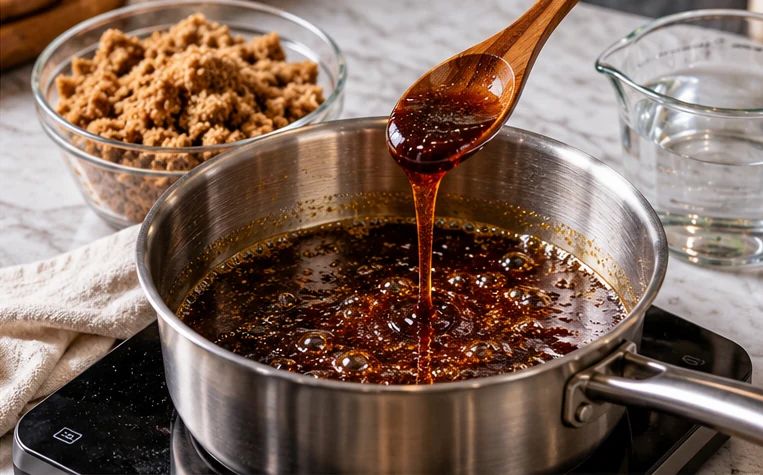
1:1 vs 2:1 Brown Sugar Syrup
Cafés do not have to use the same syrup concentration.
A 1:1 syrup contains equal weights of sugar and water. It is relatively fluid and easy to mix into cold drinks.
A 2:1 syrup uses approximately twice as much sugar as water. It is more concentrated and viscous.
These two syrups should not be compared using the same volume per drink.
For example, 15 ml of a more concentrated syrup can deliver substantially more sweetness than 15 ml of a lighter syrup.
If changing syrup concentration, rebuild the recipe around the new syrup instead of assuming it is a direct replacement.
For commercial consistency, record:
sugar type → sugar-to-water ratio → preparation method → syrup portion per drink
That creates a much more repeatable specification than telling baristas to add “brown sugar to taste.”
Brown Sugar Syrup vs Adding Brown Sugar Directly
Both methods can make a drink sweet, but they behave differently in café service.
Adding granulated brown sugar directly to warm matcha can work for a single hot drink because the sugar has an opportunity to dissolve.
For iced drinks, a prepared syrup is generally easier to portion and distribute consistently.
A syrup also makes it easier to:
standardize sweetness, use a pump or measured bottle, create visible syrup streaks and prepare multiple drinks during busy service.
The choice is operational rather than a quality ranking.
What Should a Brown Sugar Matcha Latte Taste Like?
Brown sugar adds a deeper caramel-like sweetness compared with plain simple syrup.
The goal is not to make the drink so sweet that the matcha disappears.
A balanced version should still have recognizable tea flavor after the milk and syrup are combined.
During development, evaluate:
- matcha flavor through milk
- brown sugar intensity
- overall sweetness
- bitterness and astringency
- body and texture
- finished color
- aftertaste
- cost per serving
Taste the fully mixed drink rather than judging only the visual layers.
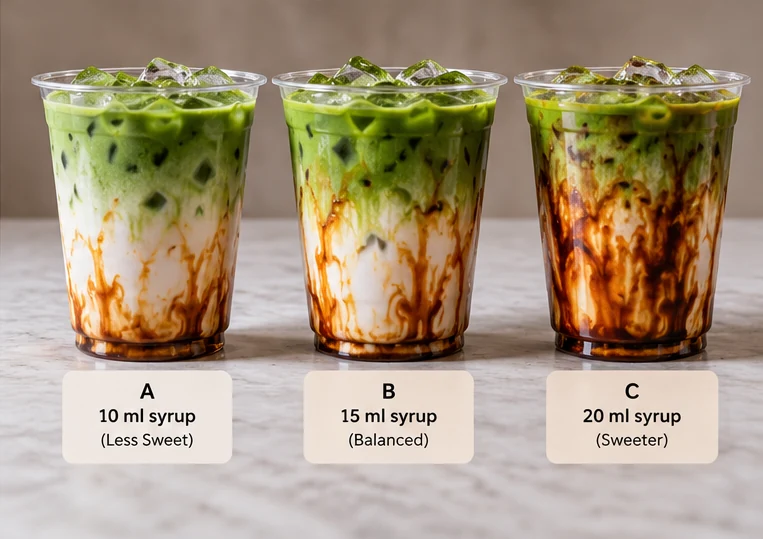
Café Recipe Testing Matrix
Start with one controlled formula and change one variable at a time.
| Test | Matcha | Brown Sugar Syrup | Milk | Objective |
|---|---|---|---|---|
| A | 3 g | 10 ml | 160 ml | Lower sweetness |
| B | 3 g | 15 ml | 160 ml | Balanced starting point |
| C | 3 g | 20 ml | 160 ml | Sweeter café profile |
| D | 3.5 g | 15 ml | 160 ml | Stronger matcha presence |
Do not change the matcha, syrup, milk and cup size simultaneously.
If the drink tastes too sweet, reduce syrup first.
If the sweetness is correct but the matcha disappears, compare matcha dose or another matcha profile.
If the drink feels too strong after stirring, reduce the matcha dose under otherwise identical conditions.
The purpose is to understand which variable caused the change.
How Much Matcha Should a Café Use?
This formula starts with 3 g per serving, but the final amount should be determined by the complete drink.
Matcha dosage can change with:
cup size, milk quantity, sweetness, syrup concentration, matcha profile and the level of tea intensity expected from the menu.
A café may find that one matcha performs well at 2.5–3 g while another needs a different dose to remain noticeable through milk and brown sugar.
The more useful comparison is therefore not simply:
Which matcha costs less per kilogram?
It is:
Which matcha gives the approved finished drink at a sustainable dose and cost per serving?
For a structured dosage test, see How Much Matcha Powder Should You Use for a Latte?
Hot Brown Sugar Matcha Latte
The same concept can be adapted to hot service.
A starting formula is:
| Ingredient | Starting Amount |
|---|---|
| Matcha | 3 g |
| Warm water | 40 ml |
| Brown sugar syrup | 15 ml |
| Steamed milk | 170–180 ml |
Prepare the matcha separately.
Mix the brown sugar syrup with the prepared matcha or the milk, then add steamed milk.
Taste the hot recipe independently from the iced version.
Temperature changes sweetness, aroma and how bitterness is perceived, so an approved iced formula should not automatically become the final hot formula.
10-Drink Café Service Planning
For purchasing and service planning, the iced starting formula scales approximately as follows:
| Ingredient | 1 Drink | 10 Drinks |
|---|---|---|
| Matcha powder | 3 g | 30 g |
| Water | 40 ml | 400 ml |
| Finished brown sugar syrup | 15 ml | 150 ml |
| Milk | 160 ml | 1.6 L |
| Ice | 120 g | 1.2 kg |
These totals help estimate ingredient requirements.
They are not a recommendation to prepare ten complete lattes or hold 400 ml of prepared matcha for extended service.
A café can prepare and standardize the brown sugar syrup separately while portioning milk and preparing matcha according to the approved workflow.
What Can Be Prepared Before Service?
The brown sugar syrup is the most obvious component to standardize ahead of service.
Once the recipe is approved, record:
the brown sugar product, syrup ratio, preparation method, finished portion per drink, storage procedure and portioning tool.
Milk can remain under the café’s normal refrigerated service system.
Matcha preparation depends on the operation.
If you are considering pre-batching any matcha component, validate:
color, dispersion, flavor, holding time and food-safety procedures under your actual café conditions.
Do not assume that a method that works for syrup also works for prepared matcha.
Pump Calibration Matters
If your café uses syrup pumps, measure the actual output.
“One pump” is not a universal measurement.
Dispensing volume varies by pump design, bottle and syrup viscosity.
During development:
weigh or measure the syrup delivered by one full pump, repeat several times, calculate the practical average, and record the approved number of pumps per drink.
This converts a recipe from:
add brown sugar syrup
into a repeatable café SOP.
Choosing Matcha for Brown Sugar Lattes
For profile selection across your milk-based menu, see matcha for lattes and café drinks and apply the same criteria to your brown sugar recipe.
A brown sugar matcha latte does not automatically require a ceremonial-positioned product.
Because the drink contains milk and a noticeable sweetener, evaluate matcha in the actual finished recipe.
Look for a profile that:
remains recognizable through milk and syrup, has acceptable bitterness at the approved dose, disperses consistently, produces the desired finished color and fits the target cost per serving.
A Café / Latte Matcha Profile may suit regular café service and higher-volume menus.
A Premium Latte Matcha Profile may be worth testing for signature drinks where stronger tea presence or premium positioning is important.
Test both using the same milk, syrup, dose and cup.
Price per Kilogram vs Cost per Drink
A cheaper kilogram price does not automatically mean a cheaper approved latte.
Calculate the matcha portion of each serving as:
price per kg ÷ 1,000 × grams used
Then add:
brown sugar syrup, milk, ice, packaging, garnish and normal preparation losses.
For example, compare a matcha that performs at 3 g with another that requires a larger dose to reach the same tea intensity.
The true commercial comparison is the finished drink.
Use the Matcha Cost Per Serving Calculator →
Example Café Costing Worksheet
Build a simple costing sheet with these fields:
| Cost Item | Input |
|---|---|
| Matcha cost per kg | Your current price |
| Approved matcha dose | g per drink |
| Syrup cost | per approved portion |
| Milk cost | per serving |
| Cup / lid | per serving |
| Ice / garnish | if material |
| Total ingredient + packaging cost | calculated total |
| Target menu price | café decision |
Do not use a recipe website’s ingredient costs as your own purchasing assumptions.
Use your real supplier prices.
Brown Sugar Matcha Latte Troubleshooting
The drink tastes mostly like brown sugar
Reduce the syrup while leaving matcha and milk unchanged.
Retest before increasing matcha.
The matcha disappears after stirring
Compare a slightly higher matcha dose or test another latte profile under the same recipe conditions.
The syrup sits at the bottom
Check syrup viscosity, concentration and how the drink is assembled.
A very concentrated cold syrup may mix differently from a lighter syrup.
The drink is too bitter
Do not assume more sweetener is the only solution.
Review matcha dose, matcha profile, water temperature, milk quantity and preparation method.
Every barista makes it differently
Convert subjective instructions into measurements.
Record grams, milliliters, pump output, cup size, milk quantity and matcha preparation.
Brown Sugar Matcha Latte With Oat Milk
Oat milk can work well with brown sugar because both can contribute a naturally sweeter impression.
However, oat milks vary considerably in sweetness, fat, body and formulation.
If your café offers both dairy and oat milk, evaluate them as separate finished drinks.
You may not need the same syrup amount for both.
Avoid assuming that switching milk requires no recipe adjustment.
Menu Positioning
Brown sugar matcha can work well as:
a permanent flavored latte, a premium iced matcha, a boba-compatible drink, a seasonal menu item or a higher-sweetness option alongside a classic matcha latte.
A simple customer-facing menu description could be:
Brown Sugar Matcha Latte
Matcha, milk and house brown sugar syrup served over ice.
If the syrup is genuinely made in-house, “house brown sugar syrup” can help communicate the preparation.
Avoid origin, health or ingredient claims that are not supported by the actual product.
Frequently Asked Questions
How much brown sugar syrup should I put in a matcha latte?
This café development formula starts with approximately 15 ml. The correct quantity depends on syrup concentration, matcha dose, milk volume and the sweetness level your menu is designed to deliver.
What ratio should I use for brown sugar syrup?
A 1:1 sugar-to-water ratio by weight is a practical starting point for a fluid café syrup. More concentrated syrups can also be used, but the portion per drink should be recalibrated.
Can I use dark brown sugar?
Yes. Different brown sugars can produce different molasses intensity, sweetness and color. Treat a change in sugar as a recipe change and reapprove the finished drink.
Is brown sugar matcha better with oat milk or dairy milk?
Neither is universally better. They produce different sweetness, texture and flavor balance. Test each milk with the same matcha and syrup before approving it for the menu.
Should cafés use ceremonial matcha for brown sugar lattes?
Not necessarily. For a milk-and-syrup drink, finished application performance is more useful than selecting from the ceremonial label alone. Compare tea flavor through milk, bitterness, color, dose and cost per serving.
Can brown sugar syrup be prepared in advance?
A café can standardize syrup production ahead of service, but storage, holding and discard procedures should be established for the actual recipe and operating environment. Do not copy an arbitrary shelf life from another recipe.
Can I batch the matcha for busy service?
Some cafés may explore batching, but it should be validated under real operating conditions. Monitor color, dispersion, sensory performance, holding time and food safety before adopting the method.
Turn the Recipe Into a Café SOP
A good brown sugar matcha latte is more than an attractive layered drink.
For commercial service, document:
Matcha profile → matcha dose → syrup specification → syrup portion → milk volume → cup size → preparation method → approved sensory result → cost per serving
That record makes training easier and gives the café a repeatable baseline when ingredients, staff or suppliers change.
Develop Your Café Matcha Menu
Brown sugar can make matcha approachable and commercially attractive, but the finished recipe still depends on the matcha underneath it.
Compare matcha samples in the approved milk and syrup recipe before scaling purchasing.
Matcha Origin Co. supports cafés and beverage brands with application-focused matcha profiles, evaluation samples and commercial supply.
Calculate Matcha Cost Per Serving →
Explore more café menu concepts:
Honey Lavender Matcha Latte Recipe for Cafés
Salted Vanilla Matcha Latte Recipe for Cafés