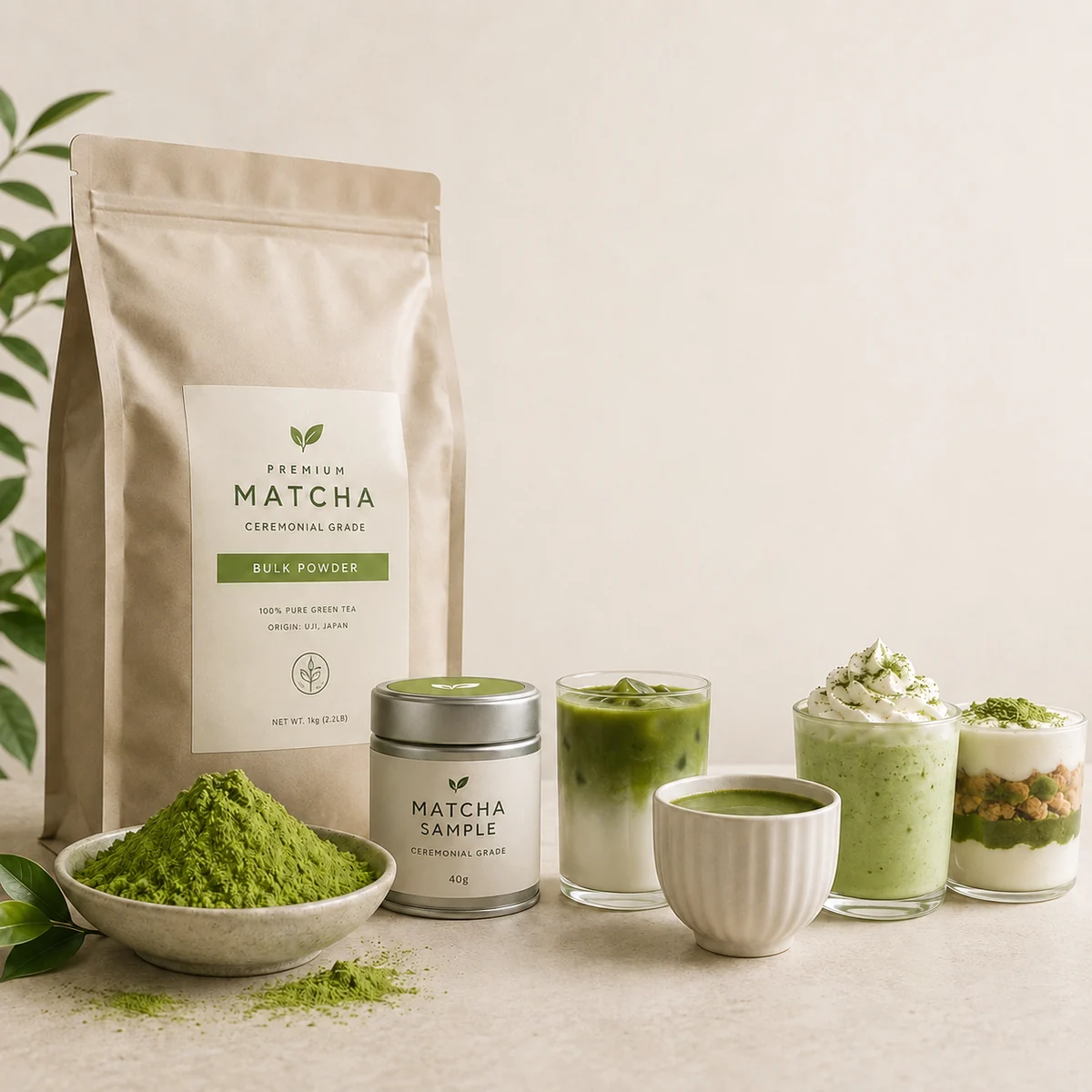
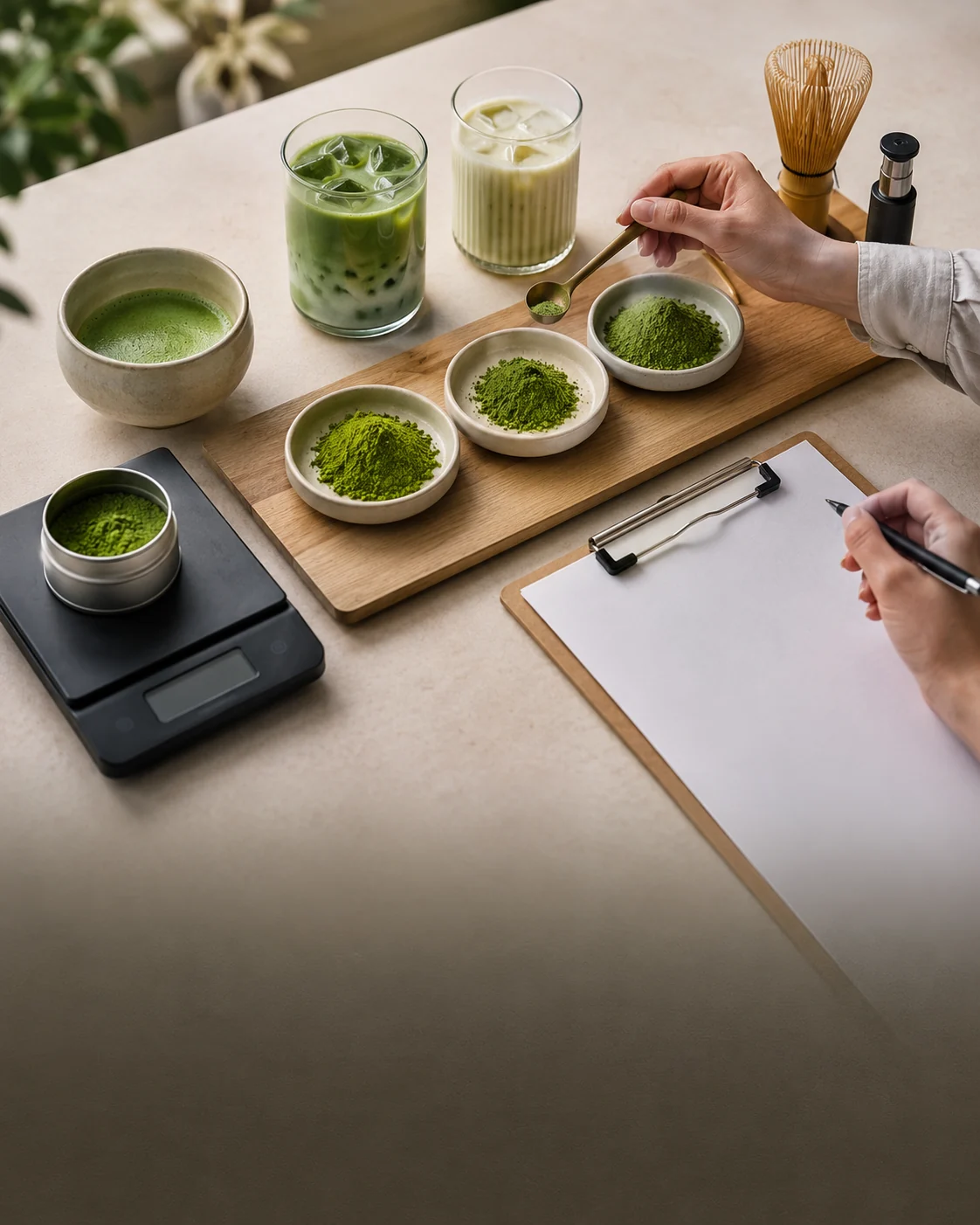
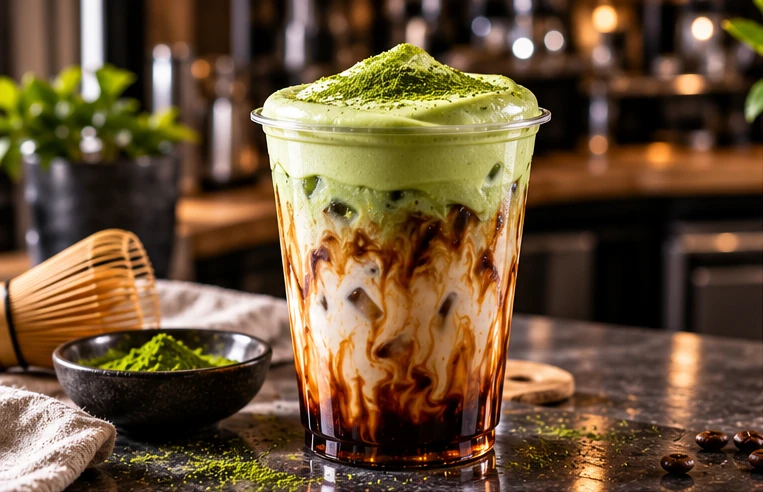
Matcha cold foam is a pourable, aerated topping made by combining matcha with a cold milk or cream base. For cafés, it can turn one matcha product into a reusable menu component for iced lattes, fruit matcha drinks, cold brew and seasonal beverages.
The important part is consistency.
A café needs to control the matcha dose, foam base, sweetener, frothing method and serving portion so the topping performs the same way from one drink to the next.
A practical starting point is 1.5 g matcha in approximately 50 ml of cold foam base per serving. This is a development formula rather than a universal standard. Test the finished foam with your own matcha, milk or plant-based base, equipment and drink underneath before approving it for service.
Matcha Cold Foam: Dairy Starting Recipe
Yield: approximately one café topping
Starting foam base: 50 ml
Starting matcha dose: 1.5 g
| Ingredient | Starting Amount |
|---|---|
| Matcha powder | 1.5 g |
| Heavy cream | 30 ml |
| Whole milk | 20 ml |
| Simple syrup | 8–10 ml |
Measurement note: The 50 ml base is cream plus milk, excluding 8–10 ml syrup. The starting liquid mixture is therefore approximately 58–60 ml before aeration; finished foam volume and usable portions must be measured.
The goal is a foam that is thick enough to sit on the drink but still pourable.
It should not become stiff like whipped cream.
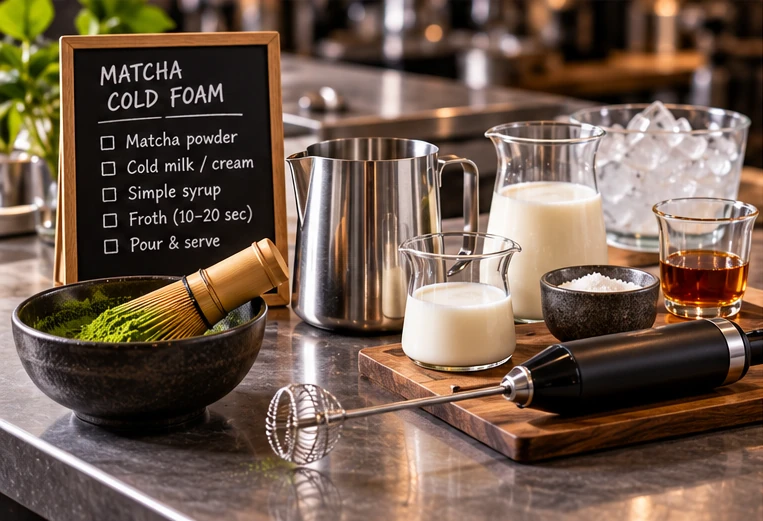
How to Make Matcha Cold Foam
1. Sift the matcha
Sift 1.5 g of matcha into a small preparation vessel.
This helps reduce dry clumps before liquid is added.
2. Pre-mix the matcha
Add a small amount of the milk and mix the matcha into a smooth concentrate.
Do not begin with a large volume of cold dairy if your matcha tends to clump.
The objective is to fully wet and disperse the powder before aerating the foam.
3. Add the remaining ingredients
Add the remaining milk, cream and syrup.
Keep the total quantities consistent during recipe development.
4. Froth
Use a handheld frother, spindle mixer or appropriate cold-foam function.
Froth only until the mixture becomes smooth, aerated and pourable.
Over-frothing can make the foam too stiff or cause the texture to become inconsistent.
5. Portion onto the drink
Pour or spoon the approved amount over the finished iced drink.
Evaluate both the foam itself and how it interacts with the beverage underneath.
Plant-Based Matcha Cold Foam Starting Recipe
A plant-based foam should be developed separately rather than treated as a direct copy of the dairy formula.
A practical test formula is:
| Ingredient | Starting Amount |
|---|---|
| Matcha powder | 1.5 g |
| Barista-style oat or cold-foam base | 50 ml |
| Simple syrup | 8–10 ml |
Use a plant-based product designed to foam if possible.
Different oat, soy and other plant-based products vary substantially in protein, fat, stabilizers and foaming performance.
Do not assume that changing only the milk will produce the same texture.
Approve the dairy and plant-based versions separately.
For the plant-based formula, 50 ml base plus 8–10 ml syrup likewise gives approximately 58–60 ml liquid before aeration. This is a separate development trial, not a claim of equivalent dairy and oat performance.
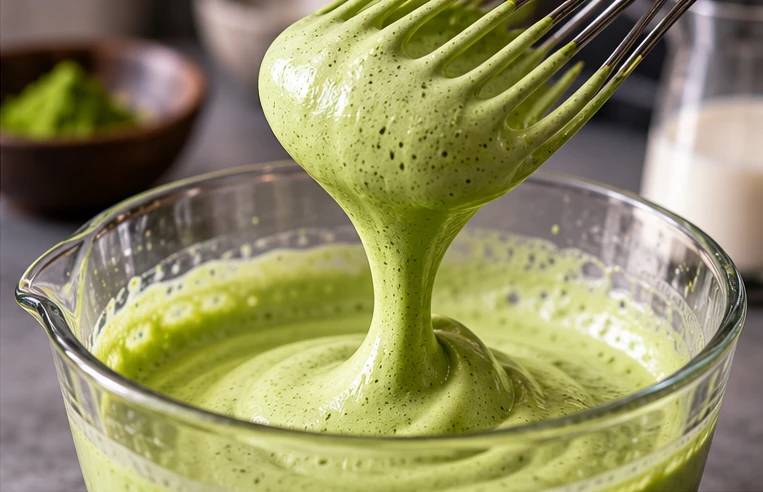
What Should Good Matcha Cold Foam Look Like?
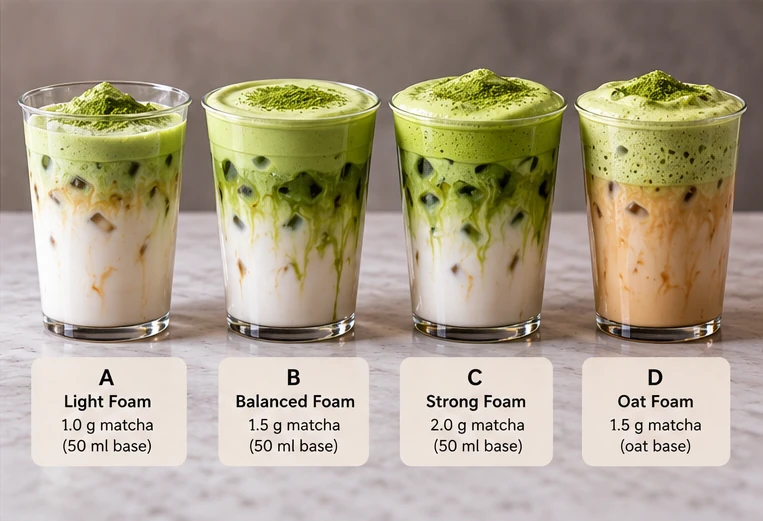
The photos illustrate menu concepts rather than a validated foam specification. Set the pourability and topping portion from your own development trials.
A café-ready cold foam should be:
- smooth
- evenly green
- free of visible dry matcha clumps
- aerated but still pourable
- stable long enough for normal service and drinking
- strong enough in matcha flavor to remain noticeable as a topping
It should not resemble dense whipped cream.
It also should not immediately disappear into the drink like ordinary milk.
The exact texture depends on the foam base and equipment, so create a visual and sensory standard for staff rather than relying only on a fixed frothing time.
How Much Matcha Should Go Into Cold Foam?
This formula starts with 1.5 g of matcha per 50 ml foam base.
That is a useful testing point, not a universal rule.
Test several levels under identical conditions:
| Test | Matcha | Foam Base | What to Evaluate |
|---|---|---|---|
| A | 1.0 g | 50 ml | Lighter matcha |
| B | 1.5 g | 50 ml | Balanced starting point |
| C | 2.0 g | 50 ml | Stronger matcha |
Evaluate:
- matcha flavor
- bitterness
- finished green color
- foam texture
- clumping
- interaction with the drink underneath
- total matcha cost per cup
A foam used on cold brew may need a different sensory target from a foam placed on top of an already matcha-forward latte.
The drink underneath matters.
Building the drink with a pre-mixed component? Our Matcha Syrup Recipe for Cafés explains portioning and how to account for sweetness and matcha across the syrup and foam.
Matcha Cold Foam on a Matcha Latte
If the drink already contains matcha, calculate the total matcha dose per finished cup.
For example:
Matcha in latte base + matcha in cold foam = total matcha per drink
Do not evaluate the foam dose completely separately from the main beverage.
A strong matcha latte with an equally strong matcha foam may taste very different from a fruit-and-milk drink topped with the same foam.
For structured latte testing, see How Much Matcha Powder Should You Use for a Latte?
10-Serving Dairy Matcha Cold Foam Batch
For café planning, the dairy starting formula scales to:
| Ingredient | 1 Serving | 10 Servings |
|---|---|---|
| Matcha | 1.5 g | 15 g |
| Heavy cream | 30 ml | 300 ml |
| Whole milk | 20 ml | 200 ml |
| Simple syrup | 8–10 ml | 80–100 ml |
This gives approximately 500 ml of liquid foam base before aeration, excluding the additional syrup volume.
The final usable volume depends on equipment and aeration.
Do not promise a fixed number of finished servings until you test the actual dispensing portion.
Batch the Base, Not the Guesswork
For a busy café, the goal is not simply to make a large container of foam.
The goal is to standardize:
matcha dose → foam base → sweetener → mixing order → frothing tool → frothing time → serving portion
Once approved, document each step.
If the café prepares a liquid foam base ahead of service, label it according to the operation’s normal food-safety procedures and keep temperature-controlled ingredients refrigerated as required.
Do not copy shelf-life claims from another recipe, supplier or commercial product and apply them automatically to your own dairy or plant-based formula.
Validate your own preparation and holding procedures.
Froth to Order vs Batch Frothing
There are two basic café workflows.
Froth to Order
Best for:
- lower-volume menus
- new recipe testing
- cafés with only occasional cold-foam orders
Advantages:
- fresh texture
- easier recipe adjustment
- less prepared product to manage
Disadvantage:
- additional preparation time per drink
Batch or High-Volume Frothing
Potentially useful for:
- busy service periods
- high-volume seasonal drinks
- operations using equipment designed for larger cold-foam batches
The café still needs to test:
- texture over time
- separation
- color
- matcha settling
- portion consistency
Operational speed should not come at the cost of an unstable product.
Hand Frother, Spindle Mixer or Blender?
Different tools create different textures.
Hand Frother
Useful for small servings and recipe development.
It is inexpensive and easy to control, but adds labor to every drink.
Spindle Mixer
Potentially faster for café service and easier to standardize when staff use a fixed vessel and time.
Blender or Cold-Foam Program
More useful when preparing several servings at once.
Do not assume an ordinary blender setting will produce the same foam as equipment specifically designed to aerate liquids.
Whatever tool you select, standardize:
- starting volume
- temperature
- container
- mixing time
- finished texture
Why Matcha Cold Foam Gets Clumpy
Matcha does not dissolve like sugar.
It disperses through liquid.
Dry particles can remain visible when matcha is added directly to a large amount of cold foam base without being properly incorporated.
To reduce clumping:
- sift the matcha
- pre-mix it with a small amount of liquid
- create a smooth concentrate
- add the remaining foam base
- aerate only after the matcha is dispersed
If clumps remain, solve the dispersion problem before increasing frothing time.
More air does not automatically fix poorly dispersed matcha.
Why Matcha Cold Foam Collapses
Cold foam stability can change because of:
- foam base composition
- temperature
- fat level
- protein level
- syrup amount
- matcha concentration
- frothing method
- over-frothing
- holding time
If the foam collapses quickly, do not immediately add more matcha or syrup.
Return to a controlled baseline and test the foam base first.
Record every change.
Why the Foam Is Too Thick
A cold foam should generally remain pourable.
If the texture resembles whipped cream:
- reduce frothing time
- review the cream-to-milk ratio
- check whether the base is excessively cold or concentrated
- evaluate whether too much stabilizing or high-fat ingredient is being used
The target is a soft foam that floats over the drink and gradually integrates as the customer drinks.
Why the Foam Is Too Thin
If the foam behaves like ordinary milk:
- confirm the base is cold
- test the correct frothing tool
- review the milk or plant-based product
- check the starting ratio
- verify that syrup or other ingredients are not reducing foam performance
For plant-based recipes, try a product specifically designed for barista or cold-foam use rather than assuming every plant milk will perform identically.
Matcha Cold Foam Café Testing Matrix
A café can compare the component systematically.
| Test | Matcha | Base (excluding syrup) | Syrup | Evaluate |
|---|---|---|---|---|
| A | 1.0 g | 50 ml dairy base: 30 ml cream + 20 ml milk | 8 ml | Light tea profile |
| B | 1.5 g | 50 ml dairy base: 30 ml cream + 20 ml milk | 8 ml | Balanced baseline |
| C | 2.0 g | 50 ml dairy base: 30 ml cream + 20 ml milk | 8 ml | Stronger matcha |
| D | 1.5 g | 50 ml barista-style oat or cold-foam base | 8 ml | Plant-based performance |
Record:
- foam height
- pourability
- texture
- green color
- matcha flavor
- bitterness
- separation
- cost per portion
Do not change the matcha, syrup, foam base and equipment simultaneously.
Drinks That Can Use Matcha Cold Foam
This is where cold foam becomes commercially useful.
One approved component can support several menu drinks.
Strawberry Matcha Latte
A strawberry-and-milk base can be topped with matcha cold foam instead of placing all the matcha in the drink itself.
Raspberry Matcha Latte
The tart berry profile creates strong visual and flavor contrast with green matcha foam.
Brown Sugar Milk or Brown Sugar Latte
Matcha cold foam can add a green-tea layer to a brown-sugar drink without rebuilding the entire recipe.
Salted Vanilla Drinks
A lightly salted vanilla milk base can be paired with matcha foam for a different presentation.
Cold Brew Coffee
Matcha cold foam can create a coffee-and-matcha crossover menu item.
Iced Tea or Chai
Test the foam against the sweetness and spice level of the base drink before launch.
Matcha Cold Foam vs Matcha Latte
They serve different functions.
A matcha latte distributes matcha throughout the drink.
A matcha cold foam topping concentrates matcha near the top of the beverage and changes how the first sips are experienced.
That makes cold foam useful for:
- visual layering
- menu modifiers
- adding matcha to non-matcha beverages
- seasonal beverage development
- premium toppings
Do not assume the same matcha dose should be used for both formats.
Choosing Matcha for Cold Foam
For a broader milk-based menu evaluation, review our matcha for lattes and café drinks guide before selecting a profile.
Cold foam does not automatically require the highest-priced matcha.
For commercial use, evaluate:
- flavor at the approved foam dose
- bitterness
- green appearance
- dispersion
- interaction with dairy or oat base
- consistency
- cost per serving
A Café / Latte Matcha Profile may be suitable for regular menu use.
A Premium Latte Matcha Profile may be worth testing when the matcha foam is a visible signature component and the tea character needs to remain stronger.
Evaluate both using the same foam recipe.
Matcha Cost per Cold Foam Portion
Calculate matcha cost with:
price per kg ÷ 1,000 × grams of matcha per foam portion
Then add:
- milk or plant-based base
- cream
- syrup
- additional flavorings
- normal preparation loss
If cold foam is added as a paid modifier, compare the full ingredient cost with the menu upcharge.
Do not evaluate margin using matcha cost alone.
Use the Matcha Cost Per Serving Calculator →
Portion Control Matters
Once the foam is approved, determine how much finished foam goes onto one drink.
Do not let one barista add 30 ml and another add 80 ml.
Use an appropriate portioning method:
- measured pitcher
- marked cup
- dispensing bottle
- calibrated pump or system
- weight during recipe development
The serving portion should become part of the café SOP.
Matcha Cold Foam SOP Example
A finished café recipe card should include:
Matcha: 1.5 g
Foam base: approved dairy or plant-based formula
Sweetener: approved ml
Pre-mixing: defined method
Frothing tool: defined equipment
Frothing time: tested range
Finished portion: approved amount per drink
Drink pairing: approved menu item
Holding procedure: café-specific validated procedure
This is more useful operationally than a recipe that only says “froth until creamy.”
Frequently Asked Questions
How much matcha should I use in cold foam?
A useful development starting point is around 1.5 g in approximately 50 ml of foam base. Test lower and higher doses under the same conditions before approving the final café formula.
Can matcha cold foam be made with oat milk?
Yes, but plant-based products vary in foaming performance. Use an appropriate barista or cold-foam product and validate the plant-based formula separately from the dairy version.
Can matcha cold foam be prepared ahead?
A café may standardize a liquid foam base or other preparation workflow, but holding time and storage must be validated for the actual ingredients and operating conditions. Do not automatically apply another company’s shelf-life recommendation to your recipe.
Why is my matcha cold foam clumpy?
Matcha may not have been fully dispersed before frothing. Sift the powder and pre-mix it with a small amount of liquid before combining it with the complete foam base.
Why does my cold foam disappear into the drink?
The base, temperature, ingredient ratios or frothing method may not be creating enough stable aeration. Return to a controlled recipe and test one variable at a time.
Can I put matcha cold foam on coffee?
Yes. Cold brew or iced coffee with matcha foam can create a coffee-matcha crossover beverage. Test sweetness, coffee intensity and matcha dose together.
Should I use ceremonial matcha for cold foam?
Not necessarily. Because cold foam contains milk, cream or a plant-based base and often sweetener, evaluate the finished component rather than selecting only from a ceremonial label.
Turn Matcha Cold Foam Into a Reusable Café Component
The commercial value of matcha cold foam is not limited to one drink.
Once a café has approved the:
matcha → foam base → sweetness → frothing method → portion → cost
the same component can be tested across multiple menu concepts.
That allows one matcha product to support a broader beverage program without creating an entirely new preparation system for every drink.
Matcha Origin Co. supports cafés and beverage brands with application-focused matcha samples and commercial supply.
Calculate Matcha Cost Per Serving →
Try matcha cold foam with:
Strawberry Matcha Latte Recipe for Cafés
Raspberry Matcha Latte Recipe for Cafés