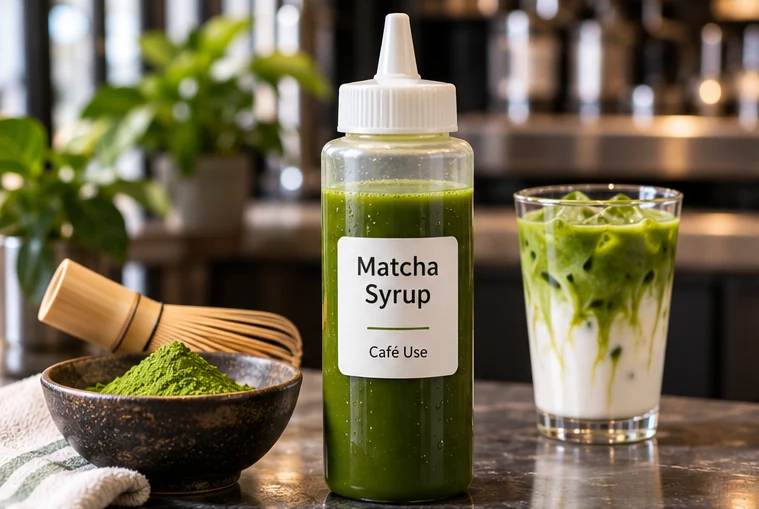
Matcha syrup is a sweetened matcha concentrate designed to help cafés portion matcha more consistently during busy service.
Instead of whisking matcha, water and sweetener separately for every drink, a café can test a pre-mixed matcha syrup that delivers a known amount of matcha and sweetness in one measured portion.
For commercial use, the important questions are not simply:
How do I make matcha syrup?
They are:
How much matcha does each portion contain? Does the syrup stay evenly dispersed? Can staff portion it consistently? Does it still taste good in the finished drink? And does the workflow actually save time?
The formula below is a café development starting point, not a universal industry standard. Test it with your actual matcha, sweetener, equipment, drink recipe and service conditions before adding it to your café SOP.
Matcha Syrup vs Matcha Concentrate
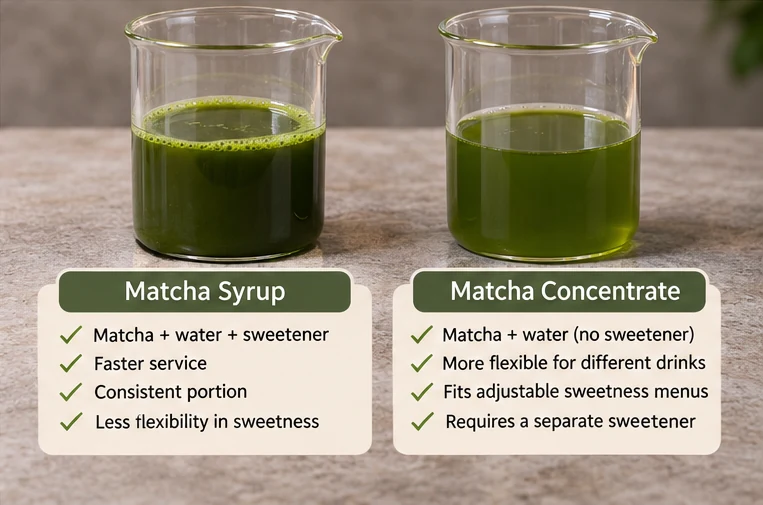
These terms are often used interchangeably, but they are not exactly the same.
Matcha Concentrate
A matcha concentrate is usually:
matcha + water
It is unsweetened and allows the café to control syrup or other sweeteners separately.
Matcha Syrup
A matcha syrup combines:
matcha + water + sweetener
The sweetener is already built into the component.
This can make service faster, but it also means the café has less flexibility to change sweetness without changing the amount of matcha delivered.
For cafés that offer multiple sweetness levels, an unsweetened concentrate may be more practical.
For cafés that sell a standardized signature drink, a sweetened matcha syrup can simplify the workflow.
Neither system is automatically better.
Choose the one that matches your menu.
Café Matcha Syrup: Starting Formula
This formula is designed to deliver approximately 3 g of matcha per serving.
10-Drink Test Batch
| Ingredient | Starting Amount |
|---|---|
| Matcha powder | 30 g |
| Warm water | 240 g |
| 1:1 simple syrup | 150 g |
| Approximate finished batch | 420 g |
Starting portion per drink: approximately 42 g
At this portion size, each serving contains approximately:
- 3 g matcha
- 24 g added water
- 15 g simple syrup
Small differences can occur from product left behind in bowls, bottles or mixing equipment.
Measure the actual finished yield before turning the formula into an operating standard.
How to Make Matcha Syrup
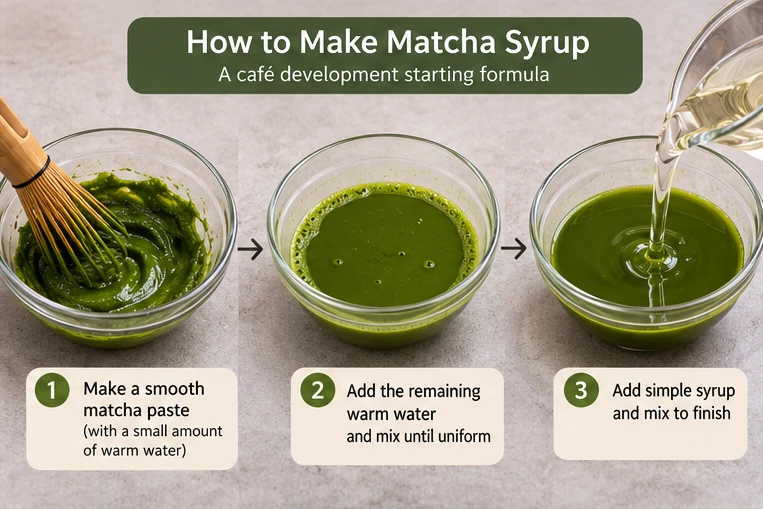
1. Sift the matcha
Sift 30 g of matcha into a clean mixing vessel.
Do not skip this step simply because the batch will later be mixed mechanically.
Sifting reduces larger dry clumps and makes the first hydration step easier.
2. Make a smooth matcha paste
Do not pour all 240 g of water into the matcha immediately.
Add a small portion of the warm water first and mix until the matcha forms a smooth, lump-free paste.
The goal is to fully wet the powder.
Matcha is a suspension rather than a sugar-like ingredient that completely dissolves in water.
Good dispersion matters.
3. Add the remaining water
Add the rest of the warm water gradually while whisking or blending.
Keep the mixing method consistent from batch to batch.
4. Add the simple syrup
Add 150 g of prepared 1:1 simple syrup.
Mix until the batch is visually uniform.
5. Measure the finished yield
Weigh the complete batch.
Do not assume the theoretical total equals the usable total.
Some syrup will remain on the whisk, blender, vessel or transfer container.
Record the real yield.
6. Transfer to a service container
Transfer the finished matcha syrup to a clean food-service container or bottle appropriate for your operation.
Label and handle it according to your café’s food-safety procedures.
If the batch will be refrigerated, make sure the container and workflow fit your established temperature-control system.
Do not assign a shelf life simply because another café or online recipe gives one.
Why Matcha Syrup Settles
This is one of the most important things for cafés to understand.
Matcha does not completely dissolve.
Fine tea particles remain suspended in the liquid and can gradually settle.
Sweetener does not eliminate this behavior.
A bottle of matcha syrup that looks uniform immediately after mixing may show sediment later.
That does not automatically mean the matcha is poor quality.
It means the component is a suspension.
Your SOP should therefore specify whether the syrup needs to be:
- shaken
- stirred
- remixed
- gently inverted
before portioning.
Test the actual product and container.
Why Matcha Syrup Gets Clumpy
Clumping usually begins during the first hydration stage.
Adding dry matcha directly into a large volume of liquid can leave pockets of powder that are difficult to break apart later.
A better sequence is:
sift → make paste → add water gradually → add syrup
If clumps remain, solve the dispersion problem first.
Increasing sweetness does not fix poor dispersion.
Neither does simply blending for a very long time.
What Temperature Should the Water Be?
For café recipe development, a practical starting range is approximately 70–80°C.
The water needs to be warm enough to help disperse the powder, but there is usually no operational reason to pour aggressively boiling water directly onto the matcha.
Use the same temperature during comparison tests.
Otherwise you introduce another variable into the recipe.
1:1 Simple Syrup for Matcha Syrup
A 1:1 simple syrup means:
equal weights of sugar and water
For example:
| Ingredient | Amount |
|---|---|
| Sugar | 100 g |
| Water | 100 g |
Heat only enough to dissolve the sugar completely.
Cool according to your café’s food-handling procedures before combining with matcha if the workflow requires it.
Once the recipe is approved, record the exact:
sugar type → syrup ratio → matcha ratio → portion size
Do not let individual baristas recreate the syrup by eye.
Can You Make a Stronger Matcha Syrup?
Yes, but stronger does not automatically mean better.
You could increase the matcha concentration and reduce the portion used per drink.
That may reduce the amount of additional water introduced into the finished beverage.
However, a more concentrated matcha mixture can also be:
- harder to disperse
- more prone to visible settling
- harder to pump
- more difficult to portion accurately
- stronger in bitterness at small measurement errors
If you test a concentrated version, compare it against the baseline using the same final matcha dose per drink.
For example:
a 30 g portion containing 3 g matcha
should be compared against:
a 42 g portion containing 3 g matcha
The finished drink—not the apparent strength of the bottle—is what matters.
Matcha Syrup Café Testing Matrix
A café can test several versions while keeping the final matcha dose consistent.
| Test | Matcha per Drink | Syrup Sweetness | What to Evaluate |
|---|---|---|---|
| A | 3 g | Low | Matcha-forward |
| B | 3 g | Medium | Balanced baseline |
| C | 3 g | Higher | Sweeter café profile |
| D | 2.5 g | Medium | Lower tea dose |
Evaluate:
- matcha flavor through milk
- sweetness
- bitterness
- green color
- sediment
- clumping
- portion accuracy
- speed of service
- cost per drink
Do not approve the syrup in isolation.
Test it in the actual menu drink.
Matcha Syrup for an Iced Latte
A simple starting build could be:
| Ingredient | Amount |
|---|---|
| Matcha syrup | approximately 42 g |
| Cold milk | 160–180 ml |
| Ice | as required |
Pour the matcha syrup over the milk and ice, or mix it fully depending on the presentation.
If you use a layered build, evaluate the drink again after stirring.
The visual layer is not the same thing as the final flavor.
Matcha Syrup for Flavored Lattes
This is where the component becomes useful—but also where sweetness control becomes important.
If the matcha syrup already contains sugar and the drink also contains:
- strawberry purée
- raspberry syrup
- brown sugar syrup
- vanilla syrup
- honey
- flavored cold foam
the final beverage can become overly sweet very quickly.
For flavored drinks, you may need to:
reduce the sugar in the matcha syrup
or switch to an unsweetened matcha concentrate.
The component should support the menu system rather than force every drink into the same sweetness level.
Matcha Syrup and Brown Sugar Matcha
A brown sugar matcha latte already contains a significant sweetener component.
Using a sweetened matcha syrup plus brown sugar syrup may create unnecessary duplication.
For this drink, compare:
unsweetened matcha concentrate + brown sugar syrup
against:
lighter-sweetened matcha syrup + reduced brown sugar syrup
Use the finished drink to decide.
See our Brown Sugar Matcha Latte Recipe for Cafés for a complete menu-development example.
Matcha Syrup and Matcha Cold Foam
Matcha syrup can also be used in combination with cold foam, but calculate the total matcha and sweetness across the whole drink.
For example:
matcha syrup in drink + matcha in cold foam = total matcha per serving
A café can unintentionally double both the matcha cost and the sweetness if each component is developed separately.
Treat the completed beverage as one formulation.
See our Matcha Cold Foam Recipe for Cafés for cold-foam testing guidance.
For a structured dose comparison, see How Much Matcha Powder for a Latte.
20-Drink Café Batch
Once the 10-drink formula is approved, the starting quantities can be doubled:
| Ingredient | 10 Drinks | 20 Drinks |
|---|---|---|
| Matcha | 30 g | 60 g |
| Warm water | 240 g | 480 g |
| 1:1 simple syrup | 150 g | 300 g |
| Theoretical total | 420 g | 840 g |
Do not automatically scale beyond this simply because the math is easy.
Larger batches should be tested for:
- dispersion
- sediment
- mixing consistency
- service speed
- real yield
- holding behavior
- food-safety workflow
A 50-drink batch introduces different operational issues from a 10-drink test batch.
How Much Matcha Syrup Should Go in One Drink?
Do not set the serving portion by eye.
The portion needs to correspond to a known matcha dose.
In the starting formula:
approximately 42 g syrup = approximately 3 g matcha
If you change the batch ratio, recalculate the matcha per portion.
The best service instruction is not:
Add one splash of matcha syrup.
It is:
Add the approved measured portion containing the approved matcha dose.
Scale, Jigger or Pump?
Scale
Best for recipe development.
A scale makes it easy to verify whether every test drink receives the intended amount.
Jigger or Measured Cup
Useful when the syrup is sufficiently fluid and staff can pour consistently.
Pump
Potentially fast during busy service, but pumps need calibration.
“One pump” is not a universal unit.
Output depends on:
- pump model
- syrup viscosity
- bottle
- temperature
- product settling
If using a pump, measure multiple full pumps and calculate the practical average output.
Also confirm that the matcha suspension does not clog the pump or create inconsistent dosing.
Why Pump Calibration Matters
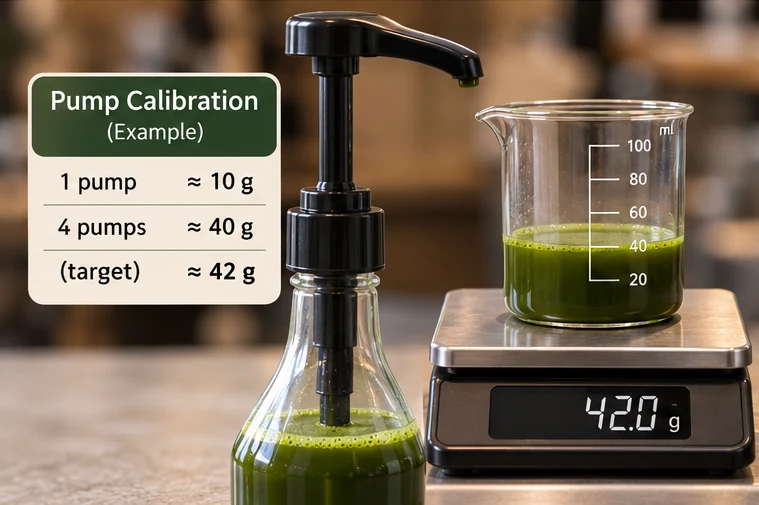
Imagine the approved recipe requires 42 g of matcha syrup.
If one pump dispenses 8 g, another 10 g and another 12 g, telling staff to use “four pumps” creates three different drinks.
During recipe development:
- tare a container on a scale
- dispense one full pump
- record the weight
- repeat several times
- calculate the practical average
- determine the approved number of pumps
Repeat the test when the pump, bottle or syrup concentration changes.
Matcha Syrup vs Whisking to Order
Pre-batching is not always better.
Whisk to Order
Advantages:
- fresh preparation
- flexible sweetness
- easier premium positioning
- no batch-holding workflow
Disadvantages:
- more preparation time
- more individual variation if staff are not standardized
Matcha Syrup
Advantages:
- faster portioning
- built-in sweetness
- easier high-volume workflow
- one component can support multiple drinks
Disadvantages:
- settling
- less sweetness flexibility
- batch-management requirements
- potential quality changes during holding
The right workflow depends on drink volume and menu design.
Matcha Syrup vs Unsweetened Matcha Concentrate
This distinction matters for commercial menus.
Choose sweetened matcha syrup when:
- sweetness is standardized
- the drink is designed around one consistent formula
- speed is a priority
Choose unsweetened concentrate when:
- customers can adjust sweetness
- multiple flavored syrups are used
- the café wants matcha and sweetener controlled separately
Some cafés may use both systems for different menu items.
How to Choose Matcha for Syrup
The best matcha for syrup is not automatically the most expensive matcha.
Because the component will often be mixed with milk and sweetener, evaluate:
- tea flavor through milk
- bitterness
- color
- dispersion
- sediment
- dose required
- consistency
- cost per serving
A Café / Latte Matcha Profile may be appropriate for everyday drinks.
A Premium Latte Matcha Profile may be worth testing for signature drinks where the tea character needs to remain stronger.
Compare samples under the same syrup and drink conditions.
Calculate Matcha Cost per Syrup Portion
The matcha portion is calculated as:
matcha price per kg ÷ 1,000 × grams of matcha per drink
If the approved dose is 3 g:
multiply the cost per gram by 3.
Then add:
- sugar
- syrup preparation loss
- milk
- flavoring
- cup and lid
- ice
- cold foam or toppings
The kilogram price alone does not tell you the true menu cost.
Use the Matcha Cost Per Serving Calculator →
Does a Cheaper Matcha Always Make a Cheaper Syrup?
No.
Suppose one matcha is less expensive per kilogram but needs a higher dose to remain noticeable through milk and sweetener.
Another costs more per kilogram but achieves the approved flavor at a lower dose.
The meaningful comparison is:
cost of matcha in the approved finished drink
not:
price of the bag alone
Matcha Syrup Troubleshooting
The matcha settles quickly
Some settling is normal because matcha is a suspension.
Define a remixing procedure before portioning.
The syrup is clumpy
Improve the initial hydration step.
Sift the matcha and create a smooth paste before adding the full liquid volume.
The syrup is too thick
Review the simple syrup concentration and total water.
Do not simply add random water during service.
Rebuild and document the recipe.
The syrup tastes too sweet
Reduce the simple syrup while keeping matcha and water unchanged.
Retest the finished latte.
The syrup tastes too bitter
Review:
- matcha dose
- matcha profile
- water temperature
- sweetness
- finished milk ratio
More sugar is not always the correct solution.
The drink changes during the day
Check:
- settling
- remixing frequency
- portioning accuracy
- temperature control
- batch size
- holding time
- staff procedure
A written SOP is more useful than asking staff to “shake it sometimes.”
Holding Time and Food Safety
A café should not adopt an arbitrary online shelf-life number for homemade matcha syrup.
The correct handling plan depends on:
- ingredients
- preparation method
- temperature
- container
- local food-safety rules
- validated operating procedures
Make batches small enough to support the expected service period.
Keep appropriate components under required temperature control.
Label the batch according to your operation’s procedures.
If your business requires a validated shelf life, establish it using the appropriate food-safety process rather than copying a blog recipe.
Quality and safety are separate questions.
A syrup may remain safe under an approved process but still lose the color, aroma or sensory quality you want for a premium drink.
Matcha Syrup Café SOP Example
Once the formula is approved, the SOP should record:
| Item | Approved Specification |
|---|---|
| Matcha product | Selected profile |
| Matcha per batch | ___ g |
| Water | ___ g |
| Water temperature | ___ °C |
| Simple syrup | ___ g |
| Finished batch yield | ___ g |
| Portion per drink | ___ g / ml |
| Matcha per drink | ___ g |
| Mixing equipment | Defined |
| Remix procedure | Defined |
| Service container | Defined |
| Batch label / holding procedure | Café-specific |
| Approved menu drinks | Defined |
This is what converts a recipe into an operational component.
Where Matcha Syrup Can Be Used
Once approved, the same component can be tested in:
- iced matcha lattes
- vanilla matcha
- honey matcha
- fruit matcha drinks
- matcha lemonade
- matcha soda
- coconut matcha
- dessert drinks
- café specials
Do not assume the same portion works in every beverage.
A 42 g portion may work in milk but be too sweet or diluted for soda or lemonade.
Each finished application still needs approval.
Frequently Asked Questions
What is matcha syrup?
Matcha syrup is a sweetened concentrate made from matcha, water and a sweetener such as simple syrup. Cafés can use it as a measured component for faster drink preparation.
Is matcha syrup the same as matcha concentrate?
Not necessarily. A matcha concentrate is typically unsweetened matcha and water. Matcha syrup includes sweetener.
How much matcha should be in one syrup portion?
This development formula provides approximately 3 g of matcha in a 42 g portion. The appropriate dose depends on the finished drink, milk volume, sweetness and matcha profile.
Does matcha dissolve in syrup?
No. Matcha behaves as a suspension rather than dissolving completely like sugar. Some settling can occur, so cafés should define a remixing procedure.
Can matcha syrup go into a pump bottle?
Potentially, but test the actual syrup. Matcha settling, concentration and viscosity can affect pump consistency or cause clogging. Calibrate the pump before using it as a recipe measurement.
Can matcha syrup be made ahead of service?
It can be tested as a pre-batched café component, but preparation, refrigeration, holding and discard procedures should be established for the actual formula and local food-safety requirements.
Is matcha syrup better than whisking matcha to order?
Not universally. Syrup may improve speed and consistency for high-volume drinks, while whisking to order gives more flexibility and can suit premium service. The correct workflow depends on the café.
Which matcha should cafés use for syrup?
Choose matcha according to finished-drink performance. Evaluate flavor through milk, bitterness, dispersion, color, approved dose and cost per serving rather than relying only on a grade label.
Turn Matcha Syrup Into a Reusable Café Component
The value of matcha syrup is not simply that it makes one drink faster.
A properly tested syrup creates a reusable component with a known:
matcha dose → sweetness → portion → cost → service method
Once those variables are documented, the component can support several café drinks without asking every barista to rebuild the matcha preparation from scratch.
Matcha Origin Co. supports cafés and beverage brands with application-focused matcha profiles, evaluation samples and commercial supply.
Calculate Matcha Cost Per Serving →
Continue building your café system with:
Matcha Cold Foam Recipe for Cafés
Brown Sugar Matcha Latte Recipe for Cafés
Strawberry Matcha Latte Recipe for Cafés
Raspberry Matcha Latte Recipe for Cafés