Last updated: November 2026
Global matcha demand is changing quickly.
For cafés, beverage brands, food manufacturers, importers and private-label businesses, the important questions now go beyond which matcha grade to buy.
Commercial buyers increasingly need to understand:
- global supply and pricing
- origin diversification
- café and beverage trends
- RTD product development
- regulatory and documentation requirements
- regional market differences
- application performance
- repeat supply
This research hub brings together Matcha Origin Co.’s market intelligence and B2B buyer guides.
The goal is not to report every matcha trend.
It is to identify developments that can affect commercial sourcing, product development and purchasing decisions.
Latest Matcha Market Intelligence
2026 Matcha Supply Outlook
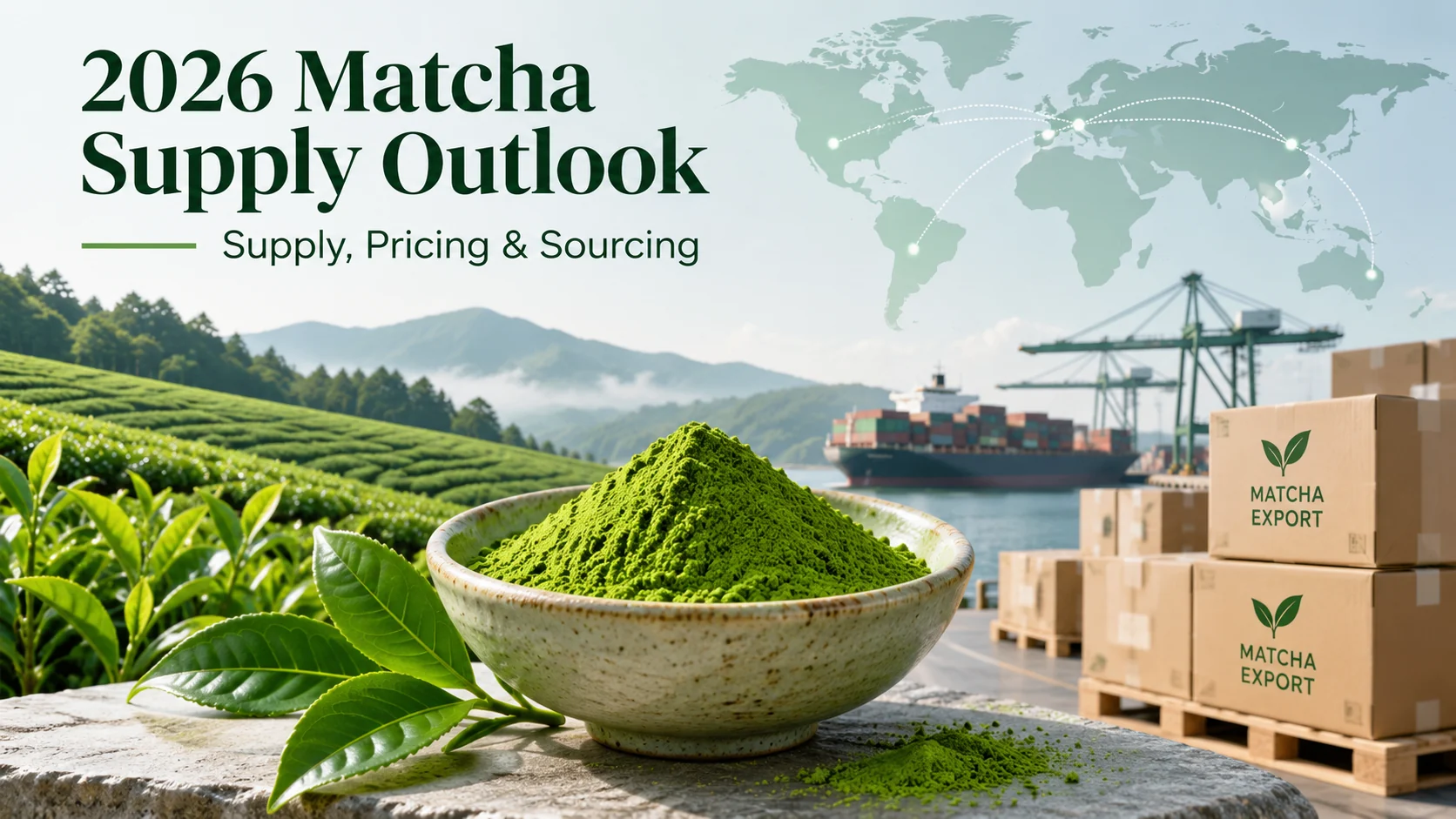
What B2B Buyers Should Know About Supply, Pricing & Origin
Japanese tea exports have increased rapidly while matcha and tencha supply has faced growing pressure.
This report examines:
- Japanese export growth
- tencha supply constraints
- pricing pressure
- origin diversification
- Japan vs China sourcing considerations
- sample-first purchasing
- repeat-supply planning
For commercial buyers, the key question is no longer simply whether matcha is available.
It is whether the selected product can meet the required application, cost, documentation and supply needs.
From Café to RTD

How Matcha Is Moving Into Packaged Beverages
Matcha is expanding beyond freshly prepared café drinks into:
- canned lattes
- bottled beverages
- sparkling matcha
- stick packs
- flavored RTD products
But a café recipe cannot automatically be transferred into commercial beverage production.
This guide explores the additional development questions around:
- dispersion
- sedimentation
- color stability
- milk and protein interaction
- processing
- shelf-life validation
- documentation
- commercial supply
Flavored Matcha Goes Mainstream

What Café & Beverage Brands Can Learn in 2026
Strawberry, vanilla, lavender, mango, brown sugar and dessert-inspired matcha are moving from niche café concepts into larger menus and packaged products.
The bigger trend is not one particular flavor.
Matcha is developing into a flexible beverage platform.
This report looks at:
- fruit matcha
- floral flavors
- dessert-inspired drinks
- coffee × matcha
- café components
- menu architecture
- recipe standardization
- cost per serving
For operators, the opportunity is to build repeatable flavor systems rather than chase every viral drink.
EU Matcha Import Testing

What B2B Buyers Should Check Before Ordering
Importing matcha into the European Union involves more than asking a supplier for a certificate.
Different documents answer different questions.
This buyer guide covers:
- EU pesticide MRLs
- pesticide testing
- COA scope
- contaminants
- microbiological testing
- organic certification
- TRACES and organic import documentation
- product and batch traceability
The central rule is simple:
Do not make a compliance claim broader than the evidence supporting it.
Southeast Asia Matcha Market 2026
Thailand, Vietnam & Singapore Buyer Signals
Southeast Asia is not one uniform matcha market.
Thailand, Vietnam and Singapore show different patterns in:
- matcha consumption
- café culture
- milk-based beverages
- RTD formats
- quality expectations
- traditional tea consumption
- purchasing behavior
This market guide compares the three countries and explains what the differences may mean for cafés, beverage brands, distributors and commercial matcha buyers.
Browse Matcha Intelligence by Topic
Supply & Sourcing
For buyers evaluating suppliers, product availability and commercial continuity.
Topics
- Matcha supply outlook
- Origin diversification
- China vs Japan sourcing
- Bulk purchasing
- Sample evaluation
- Supply planning
Café & Beverage Trends
For cafés, drink brands and product-development teams.
Topics
- flavored matcha
- café menu development
- RTD beverages
- matcha dosage
- cold foam
- matcha syrup
- cost per serving
Explore Matcha for Lattes & Café Drinks →
Browse Matcha Recipes & Café Development Resources →
Food & Beverage Manufacturing
For brands moving from bench-top formulation into commercial production.
Topics
- application matching
- pilot testing
- process performance
- batch consistency
- documentation
- repeat supply
Explore Food & Beverage Manufacturing →
Market & Regulatory Intelligence
For importers, distributors and international B2B buyers.
Topics
- European import requirements
- pesticide testing
- organic documentation
- Southeast Asian market development
- country-specific buyer behavior
- destination-market requirements
View Available Documentation →
From Market Signal to Commercial Decision
Market intelligence is useful only when it improves a purchasing or product-development decision.
For commercial matcha projects, we recommend moving through five steps.
1. Identify the Market
Where will the finished product be sold?
Consumer expectations, regulations and price positioning can differ substantially by market.
2. Define the Application
What are you making?
For example:
- café latte
- straight-whisked matcha
- bakery product
- RTD beverage
- food formulation
- retail matcha product
3. Shortlist Suitable Profiles
Compare matcha according to the finished application rather than relying only on grade terminology.
Relevant factors may include:
- color
- aroma
- bitterness
- milk compatibility
- processing performance
- required dose
- cost
4. Evaluate Samples
Test shortlisted products under consistent conditions.
A product specification can narrow the options.
The finished application should help make the final selection.
5. Confirm Commercial Requirements
Before scaling, confirm:
- selected product
- origin
- batch or lot where relevant
- packaging
- documentation
- expected volume
- lead time
- supply continuity
Market → Application → Profile → Sample → Commercial Supply
Research for Commercial Matcha Buyers
Matcha Origin Co. publishes market intelligence for B2B decision-making rather than consumer trend reporting alone.
Our research focuses on developments that may affect:
Cafés
Menu development, dosage, cost per serving and repeat supply.
Beverage Brands
Formulation, flavor trends, pilot development and commercial scale.
Food Manufacturers
Application performance, documentation and batch consistency.
Importers & Distributors
Market demand, origin, documentation and supply planning.
Private-Label Brands
Product selection, positioning, packaging and sourcing.
Where external market data is used, the original source and scope should remain clear.
Industry statistics should not be presented as Matcha Origin Co.’s own data.
Need to Evaluate Matcha for a Commercial Project?
Market research can help identify an opportunity.
The next step is product evaluation.
Tell us:
- what you are making
- target market
- expected volume
- target positioning
- relevant documentation requirements
We can help narrow a practical matcha range for testing before commercial scale.