Data note: The latest full-year Japanese export statistics used in this article are for 2025. This 2026 outlook combines those statistics with government and JETRO reporting published in 2026, plus explicitly dated 2025 industry reporting. Export averages are not matcha-specific wholesale quotations.
Global matcha demand has moved beyond a short-lived café trend.
For commercial buyers, the more important change is happening upstream: Japanese green tea exports have grown rapidly, powdered tea accounts for most of the export value, tencha supply has faced significant pressure, and buyers are paying more attention to availability, origin, application fit and supply continuity.
The practical takeaway for 2026 is not that businesses should stop buying Japanese matcha or automatically switch to another origin.
It is that commercial buyers need a more structured sourcing process:
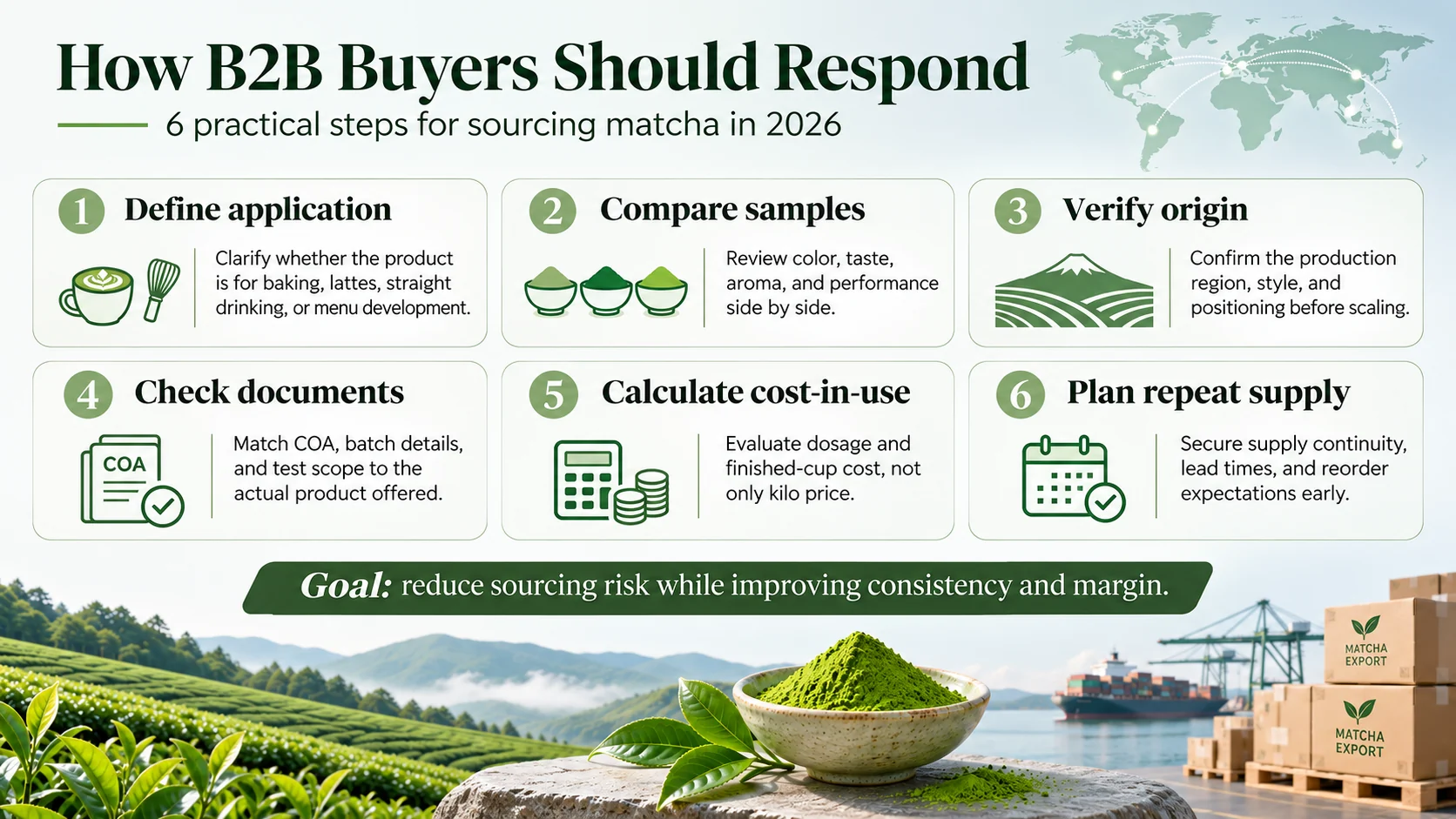
define the application → compare samples → verify origin and documentation → confirm the selected product or lot → evaluate cost-in-use → plan repeat supply.
This matters whether you operate a café, beverage brand, bakery, food manufacturing project or private-label matcha business.
2026 Matcha Market at a Glance
The latest full-year Japanese export figures show how quickly international demand has expanded.
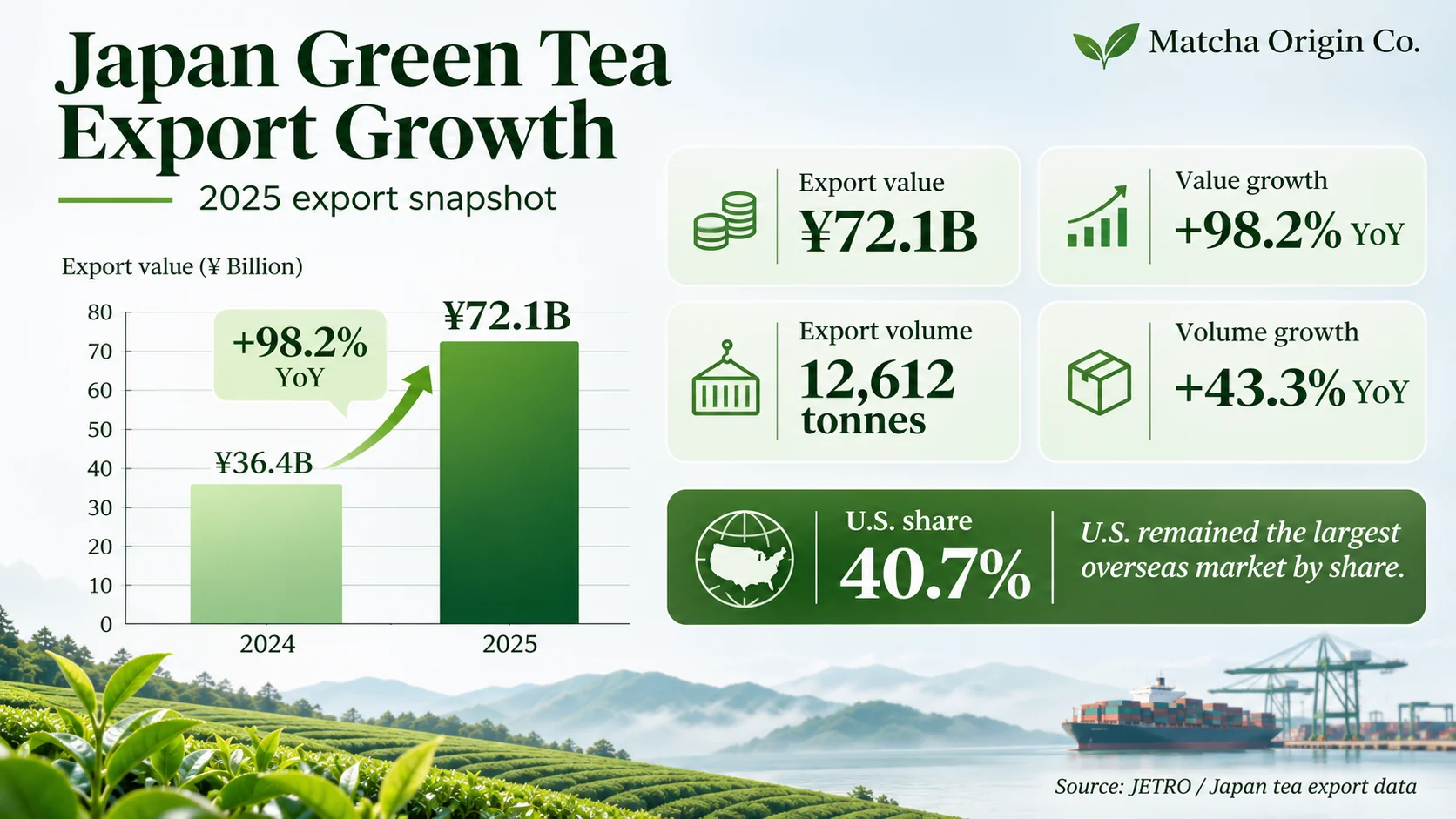
In 2025, Japan exported approximately ¥72.1 billion of green tea, up 98.2% by value from the previous year. Export volume reached 12,612 tonnes, an increase of 43.3%. The United States remained the largest market, accounting for approximately ¥29.3 billion, or 40.7% of export value. JETRO: 2025 trade figures
| Indicator | 2025 |
|---|---|
| Japan green tea export value | ¥72.1 billion |
| Year-on-year value growth | +98.2% |
| Export volume | 12,612 tonnes |
| Year-on-year volume growth | +43.3% |
| U.S. export value | ¥29.3 billion |
| U.S. share of export value | 40.7% |
| Average green tea export value | ¥5,716/kg |
These figures cover green tea exports overall, not matcha alone.
However, powdered green tea—including matcha—has become the dominant export format. JETRO reported that powdered tea including matcha reached approximately ¥60.3 billion, around 84% of Japanese tea export value in 2025. JETRO: powdered tea exports
That distinction matters.
A headline saying “matcha exports reached ¥72.1 billion” would overstate the data. The ¥72.1 billion figure is for Japanese green tea exports; matcha sits inside the much larger powdered-tea segment.
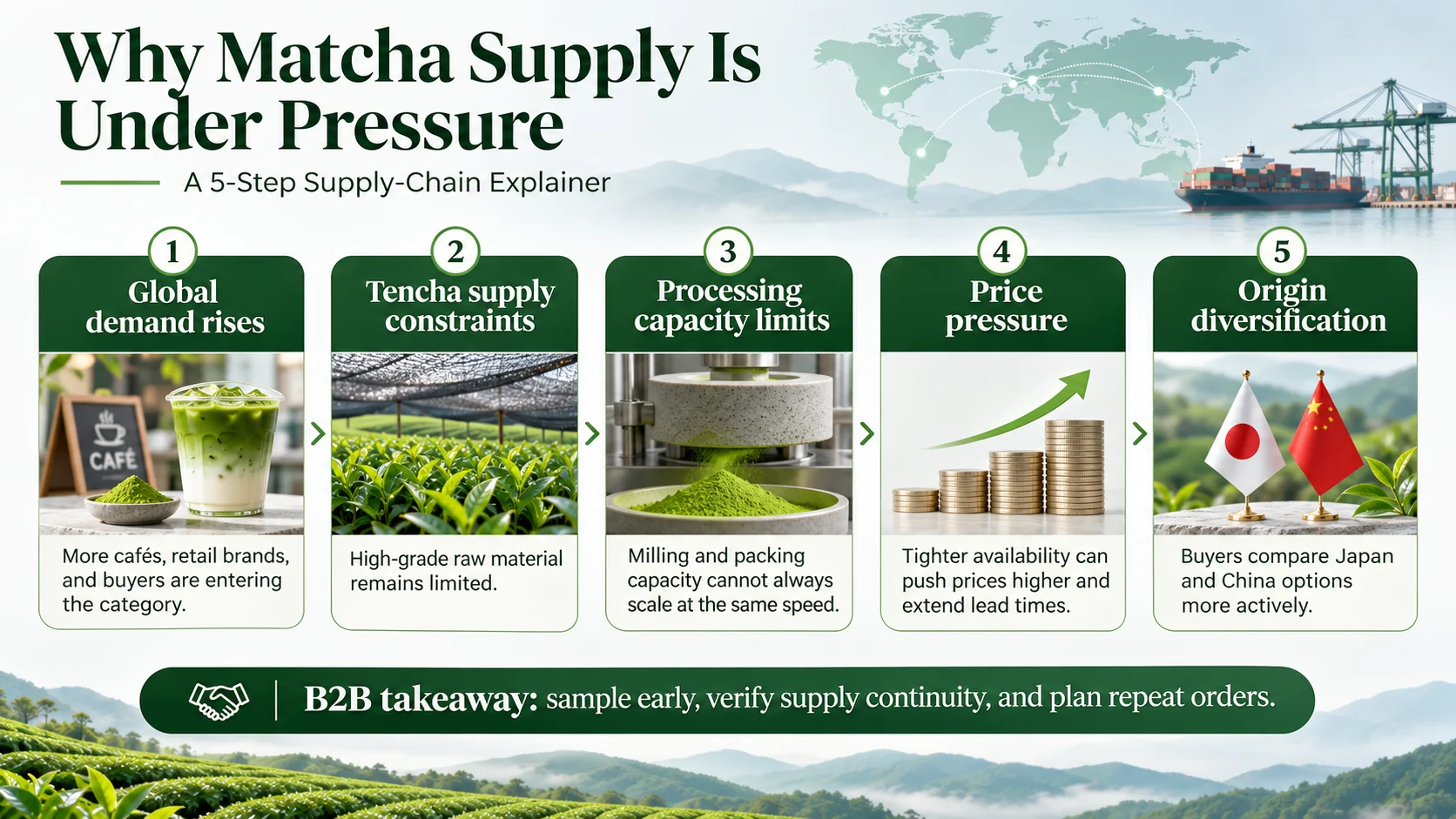
Why Matcha Supply Has Been Under Pressure
Rapid export growth is only one side of the market.
The raw material required for traditional matcha production is tencha, and producing more tencha is not as simple as immediately redirecting ordinary tea production.
Tencha production requires specialized cultivation and processing, including shaded cultivation before harvest. JETRO notes that this involves additional labor and cost, meaning not every tea grower can quickly convert production when global demand rises. JETRO: tencha production constraints
Japan’s Ministry of Agriculture is encouraging tencha production and export-oriented tea cultivation. Inventory conditions vary by reporting period and product; they should not be read as a single current nationwide shortage measure. MAFF: export and production policy
Climate has added another variable.
Reuters reported that severe heat affected tea production in Kyoto and that some producers experienced weaker harvests. At a Kyoto tencha auction in May 2025, the average price reached approximately ¥8,235 per kilogram, around 170% above the previous year. That figure reflects a specific auction market rather than a universal matcha price, but it illustrates the pressure experienced in an important Japanese producing region. Reuters, July 4, 2025 (syndicated report)
For B2B buyers, the lesson is important:
a supplier’s price change may reflect raw-material availability, harvest conditions, product specification and market demand—not simply a change in supplier margin.
Higher Export Value Does Not Mean Prices Rose by 98%
The headline export value nearly doubled in 2025, but that does not mean every kilogram of Japanese matcha doubled in price.
Export value increased 98.2%, while export volume increased 43.3%.
Calculated from MAFF’s annual export value and volume totals, Japan’s average green tea export value increased from approximately ¥4,135/kg in 2024 to ¥5,716/kg in 2025, an increase of roughly 38%. Again, this is an average across exported Japanese green tea, not a matcha-specific wholesale quotation. MAFF: annual export totals; unit values calculated
Meanwhile, particular tencha auctions and supplier contracts may have experienced much larger increases.
Commercial buyers should therefore avoid using one headline percentage as a universal benchmark.
When comparing quotations, confirm:
the actual product, origin, profile, quantity tier, packaging, shipping basis, documentation scope and lot availability.
The U.S. Remains the Largest Japanese Green Tea Export Market
The United States continues to be the dominant export destination.
In 2025, Japanese green tea exports to the U.S. reached approximately 4,431 tonnes and ¥29.3 billion. Germany and the United Kingdom also recorded substantial growth, while European and Southeast Asian markets continued expanding. JETRO: export destinations
This demand is no longer limited to traditional whisked tea.
Growth increasingly comes from applications including:
matcha lattes, flavored drinks, desserts, bakery products, packaged beverages and food ingredients.
JETRO’s 2026 ASEAN research similarly identifies matcha as a major entry product for Japanese tea consumption, with particularly strong compatibility with cafés, foodservice, desserts and RTD beverages. JETRO: ASEAN consumer research
That changes what “matcha quality” means for commercial purchasing.
A café and a straight-whisking tea bar are not necessarily buying for the same sensory target.
Neither is a bakery or RTD beverage manufacturer.
The Market Is Moving From “Can I Buy Matcha?” to “Which Matcha Fits My Product?”
JETRO reported in February 2026 that buyer selection criteria are becoming more sophisticated.
The market is moving beyond a stage where simply offering something labeled “matcha” is enough. Buyers are increasingly comparing brand positioning, applications, alternatives and commercial specifications. JETRO: buyer selection, February 2026
This is an important shift.
During a shortage, buyers may be tempted to accept any available matcha.
That creates a different risk:
supply may be available, but the product may not perform in the intended application.
For a latte, buyers should test:
color through milk, tea flavor through milk, bitterness, dispersion, required dose and cost per serving.
For baking:
finished color after heat, flavor intensity, bitterness, formulation interaction and cost-in-use.
For straight whisking:
aroma, umami, bitterness, texture, mouthfeel and finish.
For manufacturing:
dispersion, process behavior, consistency, technical specifications, documentation and repeat supply.
Availability alone is not enough.
Why Origin Diversification Is Becoming More Relevant
One of the most important signals in JETRO’s 2026 trade report is that rising overseas demand has created shortages of Japanese raw material and that some buyers are beginning to consider supply from other countries. JETRO: origin diversification
That does not mean Japanese matcha is being replaced.
Japan remains the origin most strongly associated with modern matcha culture, premium regional traditions and important segments of the straight-whisking market.
But for commercial buyers, especially those purchasing matcha for milk drinks, food production, baking, RTD beverages or larger-volume applications, a multi-origin sourcing strategy can become commercially relevant.
China-origin matcha is one option that can be evaluated for appropriate projects.
The correct comparison should not be:
Japan = good
China = cheap
or the reverse.
The better commercial comparison is:
Does this specific product meet the sensory, technical, documentation and commercial requirements of the application?
Origin should always be disclosed accurately.
But origin alone is not a complete specification.
For a deeper sourcing comparison, see Chinese Matcha vs Japanese Matcha for Commercial Buyers.
Japan Is Also Expanding Supply Capacity
Supply pressure does not mean Japanese production will remain fixed forever.
Japan is actively investing in more tencha production and processing capacity.
Japan’s national policy encourages tencha production and export-oriented cultivation, with support for production conversion and the tea supply chain. MAFF: tea-sector support
However, agricultural supply does not adjust instantly.
Tea fields require cultivation planning, equipment, labor and processing capacity. Reuters reported that newly planted fields can require several years before reaching productive maturity. Reuters, July 4, 2025 (syndicated report)
For buyers, this means the market can simultaneously experience:
higher future production capacity
and
short-term supply pressure.
Those are not contradictory.
What B2B Matcha Buyers Should Do in 2026
The most useful response to a volatile market is not panic buying.
It is better sourcing discipline.
1. Define the Application Before Asking for a Price
Do not begin with:
What is your cheapest matcha?
Start with:
What are we making?
A café latte, straight-whisking tea, cookie, ice cream, RTD beverage and private-label retail tin can require different product profiles.
A supplier can only recommend intelligently if the application is clear.
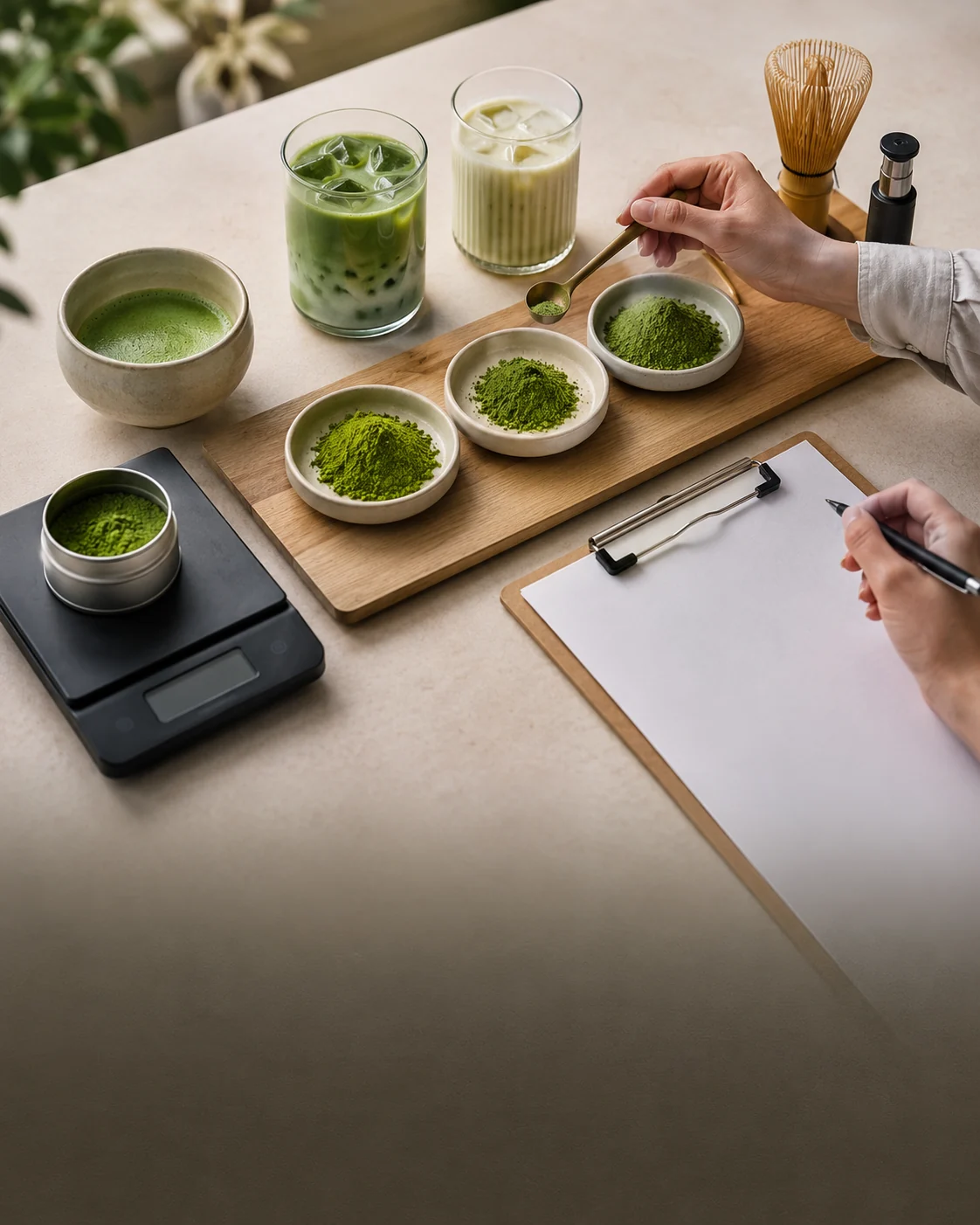
2. Compare Samples Under the Same Conditions
Specifications can narrow the options, but the finished application should make the final decision.
Keep the important variables consistent.
For cafés, use the same milk, cup, sweetness, matcha dose and preparation method.
For baking, keep formulation, processing temperature and matcha dose consistent.
For manufacturing, reproduce the intended process as closely as practical.
Compare samples side by side.
3. Separate Country of Origin From Product Performance
Country of origin is important information.
It is not a complete quality grade.
Two products from Japan can differ substantially.
Two products from China can also differ substantially.
Evaluate:
origin, raw-material selection, sensory profile, processing, application performance, documentation, lot consistency and commercial terms.
4. Confirm the Exact Product or Lot Before Scaling
A sample should lead to an identifiable commercial product.
Before a larger order, confirm that the quotation and documentation relate to the product you actually evaluated.
Do not assume that a general supplier certificate automatically applies to every product or batch.
5. Review Documentation by Scope
Ask:
What product does this document cover?
Which batch?
Which operator?
Which test method?
What date?
Which market requirement?
A COA, organic certificate, pesticide test, microbiological report and general product specification answer different questions.
They should not be treated as interchangeable evidence.
6. Compare Cost-in-Use, Not Only Cost per Kilogram
For a café, the more useful number may be:
price per kg ÷ 1,000 × approved grams per drink
A less expensive matcha that requires a much higher dose may not produce the lowest-cost latte.
The same principle applies to bakery and food manufacturing formulations.
Use the finished product as the commercial comparison.
7. Discuss Forecast Volume Earlier
When supply is tight, suppliers need better visibility into likely purchasing volume.
A buyer expecting 20 kg per month and a manufacturer expecting several hundred kilograms require different supply planning.
Share realistic expected volume when requesting samples.
This does not require committing to speculative inventory.
It helps both sides assess whether the product is commercially scalable.
8. Consider a Backup Profile
For businesses where uninterrupted supply is critical, testing a second acceptable profile can reduce sourcing risk.
The backup does not need to be identical.
It needs to be independently approved for the intended application.
Document the recipe or formulation adjustments required for each approved product.
Should Buyers Lock In Large Quantities Because Prices Are Rising?
Not automatically.
A shortage headline can create pressure to purchase more inventory than the business needs.
That can introduce other risks:
cash tied up in stock, storage conditions, aging product and purchasing the wrong profile before application testing is complete.
A better approach is:
sample first → approve the product → confirm realistic volume → discuss supply planning.
Larger commitments should follow actual demand and appropriate storage capability.
Should Cafés Use Japanese Matcha or China-Origin Matcha?
There is no single correct answer for every café.
A premium tea bar built around Japanese regional provenance may treat Japanese origin as a core part of its product identity.
A high-volume café developing flavored milk drinks may prioritize:
finished color, flavor through milk, approved dose, consistency and cost per serving.
Another brand may test both origins and use them for different menu applications.
The critical requirement is transparency.
Do not present China-origin matcha as Japanese.
Do not assume Japanese origin automatically makes every product the right choice for every commercial recipe.
Compare the product that will actually be purchased.
What Does the 2026 Market Mean for Food and Beverage Manufacturers?
Manufacturers face additional considerations beyond sensory quality.
These can include:
batch consistency, processing behavior, particle size or dispersion, microbiological requirements, pesticide-residue requirements, heavy-metal specifications, organic status, packaging format and repeat-volume capacity.
The recent demand boom makes early technical alignment even more important.
A manufacturer should not wait until after selecting a sensory sample to ask whether the required documentation or supply volume is available.
Application testing and commercial qualification should happen together.
See Quality & Testing and Available Documentation for more information on project-specific documentation.
A More Resilient Matcha Sourcing Model
The market is changing from simple product buying toward supply planning.
A more resilient sourcing model looks like this:
Application
Define the finished product.
↓
Profile
Shortlist matcha that may meet the sensory and commercial target.
↓
Sample
Compare candidates under controlled conditions.
↓
Documentation
Verify the evidence relevant to the selected product or lot.
↓
Commercial Fit
Confirm approved dose, cost-in-use, packaging, destination and volume.
↓
Scale
Move into repeat commercial supply.
This process cannot eliminate agricultural or market volatility.
It can reduce the risk of choosing a product based only on a price list, origin claim or grade name.
Matcha Origin Co.’s Approach
Matcha Origin Co. works with commercial buyers using an application-led sourcing process.
Our current supply includes China-origin matcha options for café drinks, baking, food applications, straight-whisking evaluation and private-label projects.
We do not treat country of origin or grade terminology as a substitute for product testing.
Buyers can begin by defining:
- application
- target sensory profile
- expected volume
- destination market
- required documentation
Suitable profiles can then be shortlisted for evaluation.
Frequently Asked Questions
Is there a global matcha shortage in 2026?
Demand has put significant pressure on Japanese matcha and tencha supply, and official Japanese trade reports describe shortages of domestic raw material. However, availability varies by producer, product, region, specification and origin. It is more accurate to describe the market as supply-constrained than to assume that all matcha globally is unavailable. JETRO: supply constraints
Why has matcha become more expensive?
Several factors can contribute, including rapid global demand growth, tencha availability, specialized cultivation and processing, weather conditions, labor and production costs. Specific price increases vary greatly by product and supply channel.
Did Japanese matcha prices increase by 98%?
Not necessarily. Japan’s total green tea export value increased 98.2% in 2025, while export volume increased 43.3%. Average export value per kilogram increased from ¥4,135 to ¥5,716. Individual matcha and tencha markets can move differently. MAFF: annual export totals
Is matcha from China a substitute for Japanese matcha?
It can be an alternative for some commercial applications, but products should not be treated as automatically interchangeable. Evaluate actual origin, sensory performance, application, specification, documentation and commercial requirements.
Should a café buy the highest grade available?
Not automatically. A café should test matcha in its actual milk, sweetness and serving format. The best commercial profile is the one that achieves the desired finished drink at an acceptable dose, consistency and cost.
What should buyers request before placing a bulk order?
Confirm the exact product, origin, sample match, commercial quotation, packaging, lead time, applicable documentation and repeat-supply requirements. Documentation should be reviewed according to its actual product, batch, operator and test scope.
2026 Outlook: The Bigger Shift Is in How Matcha Is Bought
The most important change in the matcha market is not simply higher demand.
It is the transition from a category where buyers often purchased by broad labels such as “ceremonial” or “premium” toward one where commercial buyers increasingly need to evaluate application performance, supply continuity, origin, documentation and cost together.
Japan’s export growth confirms that global demand remains strong. Supply-side pressure shows that production cannot always expand at the same speed. At the same time, JETRO is already observing interest in non-Japanese origins when Japanese material cannot meet demand. JETRO: trade outlook
For B2B buyers, the strongest sourcing strategy in 2026 is therefore not to chase the loudest market claim.
It is to build a repeatable evaluation process:
define → sample → test → verify → cost → scale.
That remains useful whether the selected matcha ultimately comes from Japan, China or another qualified supply origin.