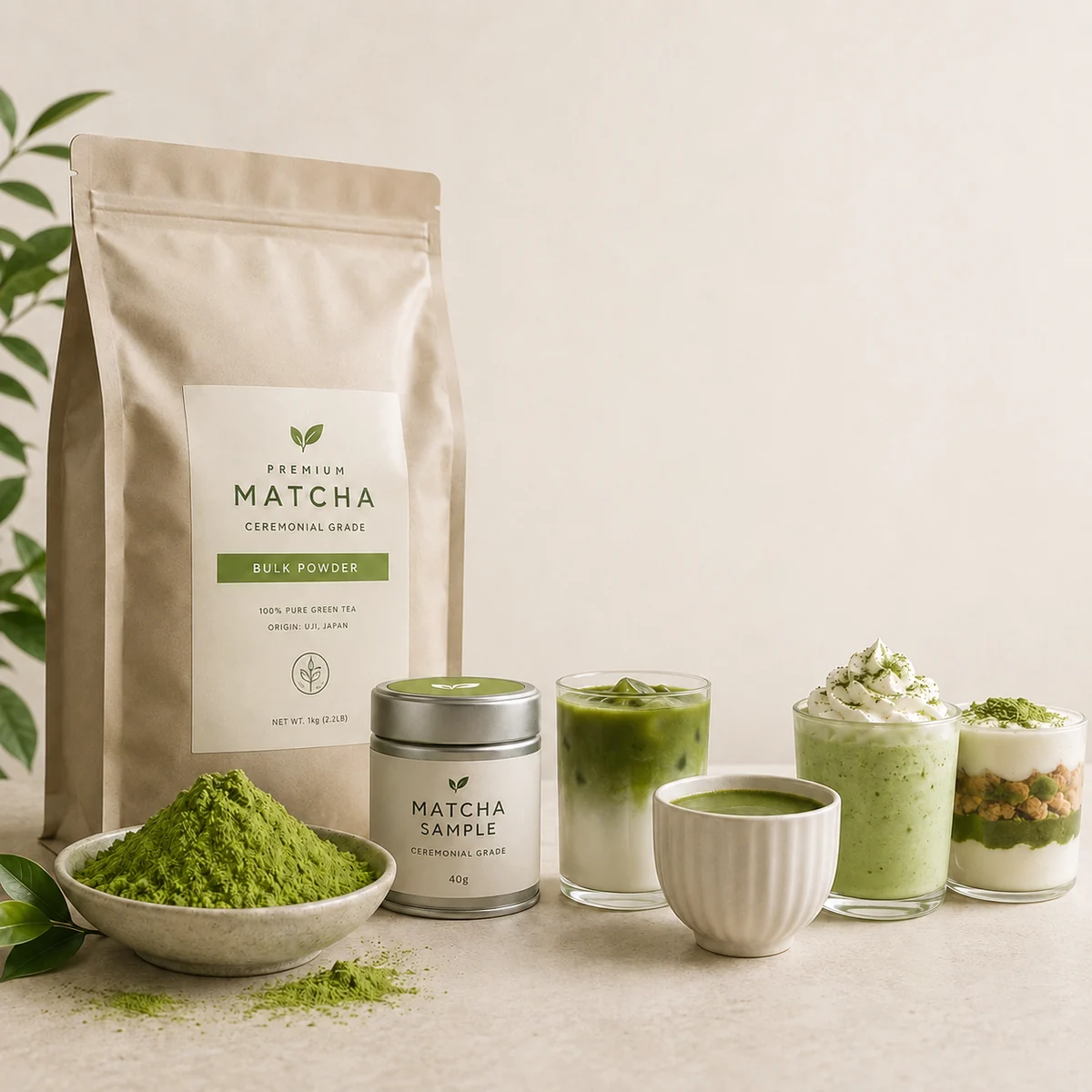
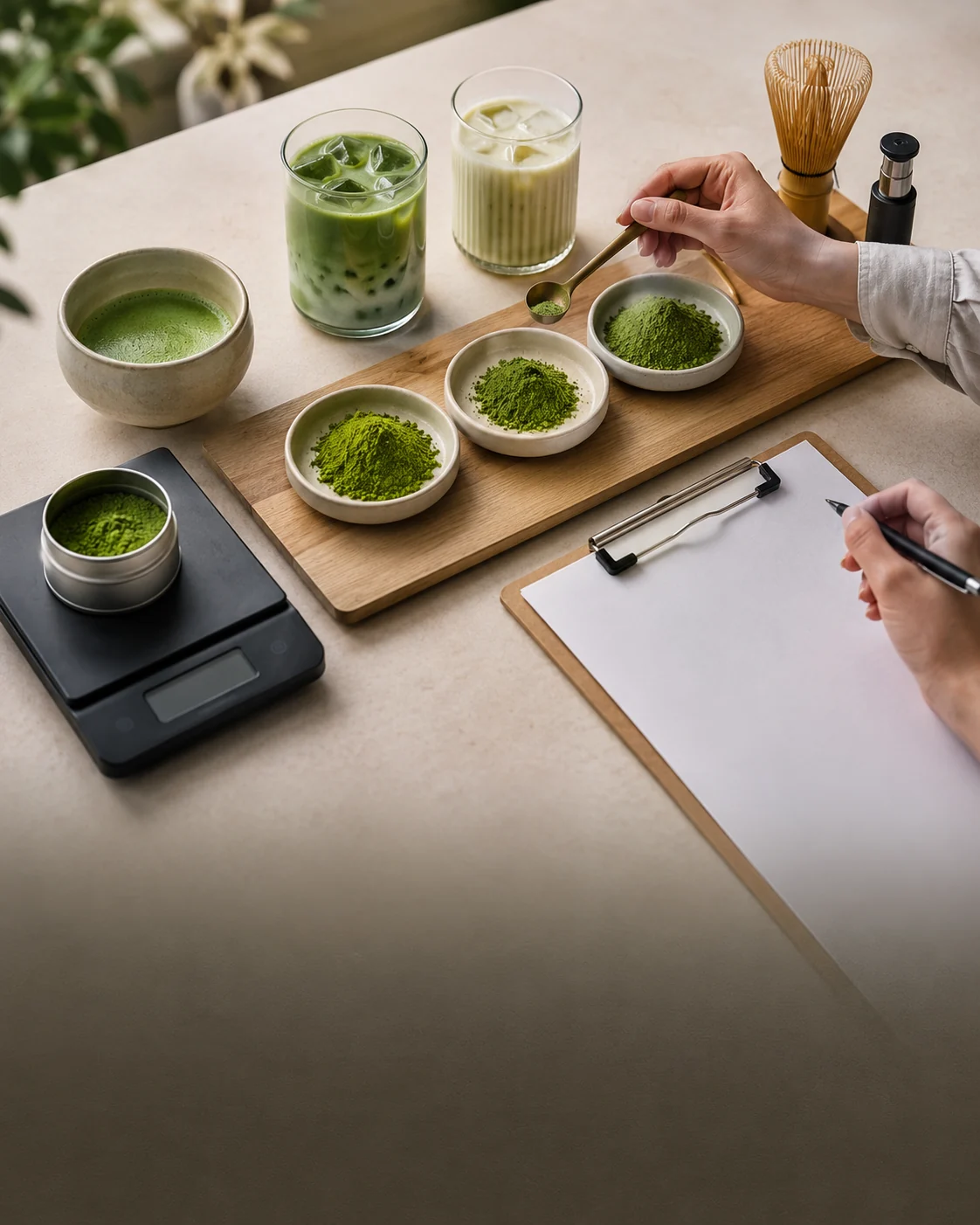
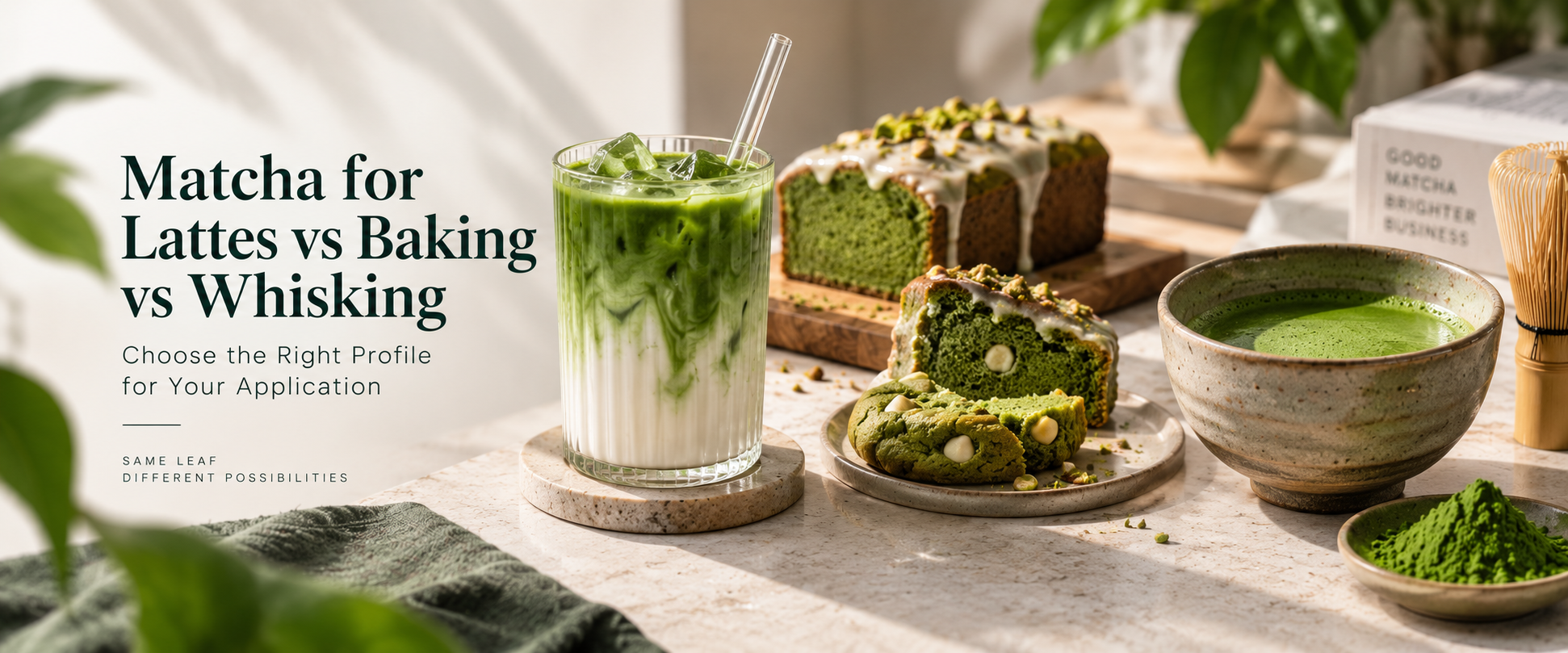
A matcha that performs beautifully when whisked with water may disappear in a sweet iced latte. A café-friendly powder may not retain enough flavor after baking. For commercial buyers, the right choice depends less on the grade name than on what the matcha must do in the finished product.
This guide compares matcha for lattes, baking and straight whisking so cafés, bakeries, beverage brands and tea businesses can shortlist suitable profiles, test them in the correct format and choose on commercial fit.
Quick Decision Guide
| Application | What matters most | Practical starting profile |
|---|---|---|
| Latte / café drink | Color and tea presence through milk, dispersion and cost per serving | Café / Latte |
| Baking / dessert | Color and flavor after processing, dosage and cost per finished unit | Culinary |
| Straight whisking | Aroma, balance, mouthfeel, bitterness, umami and finish | Ceremonial |
These are starting points, not universal rules. The final decision should come from controlled tests in the product you intend to sell.
If you are already reviewing products from several suppliers, use our commercial matcha sample comparison guide to control dose, preparation and scoring before you compare results.
1. Start With the Application, Not the Grade Name
Terms such as culinary, latte and ceremonial are useful shorthand, but they are not one universal grading system used identically by every producer. Our Matcha Grades Explained guide covers that naming issue in detail. For selection, the more useful question is simpler: what must the matcha do in the final product?
- Latte: Does it still look and taste good after milk, ice and sweetener?
- Baking: Does it remain visible after heat, fat, sugar and stronger ingredients?
- Straight whisking: Is it pleasant when the tea itself is the main experience?
The same powder can technically be used in all three. That does not make it the best commercial choice for all three.
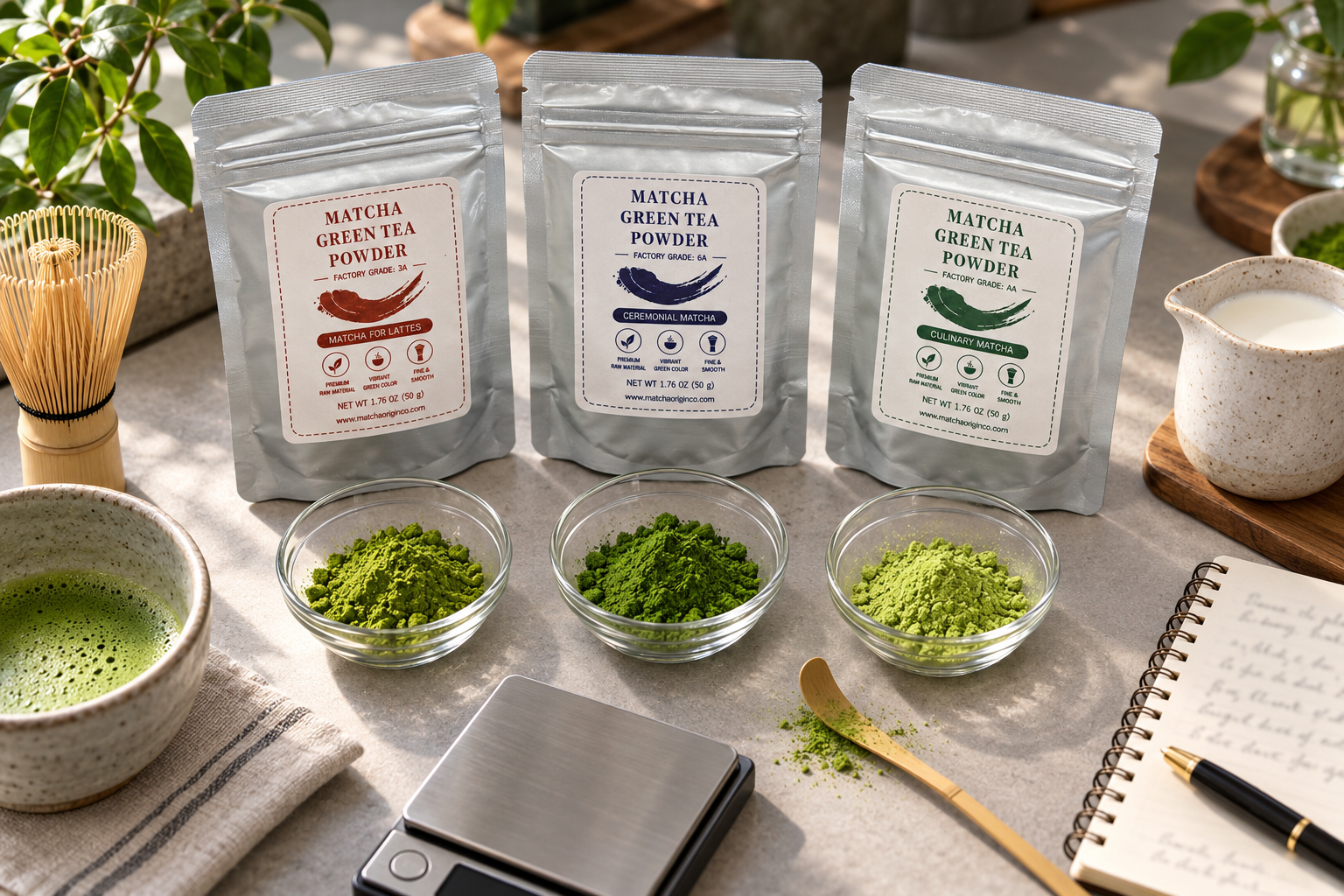
2. Matcha for Lattes: Test the Finished Drink
Milk changes matcha significantly. It affects color, perceived bitterness, sweetness, aroma, texture and tea intensity. A sample that tastes delicate in water may become difficult to notice once it is mixed with milk, syrup and ice.
Commercial latte evaluation should therefore use the actual recipe. Keep the matcha dose, milk, sweetener, ice, cup size and mixing method consistent. Our Matcha for Lattes & Café Drinks guide explains this application in more depth.
What cafés should evaluate
- Color in milk: Compare the finished green tone in dairy and plant milk, hot and iced.
- Flavor presence: Check whether customers can still recognize matcha after dilution and sweetness.
- Sweetness balance: Test with the actual syrup, fruit purée, vanilla or cold foam used on the menu.
- Dispersion and texture: Look for clumping, sediment, mouthfeel and repeatability between staff members.
- Cost per serving: Find the dose that reaches the target flavor and appearance at a workable drink cost.
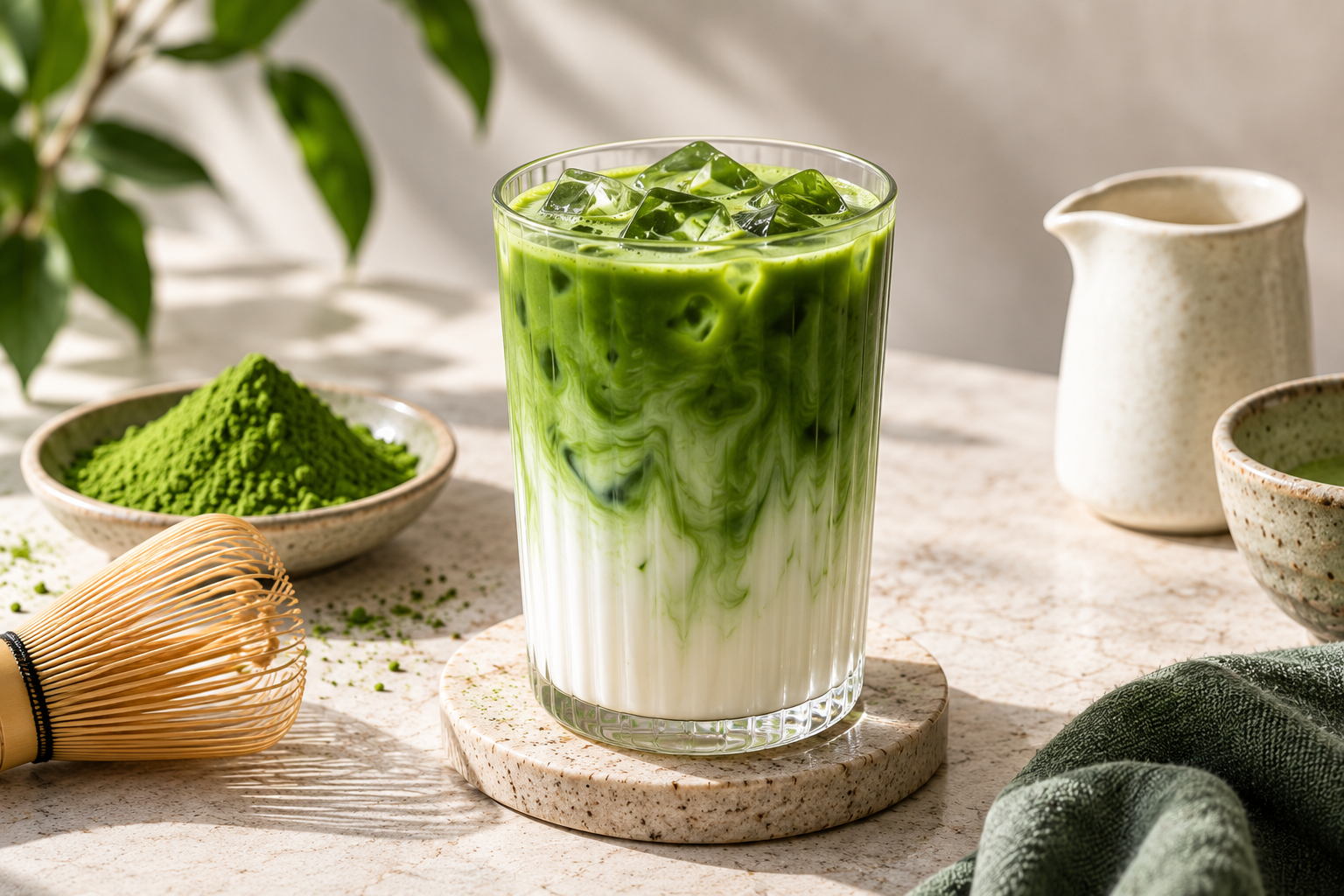
3. Café / Latte Matcha Profile
For standard milk-based menus, a Café / Latte Matcha Profile is a practical starting point. Typical applications include hot and iced lattes, milk tea, flavored matcha drinks and high-volume café menus.
Primary selection criteria: finished color + tea presence + balance in milk + serving cost.
For higher-positioned signature drinks, a Premium Latte Matcha Profile may be worth testing when a café wants a more refined sensory result or more premium visual positioning. Compare current options in the Matcha Profile Directory.
4. Matcha for Baking: Judge It After Processing
Baking creates a different environment. Matcha may be combined with flour, sugar, butter, oil, eggs, dairy, chocolate or fruit, then exposed to prolonged heat. Subtle differences that matter in straight tea may become much harder to detect.
For a bakery, the dry powder is only the starting point. The real test happens in the finished product. Evaluate the cake, cookie, mousse or dessert after it has been mixed, baked, chilled or otherwise processed. See Matcha for Baking & Desserts for application-specific guidance.
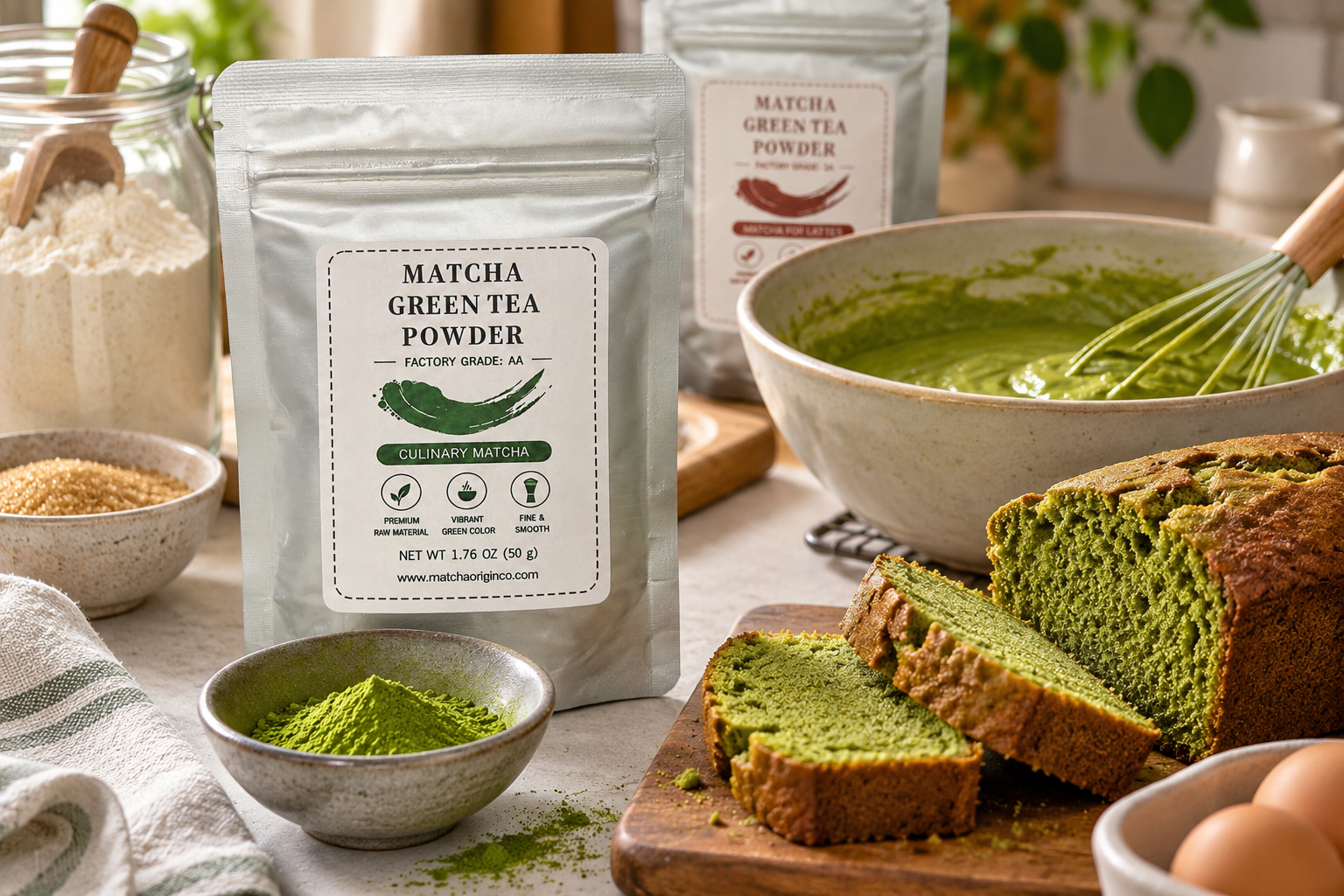
5. What Bakeries Should Evaluate
Finished color
Matcha often appears brighter in batter than after baking. Judge the customer-facing product, not the mixing bowl.
Flavor after heat
Can you still identify matcha after processing? A profile with stronger tea character may outperform a delicate straight-whisking profile in some recipes.
Bitterness and astringency
Increasing the dose can strengthen tea flavor, but it can also create excessive bitterness. Find the balance inside the complete formula.
Compatibility with fat and sugar
Butter, cream, chocolate and sugar can soften or mask matcha. Test each sample in the real recipe.
Cost-in-use
Calculate cost per finished cake, cookie or dessert—not price per kilogram alone.
6. Culinary Matcha Profile
For baking, desserts and formulated foods, a Culinary Matcha Profile is usually the most logical starting point. Common uses include cakes, cookies, loaf products, mousse, confectionery, ice cream and food manufacturing.
A culinary profile may show stronger flavor or more noticeable bitterness than a profile intended for straight whisking. That does not automatically make it lower quality. It reflects a different job.
Primary selection criteria: visibility in the finished product + color after processing + practical cost-in-use.
7. Matcha for Straight Whisking: There Is Nowhere to Hide
Straight whisking exposes matcha more directly than formulated applications. There is no milk, syrup, flour, butter or fruit purée to mask the tea. Aroma, umami, bitterness, astringency, smoothness, mouthfeel and finish become more visible.
This is why a profile selected for straight service may prioritize different characteristics from one selected for baking or flavored drinks. Explore Matcha for Straight Whisking for the dedicated service guide.
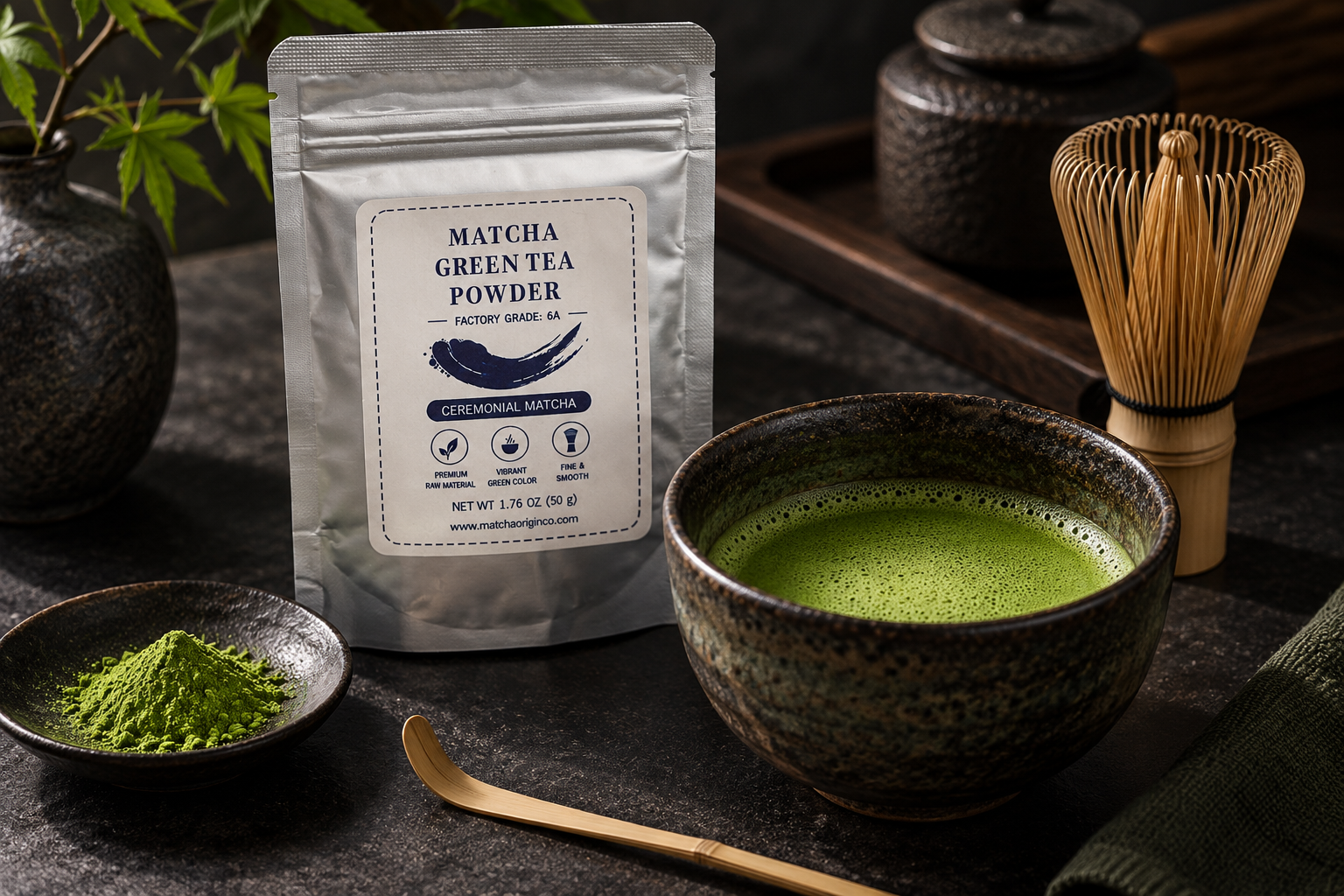
8. Ceremonial Profiles for Straight Whisking
Classic
A starting point for everyday straight whisking, tea bars and premium daily service.
Premium
For buyers seeking a more refined premium tea experience.
Reserve
For higher-end programs where sensory refinement and premium positioning matter most.
The important question is not which profile is universally “better.” It is which customer experience the business intends to create.
9. Side-by-Side: Latte vs Baking vs Whisking
| Factor | Lattes | Baking | Straight Whisking |
|---|---|---|---|
| Primary test | Finished drink | Finished baked or dessert product | Prepared bowl |
| Color priority | Color through milk | Color after processing | Natural prepared color |
| Flavor priority | Presence through milk | Presence through strong ingredients | Balance and refinement |
| Texture | Dispersion in the drink | Usually formulation-dependent | Mouthfeel is highly exposed |
| Heat exposure | Low to moderate | Often high | Minimal |
| Main masking ingredients | Milk, syrup, fruit | Flour, sugar, fat, chocolate | Very few |
| Cost focus | Cost per drink | Cost per finished unit | Premium cup experience |
| Starting profile | Café / Latte | Culinary | Ceremonial |
10. Can You Use Ceremonial Matcha in a Latte?
Yes. The question is whether the benefit remains noticeable enough to justify the cost. A refined straight-whisking profile may offer smoother flavor, more delicate aroma and a more refined finish. Those differences can be meaningful in water, but milk, syrup and flavoring may hide part of that refinement.
For a premium signature latte, ceremonial matcha may still make sense. For a high-volume flavored drink, a latte-oriented profile may offer better commercial value.
11. Can Culinary Matcha Be Whisked With Water?
Yes, technically. But a culinary profile may have more noticeable bitterness, stronger tea character or greater astringency than a tea bar wants for straight service. These characteristics can be useful in baking because other ingredients dilute the tea; consumed alone, they are more exposed.
This is not simply a good-versus-bad distinction. It is an application-fit question.
12. Do Not Pay for Characteristics Your Recipe Hides
Imagine a premium matcha with a delicate aroma. Put it into a chocolate cake with cocoa, butter, sugar, flour and heat. If customers can no longer perceive that aroma, paying significantly more for it may not improve the finished product enough to justify the added cost.
The same principle applies to a heavily flavored latte. Commercial buyers should pay for the characteristics that survive into the customer-ready product.
13. Use the Same Sample in More Than One Application
If your business is deciding between profiles, prepare the same sample in multiple formats. This makes the differences between application fit easier for the team to understand.
Test A — Straight
- Aroma
- Bitterness
- Texture
- Finish
Test B — Iced Latte
- Color in milk
- Flavor presence
- Sweetness balance
- Serving cost
Test C — Simple Bake
- Color after baking
- Flavor retention
- Bitterness
- Required dose
14. Build an Application-Based Scorecard
Do not use one universal score sheet for every project. Change the weighting according to the application.
- Café: milk performance, color, flavor presence, dispersion and cost per serving.
- Bakery: finished color, flavor after heating, dosage, consistency and cost-in-use.
- Whisking: aroma, mouthfeel, bitterness, umami and finish.
The “best” sample can change with the scorecard. That is exactly the point.
15. Profile → Sample → Application Test → Selection
- Define the application. State what you are producing and how it will be served.
- Shortlist suitable profiles. Do not request every possible product.
- Order evaluation samples. Use samples to narrow the choice.
- Test in the real formulation. Use the actual milk, recipe, equipment, temperature and serving size.
- Compare commercial fit. Review sensory performance, consistency, documentation and cost.
- Scale only after approval. Do not choose commercial supply from dry powder photos alone.
When you are ready to validate a shortlist, our B2B sample request process helps align recommendations with the application, expected volume and documentation needs.
Which Matcha Profile Should Your Business Start With?
Café or drink brand
Start with Café / Latte, then compare Premium Latte for a more premium signature drink.
Bakery or dessert business
Start with Culinary and judge the finished recipe after processing.
Straight tea service
Start with Classic Ceremonial, then compare Premium or Reserve for the desired sensory position.
Frequently Asked Questions
Is ceremonial matcha always better than culinary matcha?
No. They usually serve different purposes. Ceremonial profiles may prioritize straight drinking, while culinary profiles may prioritize flavor visibility in formulated foods.
What matcha should I use for a café latte?
Start with a profile designed for milk-based drinks and test it with your actual milk, syrup, ice and serving size.
What matcha is best for baking?
A culinary profile is usually the most practical starting point, but choose from baked color, flavor retention, required dose and cost-in-use.
Should I use the same matcha for lattes and straight whisking?
You can, but the ideal product may differ. A café may prioritize milk performance, while straight whisking exposes aroma, bitterness, texture and finish more directly.
Does a higher price mean better performance?
Not necessarily. A more expensive matcha may contain sensory characteristics that are valuable in one application but difficult to notice in another.
Choose Matcha by What You Are Making
The most useful sourcing question is not “Which grade is highest?” It is “Which profile performs best in the product I plan to sell?” Compare relevant profiles, test them in the actual application and scale only after the finished result meets your commercial requirements.
Leave a Reply