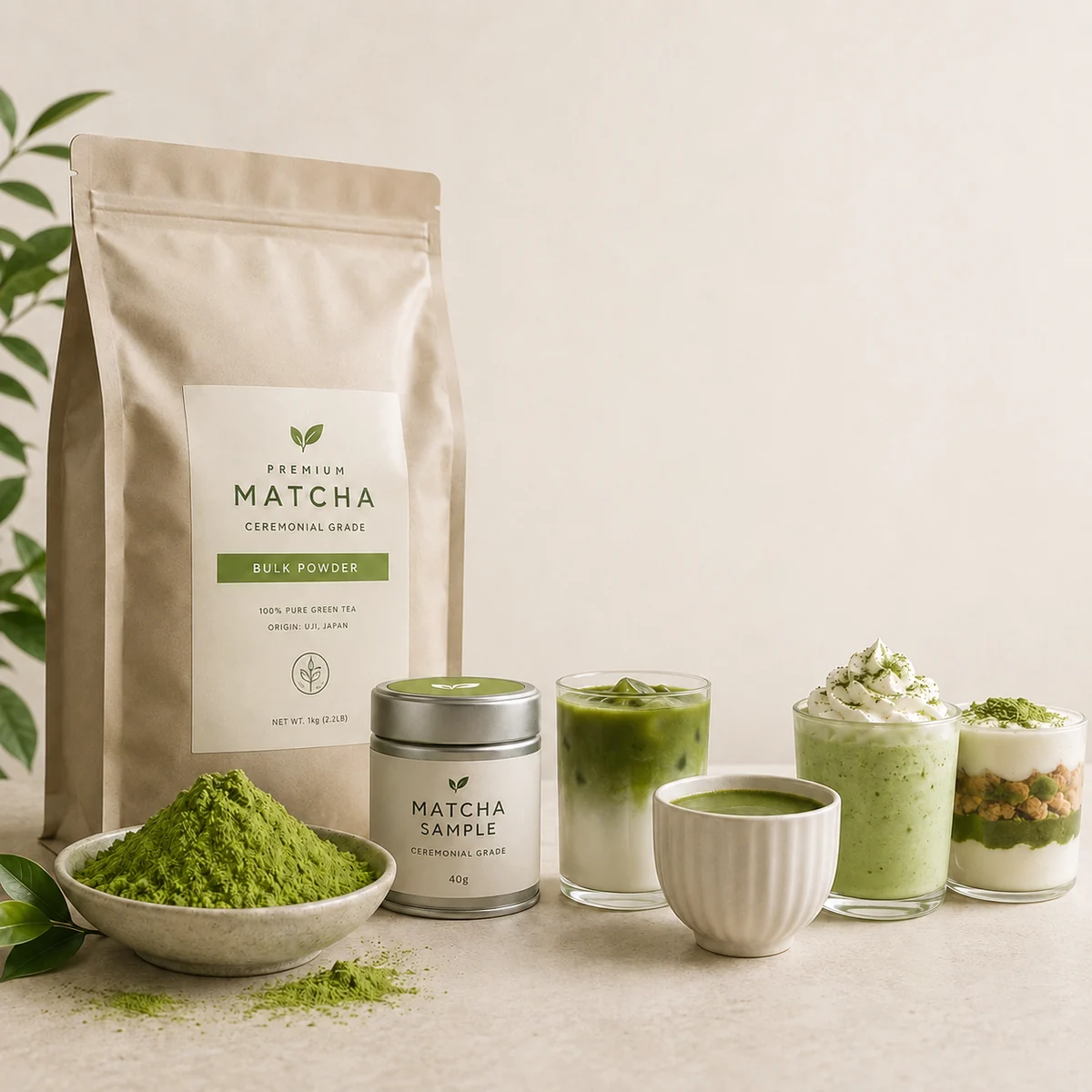
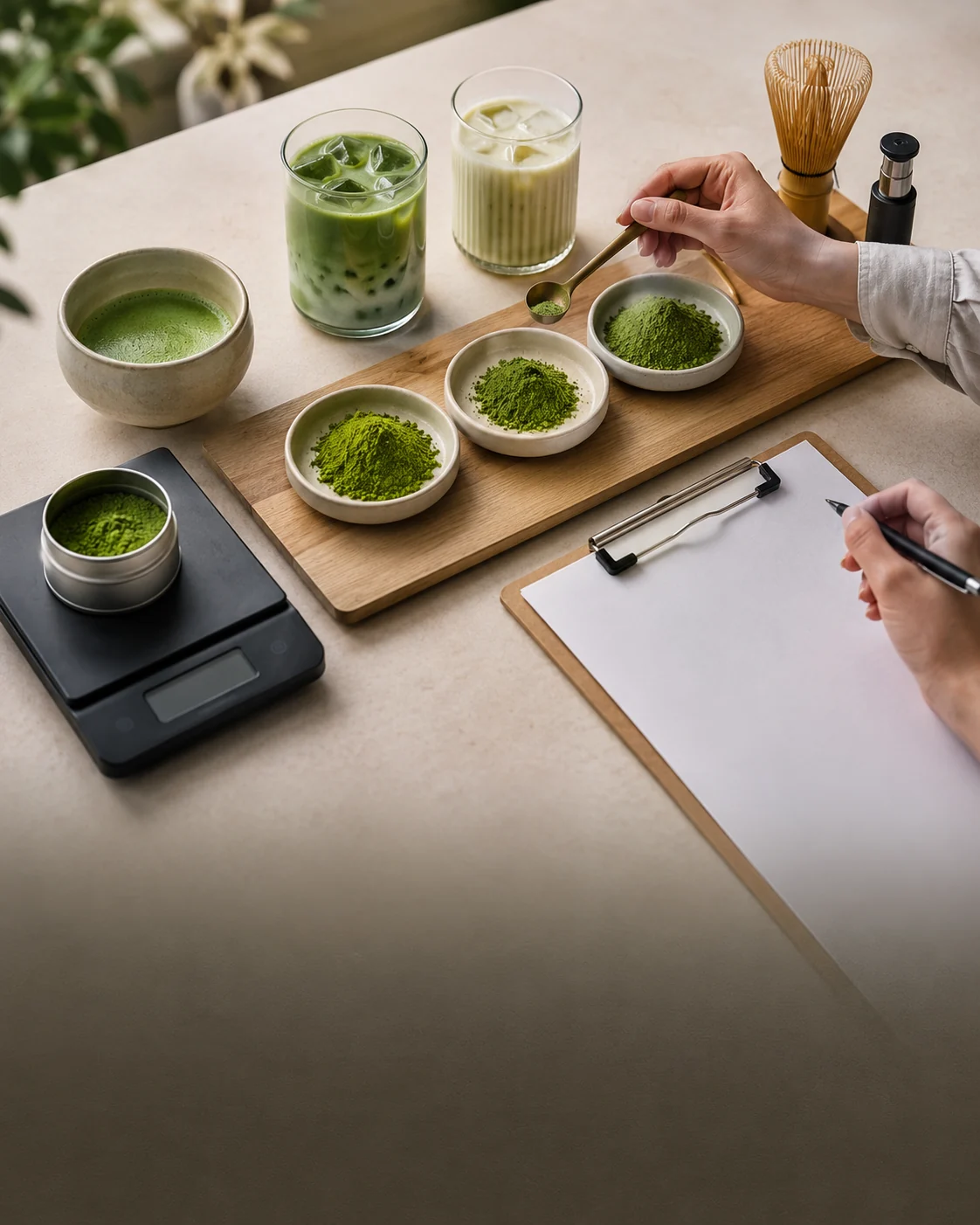
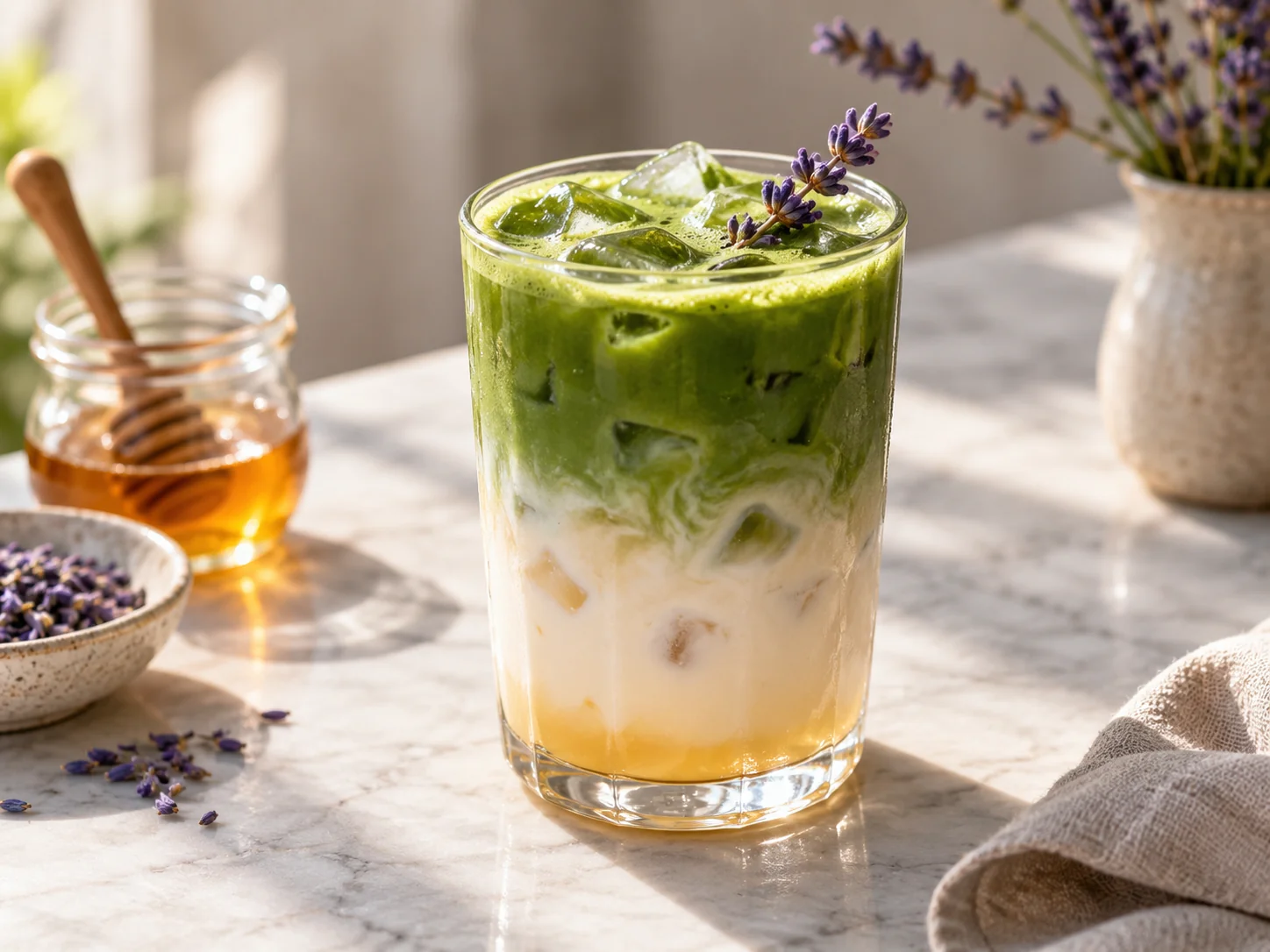
Honey, lavender and matcha create a soft floral latte that works especially well as a premium café or seasonal menu drink.
This recipe gives cafés a measured starting point for developing an iced honey lavender matcha latte with a clear matcha presence, controlled sweetness and a gentle floral note.
The formula below is a development recipe rather than a universal standard. Honey, lavender syrup, milk and matcha products vary, so test the finished drink under the same conditions before adding it to a commercial menu.
Honey Lavender Matcha Latte: Café Starting Recipe
Yield: 1 iced drink
Suggested cup: approximately 450–500 ml
Format: iced
Starting matcha dose: 3 g
| Ingredient | Starting Amount |
|---|---|
| Unsweetened matcha powder | 3 g |
| Warm water | 40 ml |
| Honey | 10 g |
| Culinary lavender syrup | 5–7 ml |
| Cold milk | 160 ml |
| Ice | approximately 120 g |
Use water at approximately 70–80°C for preparing the matcha.
For café use, choose a lavender syrup intended for food and beverage applications. Do not use fragrance oils or non-food-grade lavender products.
The lavender level should remain deliberately restrained. It is easier to increase a floral note during testing than to correct a drink that tastes overly perfumed.
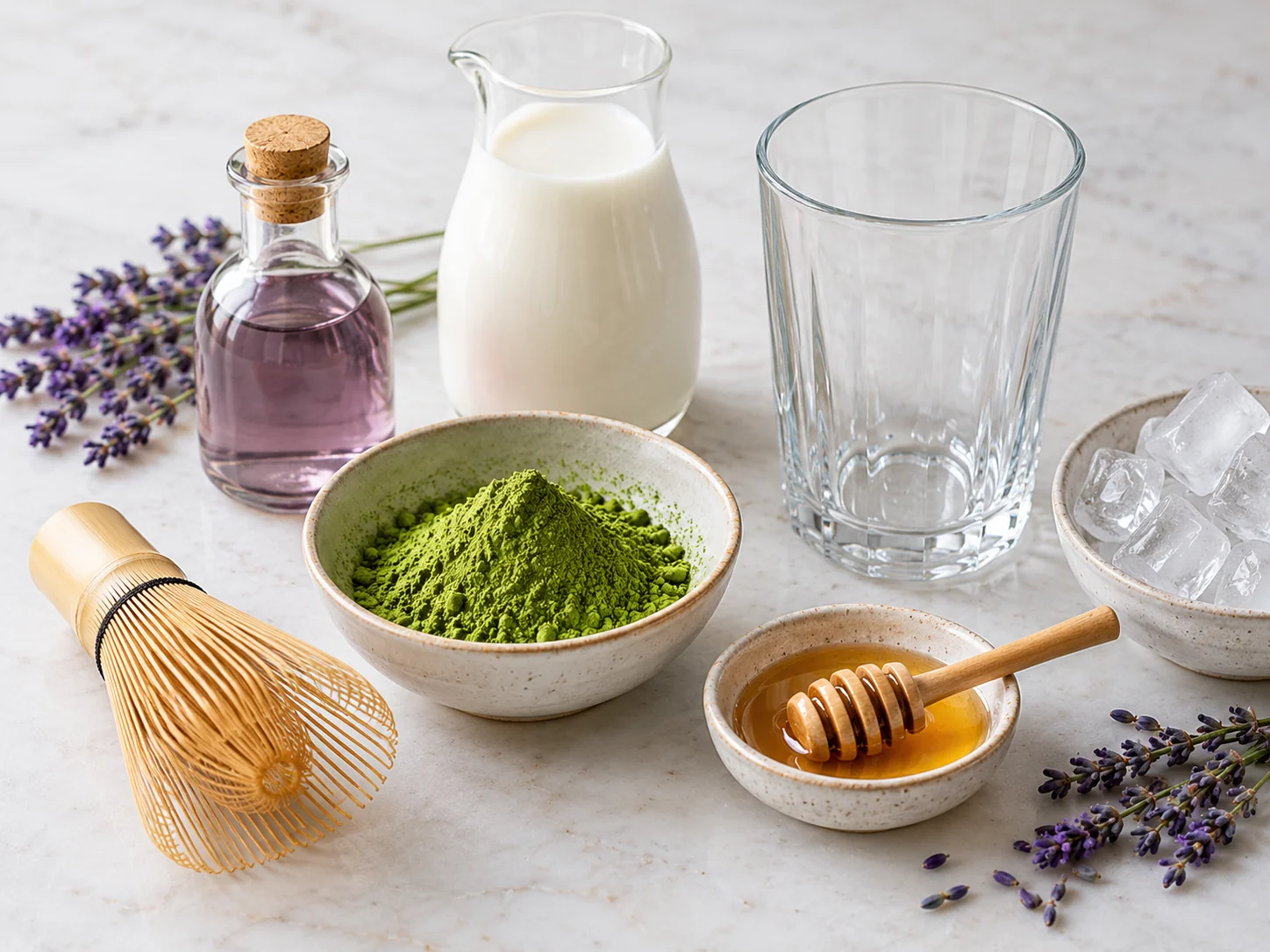
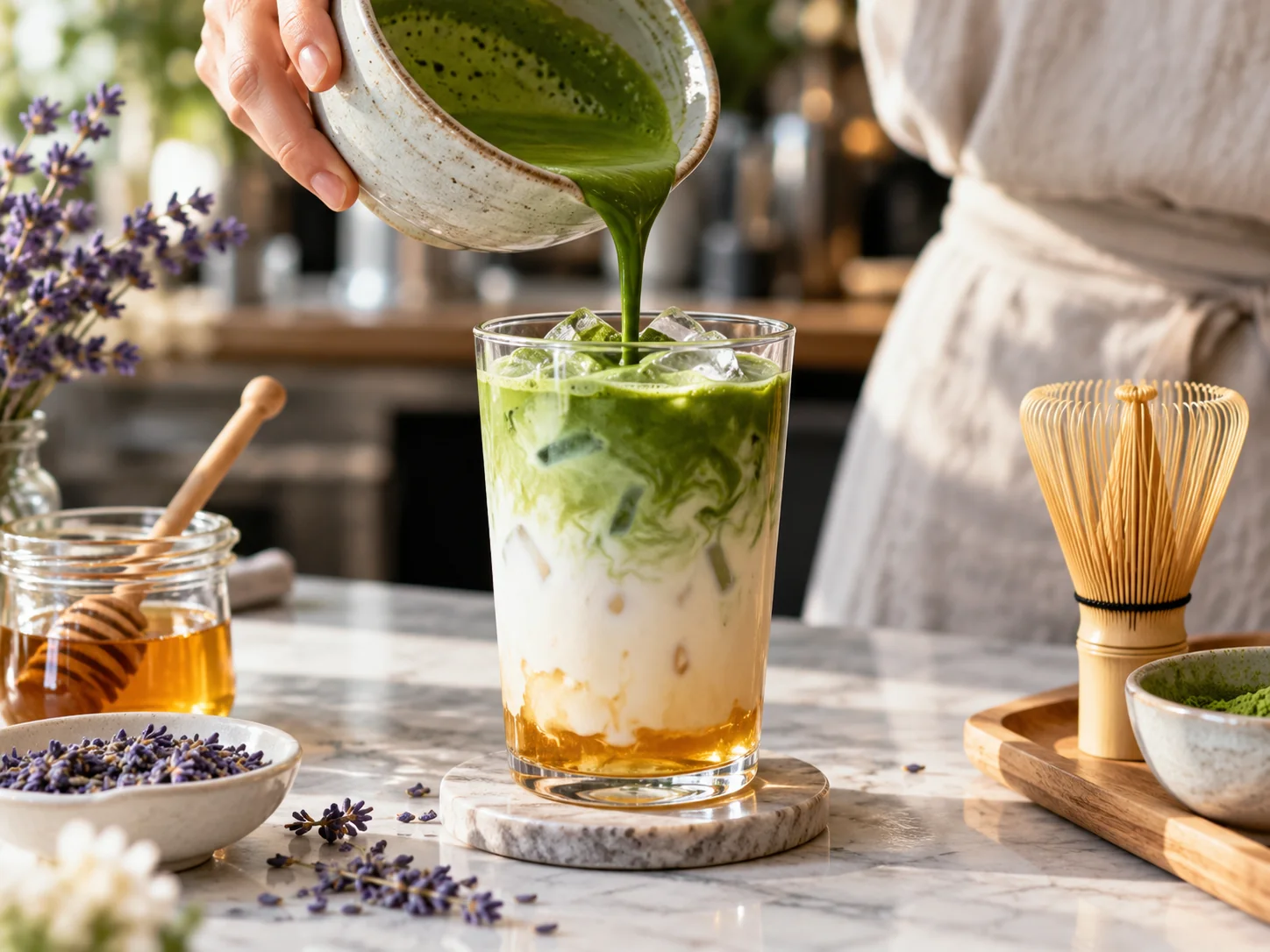
How to Make an Iced Honey Lavender Matcha Latte
1. Prepare the matcha
Sift 3 g of matcha into a clean bowl or preparation vessel.
Add 40 ml of warm water and whisk until the powder is fully dispersed and the surface is lightly frothy.
Avoid pouring boiling water directly onto the matcha.
2. Prepare the honey-lavender base
Add 10 g of honey and 5–7 ml of culinary lavender syrup to the serving glass.
If necessary, mix with a small amount of the milk until the honey is evenly incorporated.
The purpose is to create a consistent flavored base rather than leaving concentrated honey at the bottom of the drink.
3. Add milk and ice
Add approximately 120 g of ice, followed by 160 ml of cold milk.
Pour slowly if you want a cleaner layered presentation.
4. Add the matcha
Pour the freshly prepared matcha over the milk.
For a more defined green layer, pour slowly over the ice or over the back of a spoon.
Serve immediately and instruct the customer to stir before drinking.
Why Honey and Lavender Work With Matcha
Honey contributes sweetness with a different flavor profile from plain sugar syrup, while lavender adds an aromatic floral note.
The combination can work well in a milk-based matcha drink because the ingredients occupy different parts of the sensory profile:
Matcha provides tea character, vegetal notes, bitterness and body.
Milk softens the drink and changes how bitterness and aroma are perceived.
Honey adds sweetness and its own characteristic flavor.
Lavender contributes a floral top note.
The challenge is balance.
A small change in lavender syrup can have a noticeable effect, which is why cafés should treat lavender as a controlled recipe variable instead of adding it by eye.
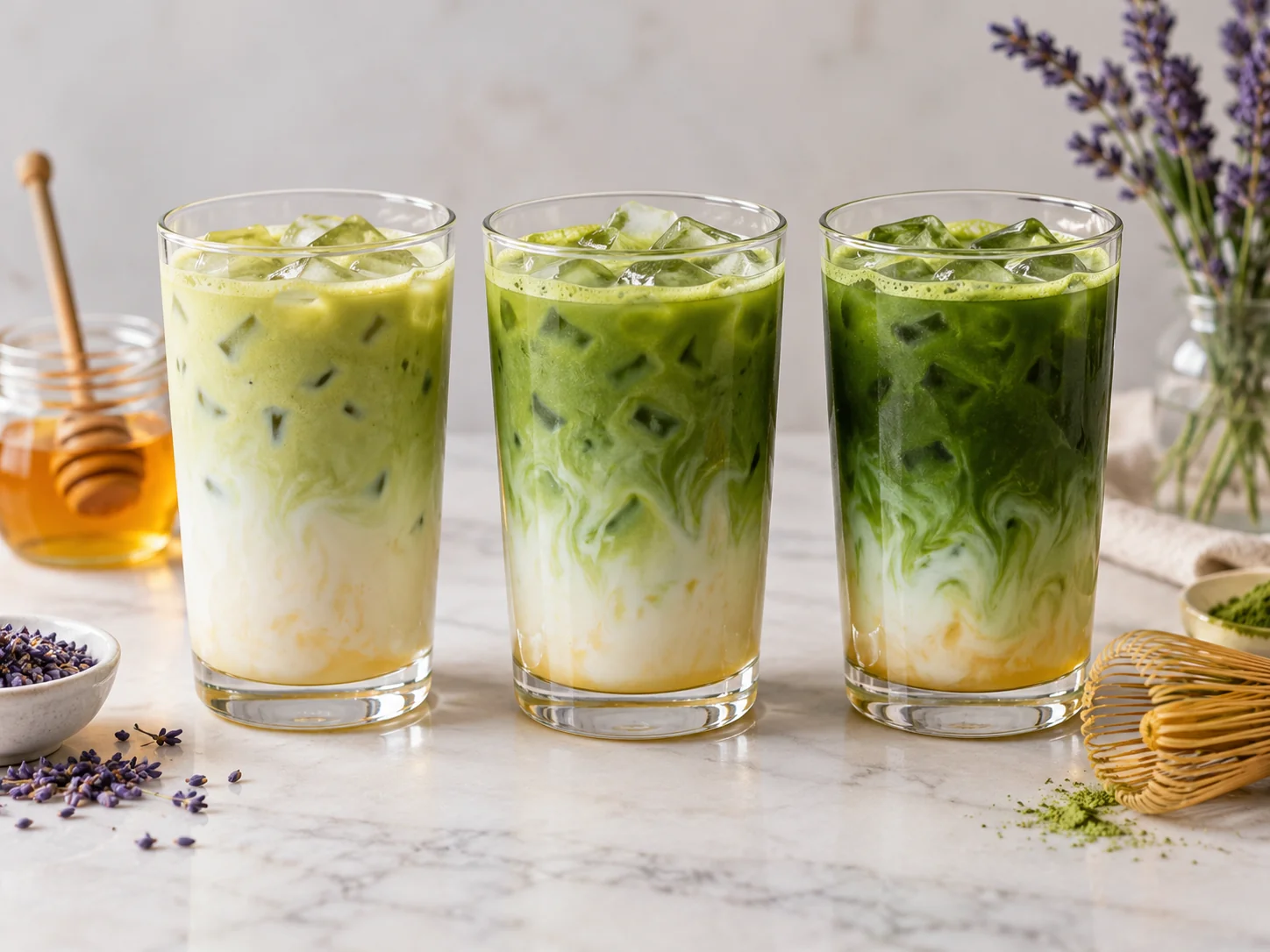
A Simple Café Testing Matrix
Do not decide the final recipe from one test.
Keep the matcha, milk, ice and cup size unchanged and compare several flavor combinations.
| Test | Matcha | Honey | Lavender Syrup | Goal |
|---|---|---|---|---|
| A | 3 g | 10 g | 5 ml | Light floral baseline |
| B | 3 g | 10 g | 7 ml | Stronger lavender |
| C | 3 g | 8 g | 5 ml | Less sweet |
| D | 3 g | 12 g | 5 ml | Sweeter café profile |
Taste the drinks side by side.
Record which version gives the best balance between matcha flavor, honey sweetness and lavender aroma.
Change only one variable at a time whenever possible.
This makes it easier to understand why one formula performs better than another.
Hot Honey Lavender Matcha Latte
The same flavor concept can also be tested as a hot drink.
Start with:
3 g matcha
40 ml warm water
10 g honey
5 ml culinary lavender syrup
160–180 ml steamed milk
Whisk the matcha separately.
Combine the honey and lavender with the steamed milk, then add the matcha.
Because aroma and sweetness can be perceived differently in a hot drink, do not assume the iced recipe will transfer perfectly.
Taste and approve the hot version separately.
10-Drink Café Planning Batch
For recipe planning, the single-serve formula can be multiplied as follows:
| Ingredient | One Drink | 10 Drinks |
|---|---|---|
| Matcha powder | 3 g | 30 g |
| Water | 40 ml | 400 ml |
| Honey | 10 g | 100 g |
| Lavender syrup | 5–7 ml | 50–70 ml |
| Milk | 160 ml | 1.6 L |
| Ice | 120 g | 1.2 kg |
These totals are useful for purchasing and menu planning.
They are not a recommendation to prepare and hold ten finished matcha lattes in advance.
For busy service, a café may choose to standardize and portion the honey-lavender component separately while preparing the matcha and final drink consistently per order.
If any component is prepared in advance, establish appropriate preparation, refrigeration, holding and discard procedures according to the ingredients used and your local food-safety requirements.
Do not assign a shelf life to a homemade syrup or beverage base without an appropriate food-safety assessment.
What Should a Honey Lavender Matcha Latte Taste Like?
A well-balanced version should still taste recognizably like matcha.
Honey should provide sweetness without completely covering the tea, while lavender should appear mainly as a light floral aroma rather than the dominant flavor.
During recipe development, evaluate:
- matcha flavor through milk
- sweetness
- floral intensity
- bitterness and astringency
- finished color
- body and texture
- aftertaste
- cost per serving
If the drink tastes primarily like lavender syrup, reduce the lavender before increasing the matcha dose.
If the drink tastes too sweet but the floral balance is correct, reduce the honey while keeping the other variables unchanged.
How Much Matcha Should You Use?
This recipe starts at 3 g per serving, but 3 g should not be treated as a universal café standard.
The appropriate dose depends on:
cup size, milk volume, matcha profile, sweetness, lavender intensity and the strength of matcha flavor you want customers to experience.
If 3 g feels too strong, compare it with a lower dose under the same recipe conditions.
If the matcha disappears behind the milk, honey and lavender, compare a slightly higher dose before changing several ingredients at once.
For a more detailed commercial testing method, see How Much Matcha Powder Should You Use for a Latte?
Standardizing the Honey-Lavender Base
For commercial service, consistency matters more than having the barista estimate the amount of honey and lavender for every order.
Once your recipe is approved, record:
the exact honey product, lavender syrup brand, amount per drink, portioning tool and serving size.
If you use pumps, verify the actual volume delivered by one pump.
Different syrup pumps may not dispense identical amounts.
A scale is useful during development even if the final café workflow uses pumps or measured bottles.
Barista Notes for Better Consistency
Keep lavender subtle
Lavender can become dominant quickly.
Start low and increase gradually during development.
Measure honey by weight
Honey is viscous, so weight can be more repeatable than estimating with a spoon.
Test the actual milk
Dairy milk, oat milk and other alternatives can change sweetness, texture and how strongly the matcha appears.
Approve each milk option separately if multiple choices will be offered.
Keep the recipe variables fixed
When comparing matcha samples, use the same:
cup, milk, honey, lavender syrup, ice, matcha dose and preparation method.
Otherwise it becomes difficult to know whether differences came from the matcha or from the recipe.
Evaluate after stirring
A layered drink is designed for presentation.
The final flavor should be evaluated after the components are mixed because that is how the customer experiences the full recipe.
Menu Positioning Ideas
A honey lavender matcha latte can work as:
a spring café special, floral signature latte, premium iced matcha, brunch menu drink or year-round specialty beverage.
Possible menu wording:
Honey Lavender Matcha Latte
Matcha layered with milk, honey and a delicate lavender finish.
Avoid making health or functional claims unless they are independently supported and appropriate for your market.
Calculate the Matcha Cost per Serving
For cafés, kilogram price alone does not show the real menu cost.
The matcha portion of the drink can be calculated as:
matcha price per kg ÷ 1,000 × grams used per serving
Then add the cost of:
milk, honey, lavender syrup, ice, cup, lid, straw or serviceware, garnish and normal preparation losses.
For example, a café comparing 2.5 g and 3 g recipes should evaluate both sensory performance and cost per finished drink.
Use the Matcha Cost Per Serving Calculator →
Choosing Matcha for a Honey Lavender Latte
A honey lavender latte does not automatically require the most expensive or highest-positioned matcha.
For a milk-based flavored drink, evaluate the matcha in the finished recipe.
Look for a profile that:
remains recognizable through milk, works with the target sweetness level, has an acceptable bitterness balance, disperses consistently and achieves the target cost per serving.
A Café / Latte Matcha Profile may work well for regular menu service.
A Premium Latte Matcha Profile may be worth testing for a signature drink where stronger matcha presence or premium positioning is important.
Compare the actual samples rather than selecting solely from profile names or dry powder appearance.
Frequently Asked Questions
How much lavender syrup should I use in a matcha latte?
Start with a small amount, such as 5–7 ml in this development formula, and compare several levels under the same recipe conditions. Lavender syrups vary in concentration, so there is no universal amount for every product.
Can I use dried lavender instead of lavender syrup?
Culinary lavender can be used to develop a house syrup or infusion, but cafés should standardize the recipe and follow appropriate food-safety procedures. For easier repeatability, a commercially prepared food-grade lavender syrup may be more practical during initial menu testing.
What matcha is best for a honey lavender latte?
For milk-based drinks, choose matcha according to finished-drink performance rather than relying only on words such as ceremonial or premium. Test color, matcha flavor through milk, bitterness, dispersion, approved dose and cost per serving.
Can I make a honey lavender matcha latte with oat milk?
Yes. Oat milk can be tested as a dairy-free recipe option, but its sweetness and texture may change the finished balance. Test the complete drink again instead of assuming the dairy recipe will taste identical.
Can cafés prepare honey lavender matcha in advance?
It is generally better to standardize components and assemble drinks consistently during service rather than holding completed iced drinks. Any prepared syrup or beverage component should follow validated storage and food-safety procedures.
Is this recipe suitable for commercial café use?
It is intended as a starting development formula for café testing. Before launch, validate your specific ingredients, portion size, preparation method, food-safety procedures, menu cost and customer sensory target.
Build a Café Matcha Recipe Around Your Own Ingredients
The best honey lavender matcha latte is not determined by one universal recipe.
A café should test its actual matcha, milk, honey and lavender ingredients under controlled conditions, select the formula that meets its sensory and cost targets, and then document the approved recipe for repeat service.
Matcha Origin Co. supports cafés and beverage brands with application-focused matcha samples and commercial supply.
Compare Matcha Profiles →
Request B2B Samples →
Looking for another café menu concept?
Try the Salted Vanilla Matcha Latte Recipe for Cafés or the Strawberry Matcha Latte Recipe for Cafés.